Day-Glow Orange and the 30-Square-Inch Flag Rule
Navigating the specific rules for riding your ATV or UTV on public roads in Nebraska can feel like trying to solve a puzzle with half the pieces missing. One particular rule that often leaves riders scratching their heads is the requirement for a bright, visible safety flag. This guide is here to break down exactly what that "day-glow orange and 30-square-inch flag rule" means for you, why it's in place, and how to ensure your machine is compliant, keeping you safe and legal on those designated county roads and city streets.
The Mandate for Visibility: Understanding the Safety Flag
When you think about the vast, open spaces and rural roads of Nebraska, it's easy to see how a smaller off-highway vehicle (OHV) like an ATV or UTV could be less visible to oncoming traffic, especially larger trucks or agricultural equipment. This isn't just a minor detail; it's a critical safety concern that the state legislature addressed head-on. The safety flag isn't just an accessory; it's a vital part of making sure you're seen and recognized as an OHV on the road, well before a larger vehicle is too close for comfort.
Why a Flag? Standing Out on the Road
Imagine cruising down a gravel county road, perhaps heading to a pasture or between farm fields. Your ATV, while fun and nimble, sits relatively low to the ground compared to a pickup or a tractor. This low profile means that from a distance, or over a slight rise, you might not be immediately visible to other drivers. The bright flag waving high above your machine serves as an early warning signal, piercing through dust, over crests, and around gentle curves, alerting others to your presence. It's all about increasing your "visual footprint" and giving other motorists ample time to react. The state's intent is clearly outlined in the rules for road-legal use, aiming to prevent accidents by making sure these machines are undeniably noticeable.
The requirement isn't about marking your territory; it's about mutual safety. It acknowledges that ATVs and UTVs, while capable, are not standard road vehicles and require additional measures to integrate safely into traffic, even on less-traveled rural routes.
The Specifics: Day-Glow Orange and 30 Square Inches
Nebraska isn't vague when it comes to the safety flag. The law specifies two key characteristics: color and size. You can't just slap any old flag on your machine and call it good.
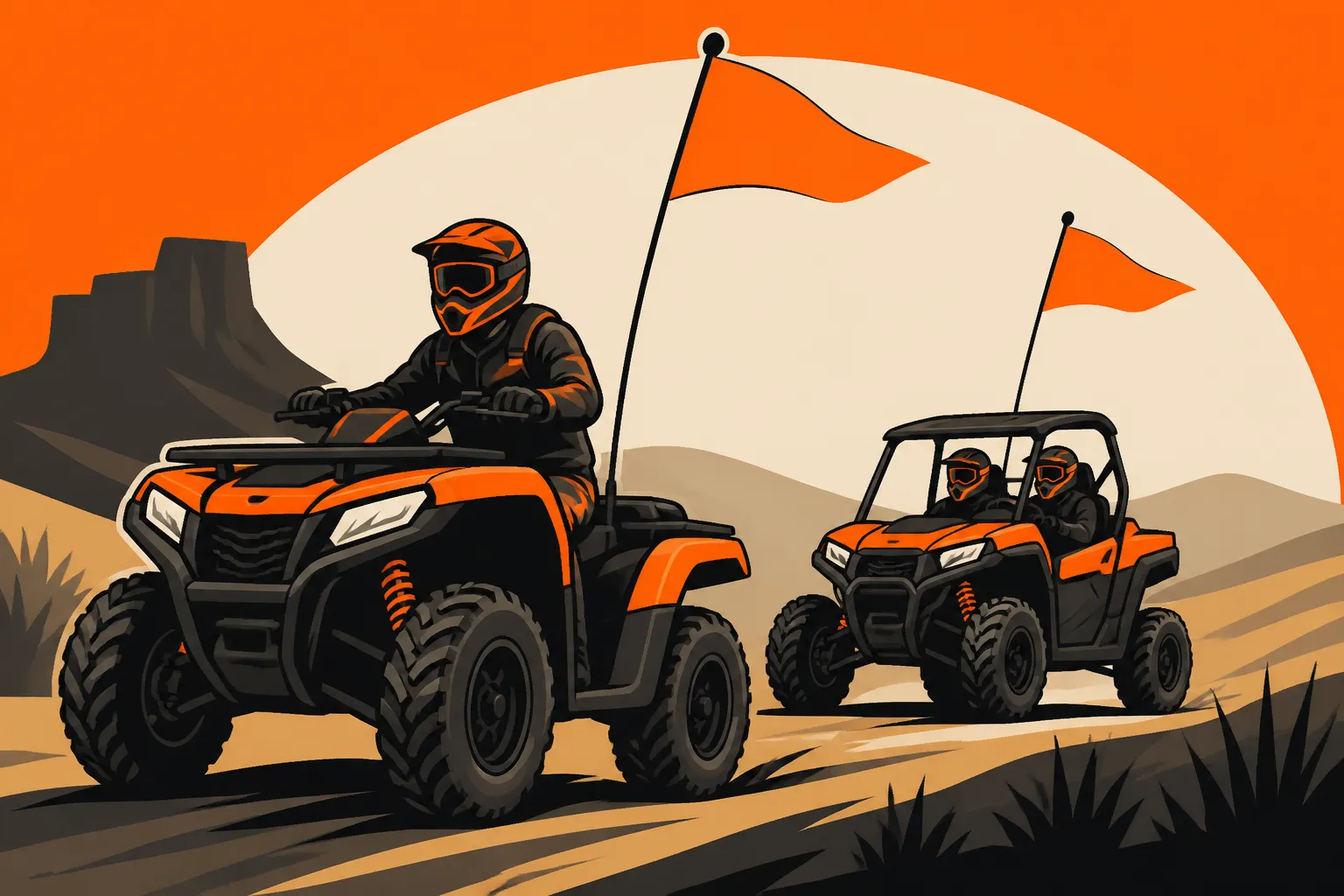
First, the color: it must be "day-glow orange." This isn't just any shade of orange; "day-glow" or fluorescent orange is specifically designed for maximum visibility in various light conditions, from bright sunshine to overcast skies. Think of the color often used for safety vests worn by construction workers or hunters – it’s a vivid, almost glowing orange that stands out against natural backgrounds and other vehicles. This isn't the faded orange of an old tarp or a dull traffic cone; it needs to be bright and unmistakable.
Second, the size: the flag needs to have a minimum area of "30 square inches." This doesn't mean it has to be a perfect 5×6 inch rectangle, though that would certainly meet the requirement. A common flag size for this purpose might be a triangular pennant that, when calculated, has at least 30 square inches of surface area. For example, a triangular flag with a base of 10 inches and a height of 6 inches would give you (0.5 * base * height) = (0.5 * 10 * 6) = 30 square inches. A rectangular flag of 5 inches by 6 inches also works. The key is to ensure the overall visible area of the flag meets or exceeds this minimum. This minimum size ensures that the flag is large enough to be easily seen from a distance, fulfilling its purpose of enhanced visibility. For more details, you might want to look into [How Big the Triangular Safety Flag Has to Be].
Mounting It Right: Height and Other Essentials
Just having the correct flag isn't enough; where and how it's mounted is just as crucial. The law is quite clear about the required height, and this is where some riders might need to get a little creative with their mounting solutions.
5 Feet Above the Ground: Achieving the Proper Height
The rule states that the top of the flag must be at least 5 feet (60 inches) above the ground level. This requirement directly correlates with the need for enhanced visibility. At this height, the flag is often above the roofline of many passenger cars and even some smaller SUVs, making it visible even when your ATV or UTV is partially obscured by terrain or other vehicles. It allows the flag to crest small hills or be seen over tall grass and fences, providing that critical early warning.
For a standard quad, achieving this 5-foot height usually means a sturdy flagpole attached to the rear rack or a specialized bumper. For side-by-sides, which often have roll cages, mounting directly to the cage with a clamp-on bracket is a common and effective solution. Many riders find durable flagpoles and flags, perhaps from a well-known brand like SuperATV, that are specifically designed to meet these kinds of height requirements and withstand the rigors of off-road and on-road riding. When picking out your flagpole, consider one that is flexible enough to bend without breaking if it snags a branch, but rigid enough to keep the flag flying high in the wind.
This 5-foot rule ensures that the flag isn't just flapping at machine height but is truly extended into the visual field of other drivers. Ignoring this height requirement could lead to a citation, even if you have the correct flag. That's why [Why Road-Legal ATVs Need a 5-Foot Safety Flag] is such a critical read.
Beyond the Flag: Headlights and Taillights Even in Daylight
The safety flag is just one piece of the puzzle for legal road use in Nebraska. Another often-overlooked but mandatory requirement is that your ATV or UTV must have its headlights and taillights on at all times when operating on public roads, even during daylight hours. This isn't just good practice; it's the law.
Think about motorcycles: many states require their headlights to be on 24/7 for the same reason – enhanced visibility. ATVs and UTVs are treated similarly in Nebraska when they are legally on the road. This helps to further distinguish them from parked vehicles or farm equipment that might be stationary. The combination of a day-glow orange flag reaching 5 feet into the air and illuminated lights makes your machine incredibly hard to miss, significantly boosting your safety profile. Neglecting to turn on your lights is an easy way to attract unwanted attention from law enforcement, so remember to flip that switch every time you hit the asphalt or gravel. This requirement is clearly laid out in the law [Nebraska Requires Head and Tail Lights].
Other Essential Gear for Road Travel
While the flag and lights are major components, a truly road-legal ATV or UTV in Nebraska also needs a few other essential items to be fully compliant and safe. These usually include:
- Brakes: Your machine must have fully functional brakes that are capable of safely stopping the vehicle. This seems obvious, but worn pads or a spongy lever won't cut it for road use.
- Mirrors: You'll need at least one rearview mirror, typically mounted on the left side, to give you a clear view of traffic approaching from behind. Some riders opt for two for better situational awareness.
- Horn: A working horn or warning device is also often required, allowing you to alert others to your presence when necessary.
- Muffler: While not strictly a safety device, your ATV must have a muffler that keeps noise levels within legal limits. Excessive noise can be a nuisance and draw unnecessary attention.
These requirements, combined with the safety flag and lights, contribute to making your OHV as visible and predictable as possible when sharing the road with other vehicles.
Where and When These Rules Apply: The Context of Legal Road Use
It's crucial to remember that these stringent safety equipment rules, including the day-glow orange flag, only apply when your ATV or UTV is legally operating on a public road or highway in Nebraska. Not all roads are open to OHVs, and there are specific conditions under which road use is permitted.
Navigating Nebraska's Roadways: When is Road Use Legal?
In Nebraska, the general rule is that ATVs and UTVs are not street legal for general transportation. However, there are very specific exceptions, primarily focused on agricultural operations and, in some cases, local city or county ordinances that specifically open certain streets.
- Agricultural Use: This is the most common reason you'll see ATVs and UTVs on Nebraska roads. Farmers and ranchers can use their machines on public roads to travel between fields, check livestock, or conduct other agricultural tasks. This use is generally limited to county roads and, under certain conditions, involves crossing highways. This is a key aspect of [Three Ways ATVs Can Legally Use Nebraska Roads].
- City or County Ordinances: Some cities and county boards have passed local ordinances that allow ATVs and UTVs on specific streets or within unincorporated villages. These ordinances often come with their own set of rules, including age restrictions, hours of operation, and sometimes even local registration fees. Always check with local authorities before assuming a road is open. Riders need to be mindful of [Nebraska Rules for Riding a City Street] and [Nebraska Rules for Riding a County Road].
If you're just riding for recreation, the expectation is that you'll be on private land with permission, or on designated OHV trails like those at Halsey National Forest, where state road rules don't apply. Attempting to ride your ATV on public roads outside these specific exemptions, even with all the safety gear, can result in significant penalties, as highlighted in [Nebraska Penalties for Illegal Road Riding].
The Law's Intention: Protecting Riders and Drivers
The intent behind Nebraska's ATV road laws is clear: safety. These rules, including the requirement for the day-glow orange flag, aren't designed to make riding more difficult but to mitigate the inherent risks when off-highway vehicles share space with conventional road traffic. The goal is to reduce accidents, injuries, and fatalities for everyone on the road, whether they're in a pickup, a tractor, or on an ATV. By providing clear guidelines, the state aims to ensure that when an ATV is legally on the road, it's done in the safest possible manner. This is why deputies perform [Nebraska Equipment Checks by Deputies] – to ensure compliance and promote safety.
Common Misconceptions and Penalties
A common misconception is that if you have a title for your ATV, you can automatically ride it on any road. This is incorrect. Nebraska titles ATVs but explicitly notes "NOT TO BE REGISTERED" on the title itself, meaning it cannot receive a traditional road-legal license plate like a car or truck. The title is primarily for ownership, not for road use permission.
Another mistake riders often make is thinking that because a road is gravel or less traveled, the rules don't apply as strictly. This is also false. Any road maintained by the county or state is a public roadway, and all applicable laws, including the safety flag rule, are in effect.
Failing to comply with the safety flag rule, or any other aspect of legal road use for ATVs, can lead to serious consequences. You could face a citation, which means fines and potentially court costs. Beyond the legal troubles, you're putting yourself and others at a much higher risk of an accident. Always verify the specific rules for the area you plan to ride, and ensure your machine is fully compliant before you hit the pavement or gravel. If you're unsure about whether you can ride on a particular road, it's always best to err on the side of caution and find an alternative route or confirm with local authorities. After all, the speed limit for ATVs on any public road is restricted to [Nebraska's 30 mph Road Limit], which is another indicator of the careful approach to ATV road use in the state.
| Requirement | Specifics | Purpose |
|---|---|---|
| Flag Color | Day-Glow Orange | Maximum visibility in all light conditions |
| Flag Size | Minimum 30 square inches | Ensures the flag is large enough to be seen |
| Flag Height | Top of flag 5 feet (60 inches) above ground | Raises visibility above other vehicle heights |
| Headlights | On at all times on public roads (day or night) | Further enhances visibility, like motorcycles |
| Taillights | On at all times on public roads (day or night) | Alerts trailing traffic to your presence |
| Brakes | Fully functional | Essential for safe stopping and control |
| Mirrors | At least one rearview mirror (left side typically) | Allows awareness of rear traffic |
| Horn | Working warning device | Alert others to immediate presence |
| Muffler | Maintains legal noise limits | Reduces noise pollution and public nuisance |
Navigating the Road Safely in Nebraska
The day-glow orange, 30-square-inch safety flag, mounted 5 feet above the ground, is a cornerstone of Nebraska's specific requirements for ATVs and UTVs on public roads. It's a simple, yet incredibly effective, piece of equipment designed to enhance your visibility and, ultimately, your safety and the safety of everyone sharing the road. While these rules might seem like a lot to remember, they exist for a very good reason: to prevent accidents and allow for the responsible, limited use of these powerful machines on our state's roads. Take the time to understand these regulations, equip your machine properly, and always prioritize safety over convenience. Being prepared means you can enjoy your ride without unexpected fines or, worse, dangerous encounters.
Disclaimer
This article is for general informational purposes only and does not constitute professional advice. Laws, prices and regulations vary by location and change over time. Consult a qualified professional for guidance on your specific situation.