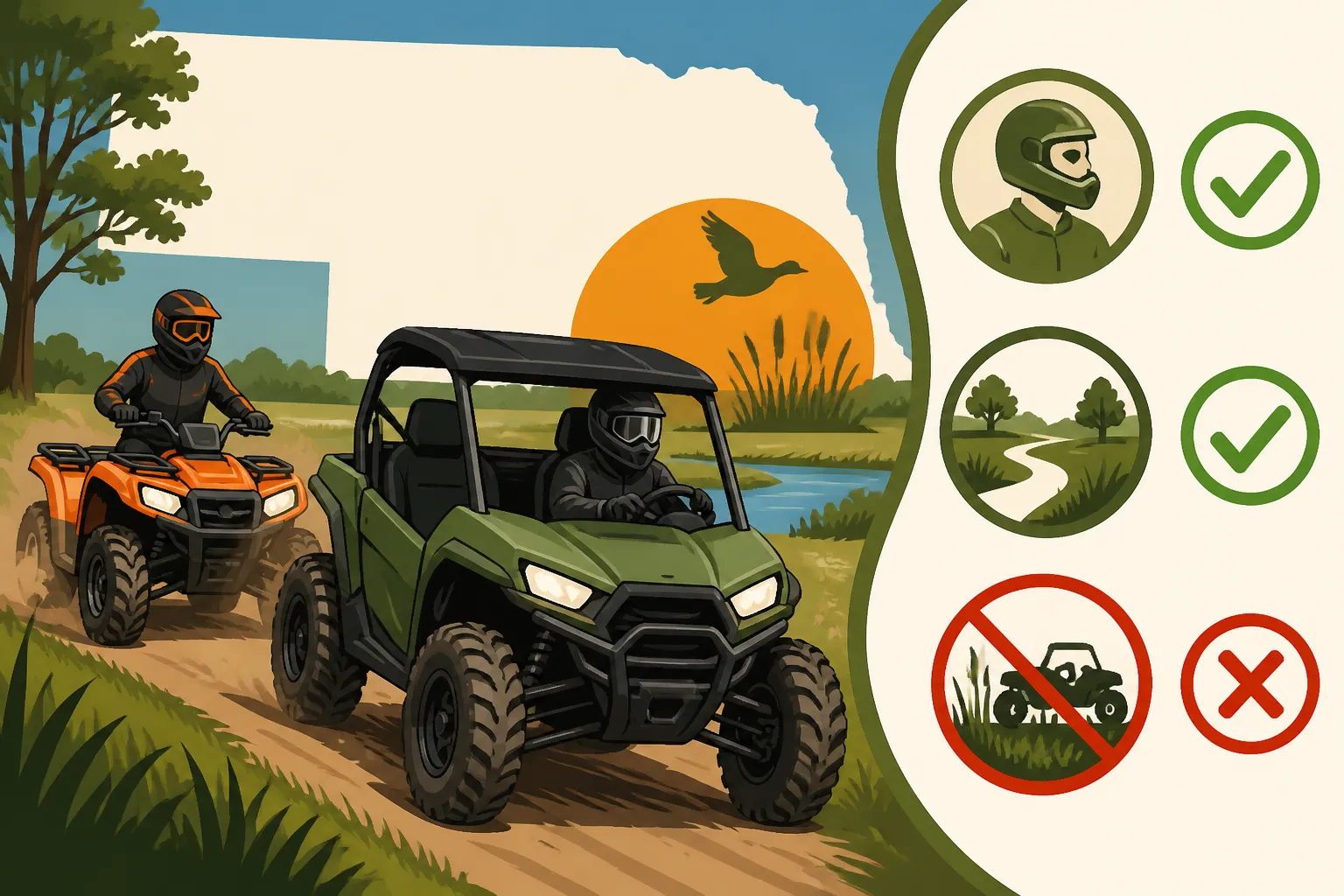
Nebraska WMA Riding Rules
A Nebraska WMA can look like an open stretch of public ground, but that does not mean an ATV or UTV can roam wherever the terrain allows. The most common mistake is treating a wildlife area like an off-road park. This guide explains where motorized riding may be allowed, how to read access rules, what to check before unloading, and how to avoid damaging habitat or earning a citation.
The basic rules for riding on Nebraska WMAs
Motorized travel is generally limited to designated roadways
A Wildlife Management Area is managed primarily for wildlife habitat and public recreation, not as a general-purpose off-road riding area. In practical terms, motorized vehicles are generally restricted to designated roadways. An ATV or UTV may be permitted on a road open to vehicle traffic, but that permission does not automatically extend to trails, field edges, grassland, riverbanks, or open ground beside the road.
This distinction can be easy to miss when a road is little more than a two-track or a rough lane across prairie. If it is a designated roadway, it may be an authorized travel route even if it does not look like a conventional paved road. Conversely, a visible tire track through grass does not prove that the route is open to motor vehicles. Tracks may be old, made by management equipment, or left by someone who should not have driven there.
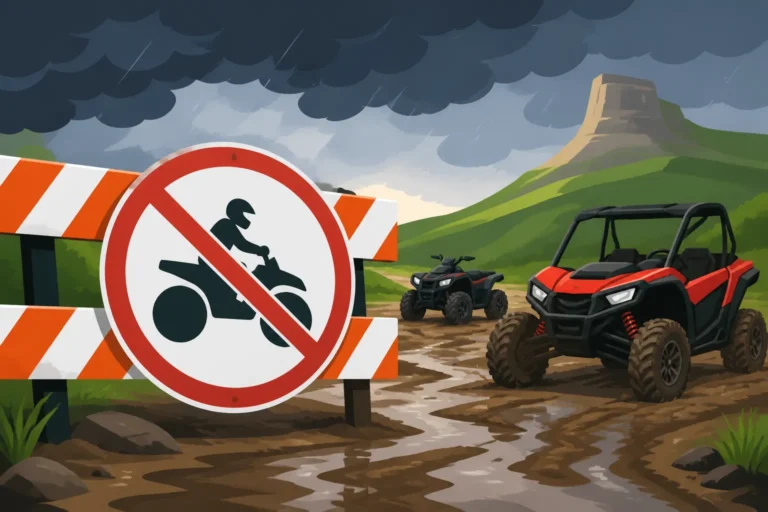
Before riding, look for signs at the entrance and along the route. Pay attention to gates, barriers, posted closures, and road surfaces that appear to continue beyond a marked boundary. If a roadway is closed, washed out, or blocked, do not ride around the obstacle to keep going. A closure can protect nesting areas, prevent damage during wet conditions, or address a maintenance or safety issue.
For a broader look at this limitation, see [Nebraska WMA Designated Roadways Only]. The plain-language version is useful to keep in mind: stay on routes that are specifically open to motorized traffic, and do not treat the rest of the WMA as an extension of the road.
A WMA is not the same thing as an OHV park
A public wildlife area can feel informal. There may be no staffed entrance, fee booth, or obvious trailhead, and the landscape may be wide open. That can create the impression that riders have broad access. But public ownership alone does not mean every kind of recreation is permitted everywhere. WMAs have their own purpose and operating rules, and motorized access can be much narrower than walking, wildlife viewing, or hunting access.
An OHV park is generally arranged for motorized recreation, with designated riding areas, trail routes, staging spots, and sometimes posted difficulty or vehicle restrictions. A WMA is not necessarily laid out that way. A road that allows vehicle access may serve hunters, staff, land managers, and visitors reaching an authorized spot, rather than provide a loop for recreational riding.
If your goal is a day of trail riding, plan to use a place that expressly allows that activity. Nebraska options and their individual conditions are covered in [Nebraska ATV Trails: Where to Ride]. That can help avoid towing to a WMA expecting a network of riding trails and discovering that the permitted route is only a short access road.
It is also worth separating state-managed WMAs from national forests, recreation areas, and private riding parks. Each land manager can set different rules. Permission to ride at one public site does not carry over to another, even when both are in the same county or appear connected on a map.
| What you see | What it may mean | Safer next step |
|---|---|---|
| A posted roadway open to vehicles | Motorized travel may be allowed on that route | Stay on the marked roadway and follow any posted restrictions |
| A two-track with no clear sign | The route may or may not be designated | Check the area’s official information before driving onto it |
| A gate, barrier, or closure sign | The route is closed or access is restricted | Do not go around it; turn back |
| Open grass, cropland, or a field edge | It is not automatically an authorized riding area | Keep the machine on the designated route |
| A frozen lake or waterbody | A specific exception or closure may apply | Check local rules and signs before accessing the ice |
| A trail shown in a third-party map app | The map may show a route without confirming legal access | Verify with the managing agency |
How to check access before you unload
Start with the specific WMA, not a general assumption
“WMAs are open to the public” is not enough information to decide whether a particular ATV route is legal. Access can depend on the specific area, route, season, surface conditions, and signs at the site. A rule that applies at one wildlife area may not describe the next one, so identify the exact WMA you plan to visit before leaving home.
Look for information from the land manager responsible for that area. Check whether vehicle access is allowed, which roadways are designated, whether any routes are closed, and whether the area has seasonal restrictions. If the information you find is unclear, contact the managing office rather than assuming that an unmarked route is open. Ask specifically about ATV or UTV access; “Can I drive in?” can lead to a different answer than “May I ride an ATV on this roadway?”
Make a note of the WMA name, entrance, and route you intend to use. If you are going with a group, share that plan before the trip. It is frustrating to have a trailer loaded, arrive at the entrance, and then discover that the area does not offer the kind of riding you expected. A few minutes of checking can save a long drive and help prevent an avoidable rule violation.
Some access details can change. A road may be closed for repair, flooding, habitat work, or another management reason. Recheck close to your trip, especially if you have not visited the area recently or if local conditions have changed.
Use maps for planning, then confirm on the ground
A map can be helpful for understanding where an entrance, road, parking area, or boundary may be. Apps such as onX Offroad can assist with trip planning and orientation, especially when a group is trying to coordinate a meeting point or distinguish nearby public and private land. But a mapped line should not be treated as proof that an ATV or UTV is allowed to use it.
Maps may show roads that are closed to motorized travel, private roads, former routes, or tracks that were never designated for public use. A displayed boundary can also be difficult to interpret on the ground, particularly where parcels meet, a road follows a property line, or a two-track appears to continue across different land. Use map information as one planning tool, not as a substitute for agency rules and posted signs.
Before riding, compare the route you planned with the entrance signs and any notices along the roadway. If the sign conflicts with an app or paper map, follow the sign and verify the rule with the land manager. If you cannot confidently determine that a road is open, do not use the ATV to test the theory. Turn around or choose a clearly authorized route.
For a more complete explanation of boundaries and road access on these properties, see [Nebraska WMA Roadway Rules] and [Nebraska WMA Access for a Quad]. This is especially helpful when your intended route passes close to a parking area, a waterbody, or a boundary with private ground.
Roadways, parking areas, and common route mistakes
Stay on the road even when the shoulder looks easier
A roadway can be uneven, muddy, rutted, or narrow enough that riding on it feels inconvenient. It may be tempting to move onto the grass to get around a puddle, avoid a washout, or let another vehicle pass. That small detour can create a new track outside the authorized route, damage vegetation, or widen the disturbed area. The fact that a shoulder is firm does not make it an approved bypass.
If a section is too muddy or unsafe, the better choice is usually to stop and turn around rather than create a new route. A muddy road can be damaged quickly by repeated vehicle passes, especially when tires spin or machines slide sideways. What begins as a short detour can turn into a deep rut that remains long after the weather clears.
Keep an eye out for road edges that are hard to see in tall grass. A designated route may narrow, curve, or end before the open terrain does. Do not assume that the most direct line across the landscape is permitted simply because it saves time. The route itself matters, not just the destination.
When another user approaches, slow down and leave room without driving off the roadway. Hunters may be carrying equipment, pedestrians may be walking along the route, and wildlife can appear without warning. A patient pause is better than forcing a pass through grass or around a closed gate.
Park only where parking is allowed
A vehicle can be allowed on a roadway while parking is restricted to specific areas. Do not assume you can pull off anywhere that looks wide enough. Parking on grass, blocking a gate, stopping in a narrow passage, or leaving a trailer in the roadway can interfere with other visitors and management access.
Use a designated parking area when one is provided, and keep the entrance clear. If you are towing, think through how you will turn around and unload before pulling into a tight spot. A trailer that blocks the access road can prevent another visitor or land manager from getting through. If the parking arrangement is unclear, choose a location that does not obstruct traffic and ask the managing office for guidance before making it your regular staging point.
Avoid parking on vegetation or damp ground when it could leave ruts. Even a stationary vehicle can cause damage if it sinks into soft soil or if a group repeatedly unloads in the same unauthorized spot. The impact is more noticeable when several machines arrive together, so groups should agree on one lawful staging location rather than spreading across the roadside.
For more detail on parking restrictions and where to leave a vehicle, read [Nebraska WMA Parking Area Rules]. If you are planning a ride at a different kind of public recreation site, remember that those parking rules may not match WMA rules.
Frozen water and seasonal access
Treat frozen-water access as a narrow exception
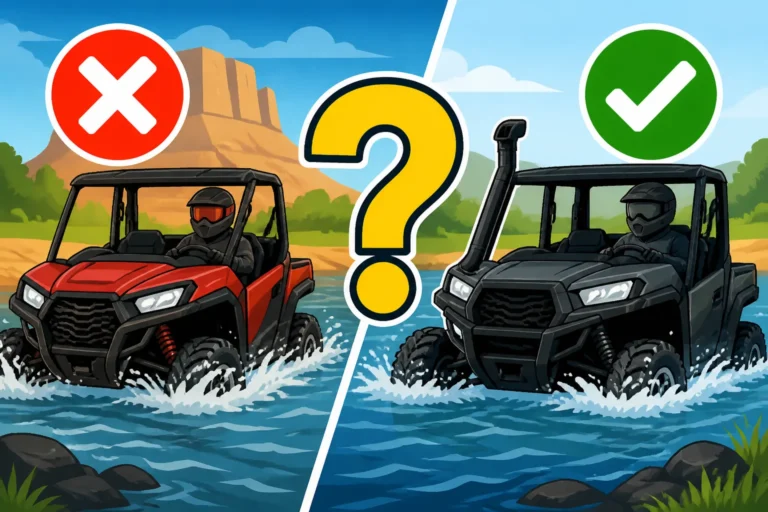
Some riders hear that motorized access may be allowed on frozen water in certain circumstances and interpret that as broad permission to ride across any frozen lake, pond, or marsh. That is a risky assumption. A frozen-water exception, where it applies, does not necessarily open the entire WMA to riding, override a posted closure, or permit travel across the surrounding habitat.
Check the rules for the specific area and the particular waterbody. Look for signs at access points and near the shoreline, and confirm whether motorized access is allowed, where it begins, and whether there are conditions attached. If a sign closes the ice area, or if the ice is not clearly open to vehicles, do not ride onto it. A frozen surface can conceal thin spots, moving water, vegetation, or other hazards.
Even where access is permitted, safety and resource protection still matter. Ice strength can vary across one body of water, and a route used earlier in the season may become unsafe as temperatures shift. Riders should not confuse a rule allowing access with a guarantee that conditions are suitable. If the area is unsafe or unclear, stay off the ice.
See [Nebraska WMA Frozen Lake Exception] and [Reading the Signs That Close a Frozen Lake] for related guidance. Those topics are particularly relevant if a trip is planned around ice riding rather than travel on a designated roadway.
Seasonal conditions can change the practical route
A roadway that is passable in dry weather may become difficult or vulnerable after rain, snowmelt, or flooding. Wet soil can rut under tire pressure, and repeated attempts to power through mud may make the road worse. If the route is soft, flooded, or visibly deteriorating, do not treat an open sign as an invitation to damage it. Conditions can make a route impractical even when the area is not formally closed.
Seasonal management work can also affect where visitors may go. A closure may protect wildlife habitat, allow maintenance, or respond to changing conditions. Follow temporary notices as carefully as permanent signs. If a gate that was open on a prior visit is now closed, do not assume it is merely a nuisance or that the route will be available once you pass it.
In winter, consider more than ice strength. Snow can hide ruts, drainage channels, rocks, and signs. It can also make it harder to see whether a route has been closed or whether you have left it. In warm months, tall vegetation can obscure the edge of a roadway or conceal a boundary marker. Slower travel and extra attention help prevent both safety problems and accidental off-route driving.
Before a trip, check the forecast and any area notices, then set a turnaround point. If conditions make the legal roadway difficult to follow, the trip should end there. The machine can be ridden another day; repairing damaged habitat or dealing with a citation can turn one frustrating outing into a much bigger problem.
Respecting wildlife, other visitors, and the land
Keep noise and speed appropriate for the setting
A WMA is shared by people who may be hunting, fishing, watching wildlife, walking, or traveling to an access point. A fast or noisy pass can disrupt other visitors and disturb wildlife. Even on a road where motorized travel is allowed, ride at a speed that lets you stop for a pedestrian, animal, or vehicle ahead.
Avoid revving the engine unnecessarily, spinning the tires, or making repeated passes along a short stretch of roadway. Those behaviors can contribute to noise complaints, erosion, and conflict with other users. If you see someone on foot, slow down early and give them space. Do not assume they can hear you coming or know which direction you intend to go.
Be especially considerate during hunting seasons and at dawn or dusk, when other visitors may be moving quietly. An ATV route can pass near a place where someone is watching wildlife or setting up for a hunt. Giving people room and keeping the machine on the road helps make shared access more workable.
A machine’s presence can have a larger impact than its rider intends. One quick ride across a field edge may look harmless, but repeated tracks can become a route that others imitate. Staying on the designated roadway makes the boundary clearer for the next visitor.
Protect habitat and leave gates as you found them
Do not ride through crops, grassland, wetlands, or other habitat to reach a scenic spot or avoid a rough stretch of road. Tire tracks can damage plants and soil, and they may direct later visitors into an area where motorized use was never intended. If you see a faint track heading away from the roadway, do not assume it is an authorized trail.
Treat gates, fences, and barriers as meaningful. A gate may control livestock, protect a restoration site, or mark a change in access. Do not climb around a barrier with your machine or open a gate and leave it unsecured. If you open a gate where access rules allow it, close it as you found it. If signs indicate that the route beyond is closed, keep the gate closed and turn back.
Carry out litter, food packaging, broken straps, and any other items you bring. Do not leave vehicle parts, fuel containers, or gear behind. If a spill or mechanical problem occurs, avoid spreading the impact and contact the relevant land manager when appropriate.
When in doubt, choose the lower-impact option: stay on the roadway, avoid fragile ground, and do not enter an area simply because it looks accessible. These habits help preserve the kind of public access that makes wildlife areas valuable to everyone.
Equipment, paperwork, and responsible trip planning
Carry what you need without assuming a state sticker makes access legal
Nebraska does not have a universal state OHV permit or sticker that gives an ATV or UTV blanket access to public land. The absence of a statewide sticker does not mean every public road or parcel is open to motorized riding. Land-specific rules still apply, and a vehicle’s title or registration status does not grant permission to ride off designated routes.
Keep proof of ownership and any paperwork that may be relevant to your machine, especially when traveling. The details of title rules are separate from land-access rules, but they can still matter during a trip or if you need to demonstrate that the machine is yours. For related background, see [Nebraska Proof of Ownership on the Trail] and [Nebraska Has No OHV Permit or Sticker].
If your trip includes public roads outside the WMA, do not assume the roadway rules are the same as the WMA access rules. Road use can involve separate requirements, local restrictions, insurance, licensing, lighting, and safety equipment. A route that begins on private land or a county road does not automatically provide legal access to a wildlife area.
A visitor from another state should be equally careful. An out-of-state sticker or registration does not necessarily open Nebraska public land to off-road riding. Check the area’s rules and the state’s requirements for the kind of road or property you intend to use. For a related overview, read [Nebraska Visitors Need No State Sticker], while keeping in mind that “no state sticker” is not the same thing as “ride anywhere.”
Prepare for a ride that may have limited services
Many WMAs are not set up like commercial riding parks. Do not count on staffed facilities, fuel, repairs, cell service, or a marked trail network. Plan the trip with the assumption that you may need to turn around, troubleshoot a minor problem, or help a riding partner without immediate assistance.
Before leaving, tell someone where you are going and when you expect to return. Bring water, a charged phone, basic first-aid supplies, and equipment appropriate to the weather. A map that works offline can be useful, but keep the distinction clear: it helps with navigation and does not establish that a route is legally open. If using onX Offroad or another mapping tool, download the information you need before losing service and check the land manager’s access information separately.
Travel with enough fuel for the planned route and a reasonable margin. Check tires, lights, brakes, and tie-downs before towing. If your group includes riders who do not know the area, agree on where to stop and what to do if someone loses sight of the group. Avoid letting a navigation screen distract the driver; pull over safely before checking it.
For longer trips, choose a riding destination that is intended for motorized recreation if you want more than roadway access. [Nebraska National Forest Riding] and [Nebraska Private Park Rules] can help you compare other settings, but each site still has its own restrictions, fees, and operating conditions. Do not assume a route is legal just because another destination allows similar riding.
Common WMA riding mistakes and how to avoid them
Mistaking a visible track for an authorized route
A worn track can seem like the strongest evidence that people ride there. It is not. The track may be old, used by staff, created by a landowner before public access changed, or made by riders who ignored the rules. Following it because “someone else went through” can put you outside the designated roadway system.
The same is true of map lines and satellite imagery. A line can represent a road without showing whether public motorized access is allowed. Aerial images may not show a gate, a seasonal closure, or a boundary marker. Use visual information to orient yourself, then confirm access with posted signs and the managing agency.
If the authorized route is not clear, stop before entering the uncertain section. Do not send one rider ahead to see whether the route continues. That can turn a small uncertainty into an unauthorized ride and make it harder to explain where the group went. Call the land manager or choose a route that is plainly marked as open.
This approach may feel overly cautious when the landscape appears empty, but it is much easier than resolving a complaint or citation afterward. Clear permission matters more than the fact that a route looks convenient.
Assuming public land means unrestricted recreation
Public land has rules, and different public lands have different purposes. A WMA may be open to visitors while limiting motorized vehicles to specific roadways. A national forest, state recreation area, county property, and private OHV park may each have separate rules for vehicle access, parking, seasonal closures, and permitted activities.
Avoid building an outing around a vague destination such as “somewhere public near the river.” Identify the named property, determine who manages it, and confirm the type of vehicle access allowed. If a route crosses multiple parcels or passes from one agency’s land to another, verify every segment. Permission on one side of a boundary does not necessarily continue on the other.
Do not let a group’s size or familiarity with the area lower the standard. A large group can widen tracks, block a road, and create more disturbance than a single rider. Set expectations before arrival: stay on marked routes, leave closed areas alone, and regroup only in a lawful place that does not obstruct others.
If you find a confusing sign or damaged barrier, do not make your own interpretation based on what seems reasonable. Take note of the location and contact the managing agency. That gives the people responsible for the area a chance to clarify the rule or address a problem.
A practical checklist before riding a Nebraska WMA
Confirm the route and conditions
Before towing, write down the WMA’s exact name and confirm that your planned activity is allowed there. Verify that the roadway you intend to use is designated for motorized travel, check for temporary closures, and identify the permitted parking area. If the site’s information is unclear, contact the manager instead of relying on a general assumption or an app map.
Check the forecast and recent conditions. Heavy rain, flooding, snow, or changing ice can make a route unsafe or vulnerable to damage. Decide in advance when you will turn around. A ride should not continue just because the group has already driven a long way or unloaded the machines.
If the outing is part of a hunting, fishing, or wildlife-viewing trip, plan for other visitors. Keep noise down, ride slowly, and allow people on foot ample space. Do not use a machine to reach areas that are not open to motorized travel simply because the machine makes the trip easier.
A simple pre-trip note can prevent confusion:
- Name the specific WMA and entrance.
- Identify the roadway that is open to motorized travel.
- Confirm the parking and unloading location.
- Check for closures, seasonal conditions, or ice restrictions.
- Save the managing agency’s contact details.
- Set a turnaround point and tell someone your plan.
Follow the signs and be willing to change plans
Once you arrive, read the entrance signs before unloading. Check again for notices at intersections, gates, and parking areas. A sign at the entrance may give broad guidance, while a later sign can close one specific route or waterbody. If the posted information is different from what you expected, follow the posted restriction and adjust the outing.
Stay on the designated roadway from the moment you enter until you leave. Do not ride into grass to meet another group, make a shortcut, or find a better view. Park only where allowed, keep access points open, and avoid leaving the machine where it could block a gate or emergency access.
If a route becomes impassable or unclear, stop rather than improvising. Turn around on the roadway if it is safe to do so. If you cannot tell whether the route continues legally, contact the managing office before proceeding. Being willing to change plans is part of responsible riding, not a failure to prepare.
Nebraska WMAs can be rewarding places to visit, but the best trip is one that respects their purpose. Treat a designated roadway as the limit of motorized travel unless the area’s official rules clearly say otherwise. Verify access before unloading, read signs carefully, and leave habitat and facilities as you found them.
Disclaimer
This article is for general informational purposes only and does not constitute professional advice. Laws, prices and regulations vary by location and change over time. Consult a qualified professional for guidance on your specific situation.