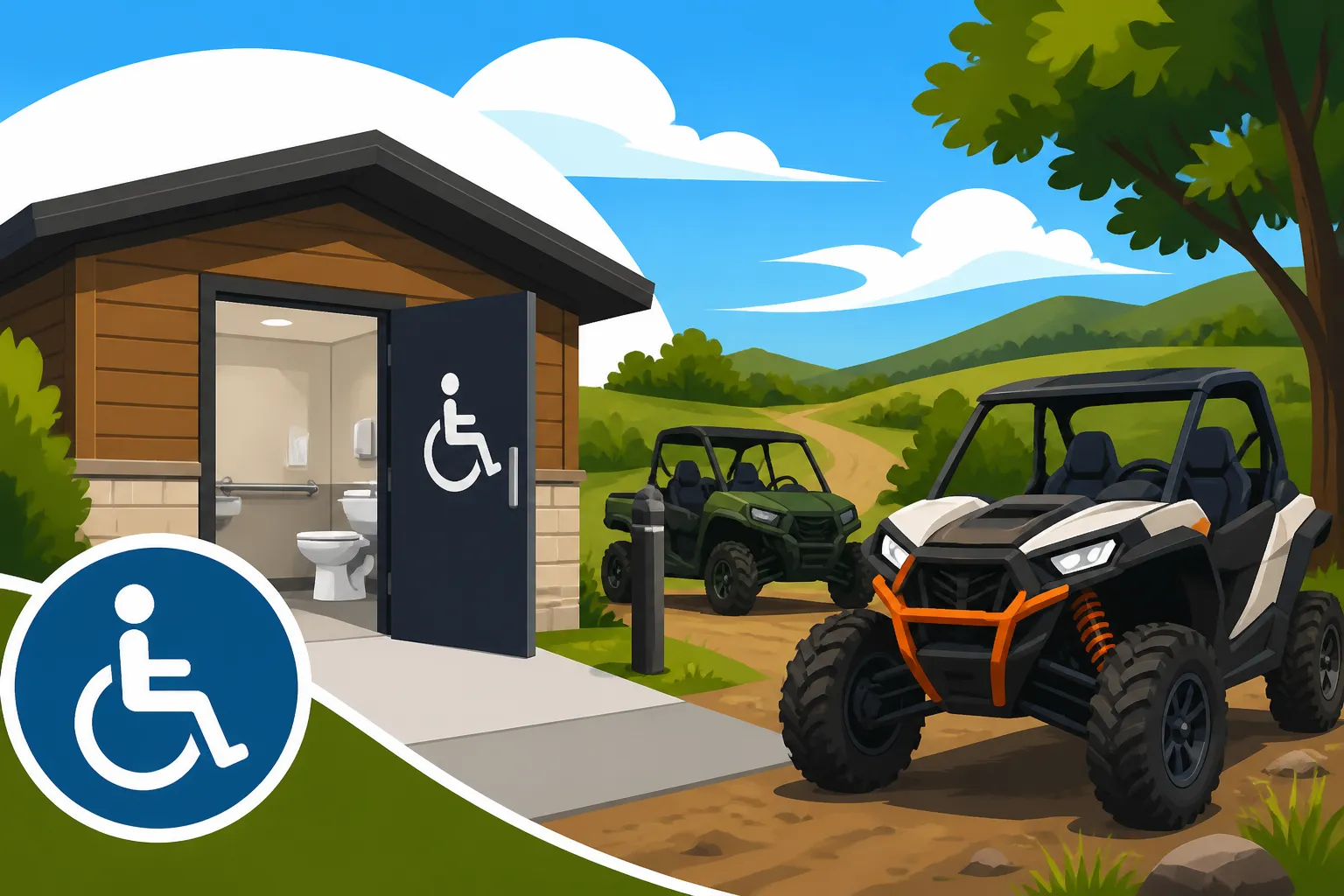
Accessible Restrooms at the Cedar Run Trailhead
A trail ride is much easier to plan when you know where the nearest restroom is, especially when kids, older riders, or someone with mobility needs is coming along. Cedar Run Trailhead is noted for accessible restrooms, but the word “accessible” does not answer every practical question. This guide explains what to check before leaving home and how to plan a more comfortable visit.
What to know about restrooms at Cedar Run Trailhead
The trailhead restroom is a useful starting point
Cedar Run ATV Trail is a riding area near Harlan County Lake, and restroom access at the trailhead can make arrival and departure more comfortable. It is particularly helpful if your group has a long drive, is meeting other riders at the staging area, or needs a predictable restroom stop before heading onto the trail.
Still, an accessible restroom listing is not a guarantee that every feature will suit every visitor. It may tell you that an accessible facility is provided, but not whether it is open during your visit, close to the parking area, easy to reach over the current surface, or equipped with the particular features someone in your party needs. If those details matter, confirm them with the site manager before you tow out.
For an overview of the riding area itself, start with [Cedar Run ATV Trail in Nebraska]. You can also review [Cedar Run's Staging Area, Picnic Shelter and Grill] to get a better sense of the facilities and gathering space around the trailhead. Restrooms are one part of the visit; parking, unloading room, and the route between those areas can matter just as much.
“Accessible” can mean different things to different visitors
A restroom described as accessible may have features intended to make entry and use easier, but visitors’ needs vary. Someone using a wheelchair may need to know about the path from the parking area, doorway clearance, turning space, and grab bars. A person who walks with a cane may care most about a firm, level route and a stable threshold. A parent with a small child may need a changing surface or enough space to manage bags and clothing.
Those needs are practical, not fussy. Discovering that a restroom is locked, too far from the vehicle, or difficult to enter after you arrive can put a real strain on a day that was supposed to be relaxing. It is reasonable to ask specific questions rather than relying on a general amenity label.
If you are traveling with someone who has a particular access requirement, write down the details before calling or checking the recreation-area information. For example: “Is the restroom open during our planned visit?” and “Is there a firm, accessible route from the parking area to the entrance?” A clear question is more likely to get you a useful answer than simply asking whether the restroom is accessible.
Plan for the whole route from parking to restroom
Check the approach, not just the facility
A restroom can be accessible inside yet still be difficult to reach if the path from the parking area is uneven, muddy, steep, or obstructed. Conditions can change after rain, snow, maintenance work, or heavy use. If someone in your party has limited mobility, consider the full trip from the vehicle: where you can park, how far the restroom is, what the ground is like, and whether there are curbs, steps, or narrow turns along the way.
When contacting the site manager, ask about the route as well as the building. You might ask whether the path is paved or otherwise firm, whether there is accessible parking near the restroom, and whether any gates or temporary barriers affect access. These are useful questions for a visitor using a wheelchair, but they can also help someone with a walker, a stroller, or an injury that makes walking uncomfortable.
Cedar Run sits within a recreation setting where different agencies may manage different areas or services. For context on the site’s management, read [What the Army Corps Manages Around Harlan County Lake] and [What Game and Parks Does at Cedar Run]. Knowing whom to contact can save you from being passed between offices when you are trying to confirm one specific facility detail.
Use a simple pre-trip checklist
A short checklist prevents the familiar last-minute scramble: the trailer is loaded, everyone is ready, and then someone asks whether there will be an open restroom at the destination. Before you leave, confirm the facility’s operating status, the route from parking, and whether the trailhead or surrounding recreation area has any access restrictions for your planned date.
Use this checklist as a starting point:
| What to check | Why it matters | Helpful question |
|---|---|---|
| Restroom operating status | A listed facility may not be open during every visit | Is the restroom expected to be open on our visit date? |
| Route from parking | The path may be more important than the restroom label | Is there a firm, accessible route from parking to the entrance? |
| Accessible parking | A nearby space can reduce the distance someone must travel | Is accessible parking available near the restroom? |
| Facility layout | Individual access needs differ | Are there grab bars, turning space, or other features we should know about? |
| Trailhead conditions | Rain or maintenance can affect access | Are there current conditions that could affect the approach? |
| Backup option | Plans can change or facilities can be unavailable | Where is the next suitable restroom stop? |
The questions are deliberately specific. “Is there a restroom?” might confirm that one exists, but it will not necessarily tell you whether it is open or workable for your group. If you cannot get a clear answer, plan a restroom stop before reaching the trailhead and identify a backup in the surrounding area.
Make restroom access part of your riding plan
Coordinate the stop with unloading and staging
On an ATV or UTV outing, the restroom stop is often tied to several other tasks: parking the tow vehicle, unloading machines, checking helmets, and getting everyone organized. If a rider needs the restroom before the group starts gearing up, make that the first stop after arriving rather than assuming there will be another convenient opportunity once the machines are off the trailer.
Give yourself a little flexibility in the schedule. A family group may need extra time for children, clothing, or mobility equipment. A larger group may need to take turns while another adult keeps an eye on the machines and gear. Planning for those ordinary delays is much less stressful than trying to hurry everyone because the riding group is already waiting.
For a broader look at the site’s acreage and riding context, see [Cedar Run's 470 Acres in Nebraska] and [Cedar Run's 9 Miles in Nebraska]. These details can help you think through how long your group may be away from the staging area. They should not be treated as a promise that a restroom will be available once you leave the trailhead.
Be thoughtful when someone has time-sensitive needs
If anyone in your group has a medical condition, uses medication that increases restroom needs, or has difficulty waiting, build that reality into the outing rather than hoping it will not come up. Let the group know the plan before you arrive: where the restroom is expected to be, who can stay with the machines, and what you will do if the facility is closed.
For a rider with mobility needs, consider whether the person can comfortably remain at the staging area while others ride, or whether the group should choose a shorter outing with regular returns. That decision depends on the individual and the trail conditions. Do not assume that an ATV or UTV can travel to any facility or across any nearby land; stay within areas where riding is allowed and follow posted directions.
A mapping app such as onX Offroad can help you review the area, save a point for the trailhead, and keep your group oriented. You can mark the parking or meeting location before you set out, then share it with companions who may arrive separately. Treat app information as a planning aid, not confirmation that a restroom is open or that a route is currently accessible. Check site guidance and signs, and use onX Offroad alongside—not in place of—information from the land manager.
Prepare for changes and have a backup
Keep a second restroom option in mind
Even with a little planning, facilities can be closed or temporarily unavailable. A backup stop before reaching the trailhead can take the pressure off, especially for families, long-distance visitors, and anyone who needs dependable access. Think about the drive to Cedar Run as well as the ride itself: a restroom in a town or at another confirmed stop along your route may be a better option before you arrive.
Avoid relying on a nearby business or recreation facility without checking that it is open to visitors and appropriate for your needs. A place that appears close on a map may be on private property, have limited public access, or require a detour that is difficult with a trailer. If the restroom is essential to someone’s ability to participate, confirm the backup directly rather than leaving it to chance.
You can use onX Offroad to save the trailhead location and plan the route to your chosen backup stop. Before leaving, share the plan with everyone in the group so a late-arriving rider knows where to meet and what to do if the first facility is unavailable. Keep a paper note or offline directions as well if you expect weak cell service.
Check trail and access conditions before towing
Restroom access is only one part of a successful trip. Trail conditions, weather, parking, and any temporary closures can affect the day, and they are particularly important when someone in the group needs a predictable route back to the staging area. Review [Nebraska Trail Conditions Before You Tow] before setting out, and check for current site information from the appropriate managing agency.
If your group includes young riders, first-time visitors, or people who may need extra help, agree on a simple meeting point before unloading. Make sure everyone knows where the tow vehicle is parked and how to return to it. For more family-oriented planning, [Nebraska Kids' Riding Areas] can help you think about what makes a riding outing manageable for children and their adults.
A good Cedar Run visit does not require perfect certainty about every detail. It does benefit from asking targeted questions, giving the group enough time, and having a realistic backup. Confirm that the restroom is open, consider the route from the parking area, and plan around the needs of the people coming with you. That small amount of preparation can make the difference between a relaxed start and an avoidable scramble.
Disclaimer
This article is for general informational purposes only and does not constitute professional advice. Laws, prices and regulations vary by location and change over time. Consult a qualified professional for guidance on your specific situation.