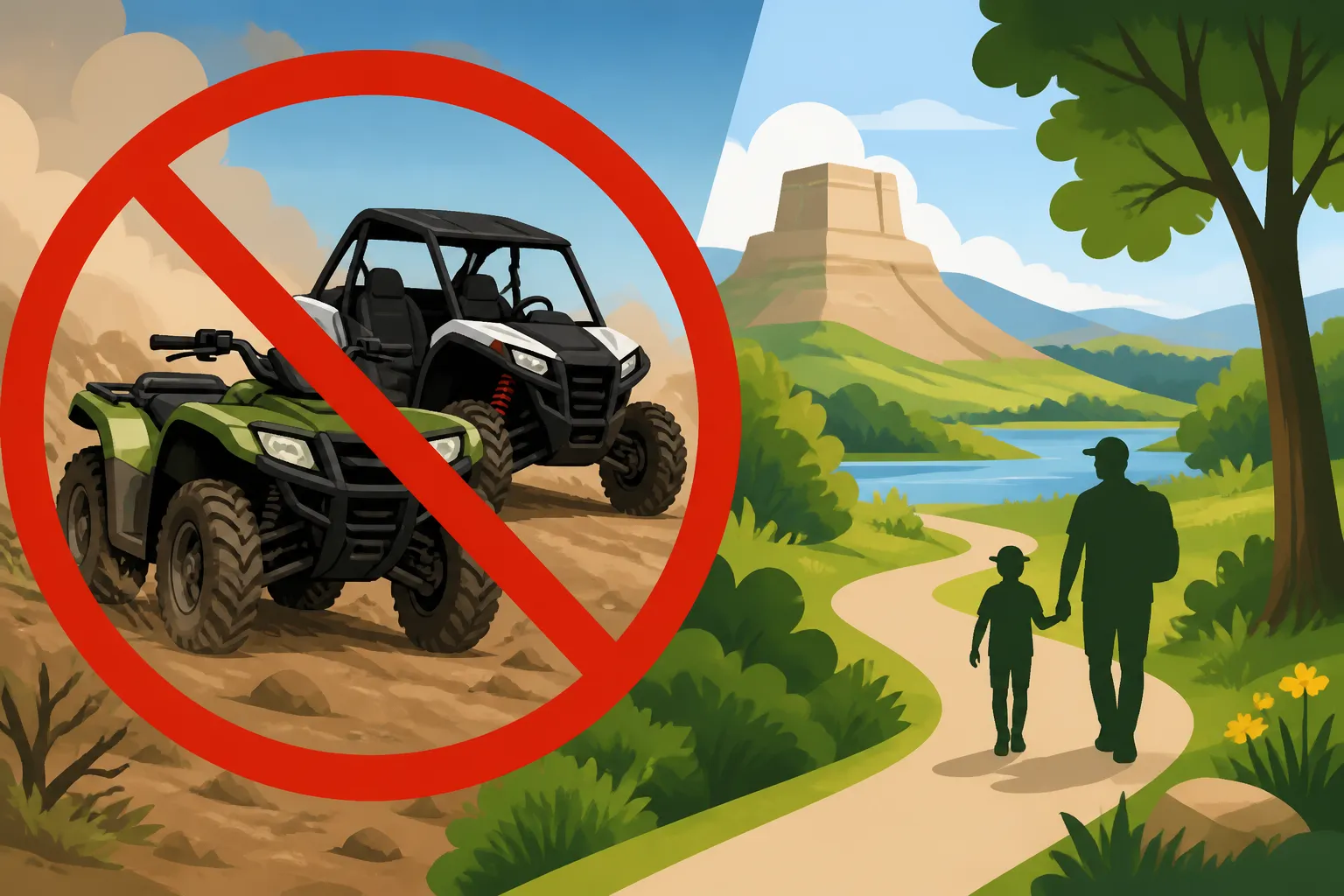
Why Game and Parks Bans ATVs in State Parks
An ATV can feel perfectly suited to Nebraska’s wide-open landscapes, so it’s frustrating to arrive at a state park and discover that riding it there isn’t allowed. The restriction is about how these public places are managed, not whether ATVs are welcome everywhere in the state. Here’s why the rule exists, what it means for different kinds of public land, and how to find a legal place to ride instead.
Why Nebraska state parks restrict ATV riding
State parks are managed for different kinds of recreation
Nebraska state parks are designed for activities such as hiking, camping, fishing, picnicking, and enjoying the natural setting. Allowing recreational ATV traffic across park grounds would add a different kind of use, one that can be hard to fit alongside quiet trails, campsites, and areas used by families on foot.
That doesn’t mean ATV riders are unwelcome in Nebraska. It means a state park is not automatically an off-highway riding area. The Nebraska Game and Parks Commission manages public lands for particular purposes, and visitors are expected to use each property only in ways its rules allow. The basic distinction is covered in [Nebraska State Parks Ban ATVs] and [Why Nebraska State Parks Are Closed to ATVs].
A useful way to think about it is to separate access to a park from permission to ride an ATV there. You may be able to drive a street-legal vehicle to a campground or parking area, but that doesn’t mean you can unload a quad and ride it on park paths or open ground. The vehicle that gets you to the recreation area and the machine you want to use for off-road recreation are subject to different rules.
Safety and trail conflicts matter
A shared path can feel very different to someone walking a dog, pushing a stroller, or riding a bicycle when an ATV comes around a bend. Even at a modest speed, a motorized machine is heavier and wider than most people on foot. Dust, noise, and limited sightlines can add to the concern, especially where paths are narrow or busy.
Those conflicts are not limited to hikers. Campers may be backing vehicles near tents, children may be moving between picnic areas, and wildlife may be using quieter parts of a property. Restricting recreational ATV use helps reduce the chance that these activities overlap in places that were not laid out for motorized trail traffic.
It’s also a practical issue for riders. A trail that isn’t built or maintained for ATVs may have tight turns, soft edges, drainage features, or other obstacles that are difficult to navigate safely on a larger machine. Keeping ATVs to designated riding areas helps visitors avoid assuming that any visible path is suitable for motorized use.
Protecting land and facilities is part of the policy
ATV tires can loosen soil and widen a track when riders steer around mud or ruts. Repeated traffic may damage vegetation, disturb habitat, and make erosion worse. A shortcut that seems harmless to one rider can become a deeper, broader route after many passes, particularly after rain or during thawing conditions.
Park roads, lawns, and pedestrian paths are not necessarily built to withstand repeated off-road use. Even if a machine leaves no obvious damage during one ride, the cumulative effect of many machines can mean more maintenance and less room for the activities the park is meant to support.
The restriction is therefore about more than noise. It can help protect the landscape, reduce conflicts among visitors, and keep the property usable for its intended recreation. That’s why it’s worth checking the rules before unloading, rather than judging permission by whether a trail looks wide enough.
Know which kind of public land you’re visiting
State parks, recreation areas, and wildlife management areas are not interchangeable
People often use “state park” as a casual name for several kinds of public land. In Nebraska, a state park, a state recreation area, and a wildlife management area may be managed under different rules. A rule that applies at one property should not be assumed to apply—or not apply—at another.
State recreation areas have their own restrictions, so check the specific site’s rules before you go. The overview in [Nebraska Recreation Area Rules for ATVs] is a useful starting point, but property-specific signs and posted closures still matter. On wildlife management areas, access may be limited to designated roadways or other specifically permitted locations; see [Nebraska WMA Access for a Quad] before planning a ride.
This distinction matters when you’re looking at a map. A public boundary on a phone screen does not tell you whether ATV riding is permitted within it. Nor does a county road or access road that appears to cross public land automatically become an approved trail. Confirm the land category, the permitted routes, and any current closures for the exact destination.
A park permit is not an ATV riding permit
A state park entry permit may be required to bring a vehicle into a park, but paying for that permit does not grant permission to ride an ATV around the property. The permit and the vehicle-use rules answer different questions: one concerns entry, while the other concerns what you may do once you arrive.
Nebraska also does not have a statewide OHV permit or sticker that, by itself, gives riders permission to use trails on public land. The distinction is explained in [Nebraska Has No OHV Permit or Sticker]. Before relying on a permit, sticker, title, or registration from another state, check the rules for the land you intend to enter.
This is an easy point to miss when planning a weekend. A rider may have paid for park access, loaded the machine, and driven several hours, only to learn that the permit covers the tow vehicle’s entry—not recreational riding. Check both requirements before leaving home: whether your vehicle needs an entry permit and whether ATV use is allowed at that particular location.
| What you’re checking | What it tells you | What it does not automatically allow |
|---|---|---|
| State park entry permit | Whether the vehicle may enter the park under its entry rules | ATV riding on park trails or grounds |
| Property-specific riding rules | Whether ATVs may use designated routes at that property | Riding beyond the marked or approved area |
| ATV title or out-of-state registration | Information about ownership or vehicle status | Access to a public trail that is closed to ATVs |
| Posted signs and closures | Restrictions that apply at the location | Permission to ignore other rules that still apply |
Find a Nebraska riding area made for ATVs
Look for designated off-highway areas
If your plan is to ride rather than simply visit a park, choose a destination that specifically identifies ATV or off-highway vehicle use. Nebraska has designated riding opportunities, but they are not interchangeable with state parks, and details such as allowed machine types, routes, fees, and seasonal access can vary.
For a forest setting, start by researching [Bessey OHV Trails at Halsey in Nebraska]. For another option, look into [Cedar Run ATV Trail in Nebraska]. Riders closer to the eastern part of the state may also want to check [Flat Rock Riders OHV Park in Nebraska]. These links are starting points for comparing areas, not a substitute for confirming the rules and access details for your planned visit.
As you compare destinations, check whether the site allows your type of machine. A trail that welcomes ATVs may have limits that affect a wider side-by-side, a dirt bike, or a youth machine. Look for information about trail layout, parking, camping, operating rules, and closures. If any detail is unclear, contact the land manager or riding area before loading the trailer.
Use maps to plan, but verify the rules
An off-road map can help you understand where routes appear to go, how far they are from your starting point, and whether the trip might connect with other roads or recreation areas. Apps such as onX Offroad can be useful for organizing a route and reviewing mapped access before you leave.
Treat any app as a planning aid, not as permission to ride. A mapped line may not show a new closure, a seasonal restriction, a property boundary detail, or the latest local rule. Compare the route with information from the land manager, look for signs when you arrive, and turn around if the route is closed or unclear.
For example, a rider heading toward Halsey might use onX Offroad to prepare a general route and identify nearby roads, then confirm the riding area’s own access information before departing. That extra check can prevent the frustrating—and potentially costly—mistake of following a map line onto land where motorized riding isn’t allowed.
Plan the whole trip, not just the trail
Before driving out, confirm the destination’s operating conditions and whether your machine is permitted. Check for closures after weather, restrictions on certain routes, and any rules about unloading or staging. A legal riding area can still be a poor fit if it does not accommodate your machine or the kind of ride your group wants.
Think through the basics as well: trailer parking, fuel, water, protective gear, and whether you’ll have reliable cell service. On unfamiliar routes, carry a backup navigation option and agree on a meeting point in case riders become separated. A little preparation can make the day easier, especially if you’re traveling with children or a group that includes riders with different experience levels.
Finally, follow posted directions and practice good trail etiquette. Stay on the route, avoid spinning tires, give others room, and leave gates or facilities as you found them. [Nebraska Trail Etiquette Locals Expect] offers a helpful reminder that responsible riding includes how you treat the trail and the people sharing the area.
What to do before riding at a public property
Check the exact property and the exact route
Start with the property’s official name and land category. Don’t rely only on a social media post, an old map, or a friend’s memory of a trip from years ago. Then check whether ATV use is allowed, where it is allowed, and whether your machine type is included.
If the property has multiple entrances or trailheads, confirm that the route you plan to use begins at an approved access point. A road that reaches a public parcel may be open to ordinary traffic but not to recreational ATV riding. If a boundary or route is difficult to interpret, ask the managing office before you go.
Read signs and respect closures on arrival
Posted signs are there to communicate rules at the place where they apply. If an entrance, trail, or area is marked closed to motorized vehicles, don’t assume that a title, permit, or map overrides the sign. Closures can be specific to one route or section, so follow the instructions for the area you’re actually entering.
If you encounter an unmarked junction or a route that seems to leave the approved riding area, pause rather than guessing. It is better to backtrack than to create damage, trespass, or put your group in an unsafe situation. When in doubt, contact the land manager and get clarification before riding farther.
Match your plans to the purpose of the place
A quiet picnic at a state park and a full day of ATV riding are both reasonable outdoor plans; they simply call for different destinations. Choosing the right place makes the trip more enjoyable and reduces friction with other visitors. If your main goal is off-road riding, start with a designated OHV area. If you want to camp, hike, fish, or enjoy a state park, plan to leave the ATV riding for a location where it is expressly allowed.
That small change in planning can save a long drive, an awkward conversation at the trailhead, and the disappointment of unloading only to turn around. Nebraska offers different kinds of outdoor recreation, but the rules depend on the land and the activity. Confirm the property, route, and current restrictions before you go.
Disclaimer
This article is for general informational purposes only and does not constitute professional advice. Laws, prices and regulations vary by location and change over time. Consult a qualified professional for guidance on your specific situation.