Sharing a Forest Road With Cattle
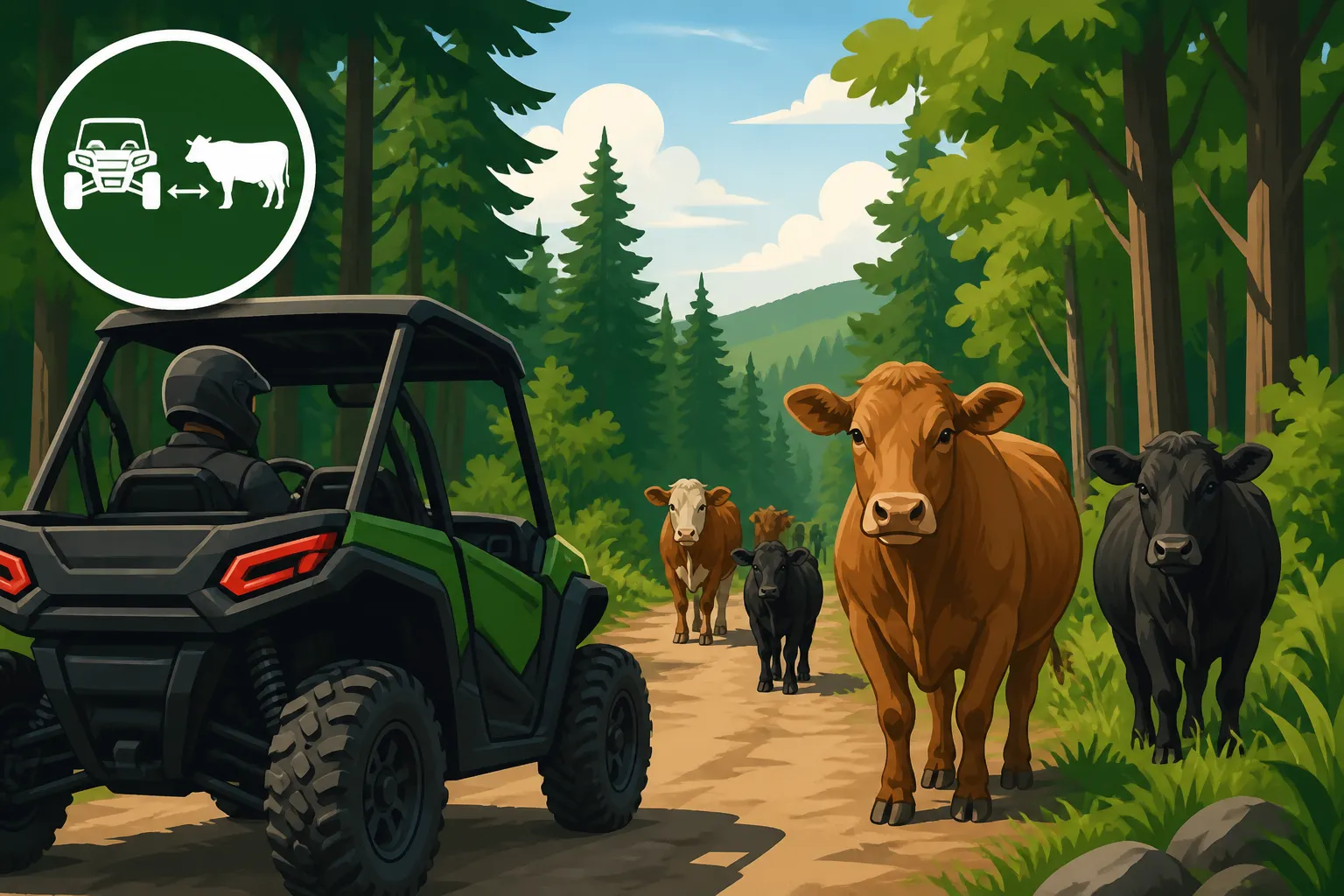
A quiet forest road can feel easy to navigate until cattle appear around a bend or fill the track ahead. For ATV and UTV riders in Nebraska, the safest response is usually to slow down, give the animals room, and avoid trying to move them. This guide explains how to approach cattle, handle a blocked route, and ride responsibly around grazing areas.
Why cattle may be on a Nebraska forest road
Roads can cross working grazing areas
A road through a forest or grassland may also pass through land used for grazing. Cattle can wander onto the road, gather near water or shade, or move as a group between parts of a grazing area. Their presence does not necessarily mean the road is closed, but it does mean the route needs extra care.
This is worth remembering when riding around places such as the Bessey Ranger District near Halsey or in Nebraska’s Pine Ridge country. Conditions can differ from one route to another, and a public road or trail may pass through an area where livestock are present. Follow posted directions and use the routes open to your vehicle; a visible track is not proof that every road or two-track is available for public use. Check Nebraska National Forest riding and What the Pine Ridge Ranger District Allows Riders when planning a ride in those areas.
Cattle do not understand that a machine is simply trying to get past. A sudden engine noise, fast approach, or tight pass can startle them and cause unpredictable movement. A rider who expects livestock may be less tempted to accelerate through a herd or make a risky maneuver when the road gets crowded.
A blocked road may require patience or a change of plan
Sometimes cattle occupy only part of the road, leaving a wide, clear route around them. Other times they may fill the track, stand in a narrow passage, or move in the same direction you need to travel. The safest choice depends on the space available and the animals’ behavior. If there is no calm, generous way through, wait rather than forcing a pass.
A delay can be frustrating, especially when you are riding with a group, watching the weather, or trying to reach a trailhead before dark. Still, rushing may scatter cattle, separate a calf from an adult, or create a dangerous situation for riders and animals alike. Plan enough time for slower travel and unexpected stops, particularly on unfamiliar forest roads.
If a route is blocked for a prolonged period, turn around only where you can do so safely and legally. Do not bypass the blockage by cutting across grass, entering a closed road, or taking an unmarked shortcut. Before leaving home, review Nebraska Trail Conditions Before You Tow and plan a backup route that stays on authorized roads and trails.
How to approach cattle on an ATV or UTV
Slow down early and keep your group together
Reduce speed as soon as you see cattle, even if they appear far away. On a bend or rise, slow enough that you can stop within the clear distance ahead. Keep the machine under control and avoid abrupt steering or braking that could make the animals move suddenly.
If you are riding in a group, signal the riders behind you to slow down and stop at a safe distance. Avoid having each person approach the herd separately. A line of machines can be more intimidating than one quiet vehicle, and riders who bunch up may leave little room to turn around. Keep the group organized, with enough space between machines for everyone to stop without crowding the cattle.
A practical approach is to pause, watch the animals, and let them settle before deciding what to do next. Turn off unnecessary noise if you can do so safely. Avoid revving the engine to make cattle move, and do not use a horn or shout unless an immediate hazard makes a warning necessary. The goal is not to direct the herd; it is to give the animals time and space to move naturally.
Give cattle a wide berth and avoid splitting the herd
When cattle leave an obvious, generous gap, pass slowly and steadily while keeping as much distance as the road allows. Do not squeeze between animals or drive through the middle of a group. A cow with a calf nearby may react defensively, and even calm cattle can shift direction without warning.
If the animals are moving away from you, do not follow closely or try to push them down the road. Stop and allow them to continue at their own pace. If they turn toward your machine or begin moving unpredictably, increase distance where possible. Do not approach on foot to coax them aside, and do not let passengers or children get close for a better look.
A narrow road may leave no safe passing space. In that case, wait at a distance, give the herd time, and reassess. Riders can compare this with general narrow-trail courtesy in Who Yields on a Narrow Two-Way Trail, but livestock calls for extra caution: the priority is space for the animals, not getting through first.
| What you see | Safer response | Avoid |
|---|---|---|
| Cattle well ahead on the road | Slow early and stop at a comfortable distance | Maintaining speed until you are close |
| A herd moving away | Wait and let it continue without following closely | Trying to push the animals down the road |
| A clear, wide gap around the herd | Pass slowly only if the route is authorized and the animals remain calm | Squeezing between cattle or separating a calf |
| Cattle blocking a narrow road | Wait, then turn around safely if needed | Driving off-road or through the herd |
| A gate or closure sign | Follow the posted direction and do not assume access | Opening a gate to reach an unverified route |
Gates, route access, and responsible riding
Do not treat a gate as permission to enter
A gate can mark a boundary, control livestock, or indicate that access is restricted. Its presence alone does not tell you whether a road is open to public riding. Check signs and route information before entering, and respect closures even if you can see tire tracks on the other side.
If you are already on a route where passage is clearly allowed and encounter a gate, follow the instructions posted there. When permitted to open it, leave it as you found it. A gate left open can allow livestock to move into an unintended area; one left closed may be part of the grazing plan. For additional context, see Leaving Pasture Gates the Way You Found Them and Reading Posted Signs on Ranch Land Before You Ride.
Do not cross private land or take an alternate ranch road simply because cattle have blocked your route. Where access is unclear, stop and verify it rather than relying on an online track or a route someone mentioned casually. Getting Written Permission From a Ranch Landowner is useful background when a ride involves private property.
Use maps as planning tools, not permission
A mapping app can help you understand the general layout of a ride, but it cannot replace posted signs, official route information, or land-manager instructions. onX Offroad can be useful for reviewing route context before a trip, especially when you are trying to understand where a mapped track appears to connect with other roads. Confirm that the route is open to your machine and that access is allowed before you ride it.
Download or save the information you may need before leaving reliable service. Forest roads and rural riding areas can have weak or absent cell coverage, so do not depend on loading a map only after you reach a junction. onX Offroad may help you keep a route available for reference, but it should not be treated as proof that a road is open or as a substitute for signs and current land-management guidance. See Planning for No Cell Service on a Forest Ride for more preparation ideas.
Route planning is especially helpful when a herd blocks a road. If you know where an authorized turnaround or alternate route is located, you are less likely to improvise by crossing a field or taking a questionable spur. Keep a paper map or another offline navigation option as a backup, and share the planned route with someone who is not riding with you.
What to do when cattle block your route
Stop, observe, and decide without pressuring the herd
First, stop far enough away that the animals are not crowded by the machine. Watch their direction and behavior. If they are moving calmly, give them time. If the herd is spread across the road or appears unsettled, remain stopped and avoid trying to thread your way through.
Make a decision as a group. If the road clears and a wide, safe pass becomes available, move through slowly and without unnecessary noise. If the cattle remain in the way, or the road is too narrow to pass without crowding them, wait longer or turn around at a suitable spot. Do not ride into roadside vegetation to get around them unless the route is clearly designated and open for that use.
For a group ride, the lead rider should communicate the plan clearly. A simple hand signal or verbal instruction can prevent someone farther back from riding forward unexpectedly. Riders should not fan out across the road, chase cattle in different directions, or attempt to surround the herd.
Know when to contact the land manager
If cattle appear injured, trapped, entangled, or in immediate danger, do not try to handle them yourself. Keep a safe distance and contact the appropriate land manager or livestock owner if you can identify the right contact. If the situation creates an immediate threat to people, use the appropriate emergency channel.
It may also be useful to report a damaged gate, a fallen fence, or a blocked route that appears to be a safety concern. Share the location as accurately as possible, along with a description of what you observed. Avoid posting sensitive access details or encouraging others to use a route whose status you have not confirmed.
The most reliable habit is to ride as a guest: stay on authorized roads, keep noise and speed down near livestock, and leave gates and property undisturbed. That approach protects the animals and reduces the chance that a brief encounter becomes an injury, property problem, or stressful ride. For broader trail behavior, Nebraska Trail Etiquette Locals Expect offers related guidance.
Disclaimer
This article is for general informational purposes only and does not constitute professional advice. Laws, prices and regulations vary by location and change over time. Consult a qualified professional for guidance on your specific situation.