Riding in Nebraska on an Out-of-State Registration
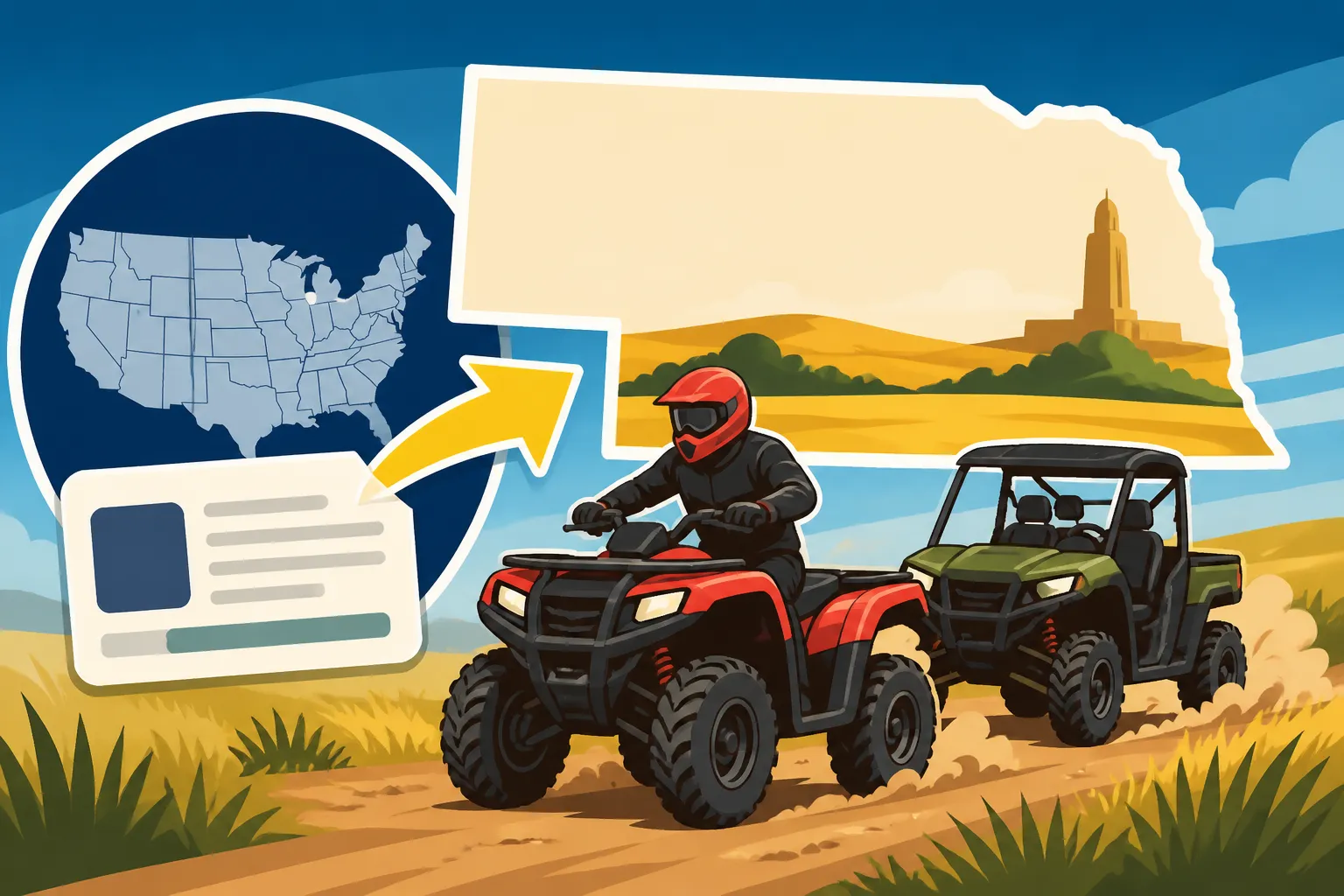
Bringing an ATV or UTV into Nebraska with an out-of-state registration can make the rules feel confusing: your home state may require a sticker, while Nebraska generally does not issue a statewide ATV registration. This guide explains what your registration does and does not allow, which permits may still apply, and how to check trail, road, insurance, and local rules before unloading.
What an Out-of-State Registration Means in Nebraska
Nebraska does not have a statewide ATV registration to transfer
Nebraska does not operate a statewide ATV registration or OHV sticker program. That means a registration card or decal from Iowa, Kansas, South Dakota, Colorado, or another state does not convert into a Nebraska registration. It also does not substitute for a Nebraska permit: for ordinary off-road riding, Nebraska does not issue a general statewide ATV permit or trail sticker.
That distinction can be easy to miss when you are used to showing a state decal at a trail gate. In Nebraska, the question is usually not “Which state registration is recognized?” but “Is this place open to this type of machine, and what does this particular location require?” A facility may have its own access, parking, or operating rules even though there is no general state OHV sticker.
The lack of a statewide ATV registration does not mean every Nebraska agency or landowner treats every machine as automatically allowed. Rules depend on the land and the activity. A forest trail, a wildlife management area, a private riding park, and a town street can each have different requirements. Start with Nebraska Has No Registration to Reciprocate and Nebraska Has No OHV Permit or Sticker to keep the statewide permit question separate from site-specific rules.
Your home-state documents still have a purpose
Keep your out-of-state registration with you if your home state issued one. It may help establish that the machine is registered where you live, and it can be useful if an officer, land manager, or riding facility asks for ownership or machine information. It can also matter for your return trip, since your home state’s requirements still apply when you get back.
Registration is not the same as proof of ownership. A registration card may list an owner and machine, but it does not always resolve a dispute about a lien, a missing title, or a mismatched serial number. Carry any ownership documents that are relevant to your machine, especially if you recently bought it, borrowed it, or are transporting it on someone else’s behalf.
Before leaving home, compare the machine’s serial number or VIN on the frame with the number shown on the paperwork. If the numbers do not match, or a document lists a different owner, pause and resolve that before the trip. It is much easier to correct a paperwork problem in your driveway than to explain it at a trailhead after a long tow.
Registration does not grant permission to ride
A valid registration from another state does not give you permission to ride on Nebraska land. It does not open a state park, a wildlife management area, a forest road, a private pasture, or a city street. Access comes from the rules for that place, and those rules may prohibit ATVs entirely or limit them to designated routes.
This is where visitors sometimes get caught out. A rider sees a road, trail, or open-looking field and assumes the machine’s registration makes the ride lawful. In reality, access and registration are separate questions. You need to establish both that you may ride there and that you have met any location-specific requirements.
For a particular public area, look for its official map, posted signs, and agency rules before unloading. For private land, get the owner’s permission rather than relying on a public road or trail map. For a city, check its ordinance and registration rules directly. Nebraska’s lack of a statewide sticker is not a general invitation to ride wherever you find open ground.
Permits You May Still Need
A state park permit is not an ATV permit
Nebraska’s state park entry permit and an ATV registration are different things. A park permit relates to entry by a vehicle into a park or recreation area; it does not register an ATV, make an ATV trail-legal, or override a rule that closes an area to ATVs. A permit displayed on the tow vehicle does not authorize unloading and riding the machine where motorized riding is prohibited.
This matters when a family is heading to a park with a truck, trailer, and ATV. The truck may need the appropriate park entry permit to enter the property, while the ATV may still be barred from operating there. Do not assume that buying a park permit for the truck buys riding access for everything being hauled behind it.
Nebraska state parks and recreation areas generally prohibit ATVs, with narrow exceptions that can involve frozen water and specific posted conditions. Those exceptions should never be inferred from the weather alone. Check Nebraska Parks Closed to ATVs, Nebraska Recreation Area Rules for ATVs, and Nebraska Frozen Lake Riding Rules before planning a winter ride.
Public land has location-specific rules
A Nebraska National Forest trail, a wildlife management area, and a Corps-managed recreation site do not necessarily share the same rules. On National Forest land, riding may be limited to designated routes and open areas. Trail closures, seasonal restrictions, vehicle-width limits, and parking requirements can affect a trip even when the land is open to visitors.
Wildlife management areas require special care. A road or track that looks established may not be designated for motorized travel. Some areas allow motor vehicles only on designated roadways, while parking and frozen-water exceptions may have separate restrictions. Read the signs at the entrance and confirm the area’s current map before assuming that a route is open.
If you are planning to ride near Halsey, for example, distinguish Bessey Recreation Complex’s designated OHV trails from nearby forest roads or other public land. A route that is open to one kind of vehicle may not be open to your ATV or side-by-side. Nebraska Public Land Rules Compared to Private and [Nebraska WMA Roadway Rules] are useful starting points for sorting out these differences.
Private parks can set their own entry conditions
A private OHV park may require a waiver, an admission payment, proof of insurance, a particular safety item, or compliance with rules about passengers, helmets, sound, or machine size. These are park rules, not Nebraska statewide registration rules. A home-state registration card does not replace the waiver or entry requirements that a private operator sets.
Call or check the park’s official information before driving there. Ask whether your machine type is allowed, whether a side-by-side has a width limit, whether children may ride, and whether the park requires proof of ownership or insurance. Also confirm whether riding is limited to signed trails and what happens if weather closes part of the property.
This check is especially important for a group trip. One rider may bring a youth quad, another a three-wheeler, and a third a side-by-side that is wider than the trail allows. If one machine does not meet the park’s rules, the problem can affect the whole day. Nebraska’s public-land rules do not automatically set private parks’ minimum ages, equipment standards, or operating conditions.
| Location | What an out-of-state registration does | What to check before riding |
|---|---|---|
| Nebraska public roads | Does not make the machine road-legal | State road-use rules, insurance, licensing, and any local ordinance |
| State parks and recreation areas | Does not authorize ATV use | Area restrictions and any narrow posted exception |
| Wildlife management areas | Does not open roads or trails | Designated routes, parking rules, signs, and seasonal restrictions |
| National Forest riding areas | Does not replace route rules | Open trails, closures, vehicle limits, and parking requirements |
| Private OHV park | Does not replace park admission or waivers | Park-specific access, equipment, age, and safety rules |
| Private land | Does not grant landowner permission | Explicit permission from the owner or person in charge |
Riding on Nebraska Roads
A plate from another state does not make an ATV street-legal
An ATV or UTV that carries a registration plate in its home state does not automatically become legal to drive on Nebraska roads. Nebraska road use is controlled by Nebraska law and, in some places, local ordinances. The out-of-state plate does not override those rules or turn a restricted off-road machine into a general-purpose road vehicle.
Nebraska allows only limited forms of ATV or UTV road use. Some situations involve agricultural work, while some cities or villages may allow operation on specified streets under local rules. A rider should not treat a short trip between fields, a ride down a gravel road, or a convenient route to a trailhead as lawful just because the machine is registered elsewhere.
Before riding on a road, identify the exact route and the legal basis for using it. Check whether the route is inside city limits, whether a local ordinance opens the street, and whether the road is a state highway or another restricted road. Can You Drive an ATV on the Road in Nebraska? and Three Ways ATVs Can Legally Use Nebraska Roads explain why road access is limited rather than automatic.
Road-use requirements are separate from registration
When Nebraska law allows a particular road trip, the rider may still need to meet requirements for speed, lighting, safety flags, crossings, licensing, insurance, and time of day. Those requirements do not disappear because the machine has a home-state plate. Nor should you assume that a machine’s ordinary trail equipment is enough for a road-legal trip.
The rules can be very specific. Nebraska has a 30 mph limit for applicable road use, a safety-flag requirement, and restrictions on when and where a machine may operate. Crossing rules matter too: a permitted crossing is not the same as permission to travel along the highway. A rider who is only crossing a road should use the legal crossing method and yield as required.
Insurance deserves a separate check. A policy that covers recreational off-road riding may not cover a road trip in the same way. Confirm with your insurer that the intended Nebraska use is covered, and carry proof if the law or local rules require it. The practical answer is not to assume that “registered at home” means “insured for Nebraska road use.”
City rules can change from one town to another
A city or village may allow some ATV or UTV operation on designated streets, but permission is local rather than statewide. One town may open certain streets and impose registration, age, equipment, or insurance requirements. A nearby town may not allow the same use at all. Crossing a city boundary can change the applicable rules in the middle of a ride.
Do not rely on a neighbor’s experience or an old social media post. Ordinances can be amended, and a local registration issued by one town does not automatically apply in another. Ask city hall or the village clerk which streets are open, what paperwork is required, and whether an out-of-state resident can satisfy the town’s registration conditions.
If you are staying near Omaha, Lincoln, Grand Island, North Platte, or a smaller Sandhills community, check the rules for the specific municipality rather than assuming that the nearest city’s policy applies everywhere. Nebraska Cities With ATV Ordinances and How to Find Your Town’s ATV Ordinance Online can help you identify the questions to ask before riding.
Titles, Ownership, and Borrowed Machines
A title is not the same as registration
Nebraska’s title system and its lack of statewide ATV registration can sound contradictory, but they serve different purposes. A title identifies ownership and may record a lien. Registration or licensing generally concerns permission to operate a vehicle under a particular system. Nebraska titles many ATVs without issuing a statewide ATV plate or sticker for off-road use.
As a visitor, do not assume that bringing a machine into Nebraska for a trip means you must immediately transfer its title to Nebraska. A short visit is different from moving to Nebraska, buying a machine in Nebraska, or establishing Nebraska ownership. If you have recently moved, purchased the ATV locally, or plan to keep it in the state, ask the appropriate county treasurer about title requirements for your circumstances.
The distinction matters at a trailhead because proof of ownership and proof of permission are separate. A title may help show who owns the machine, but it does not establish that a particular trail is open. A state decal may show that the home state issued registration, but it does not create Nebraska road access. Keep the documents that are relevant without treating any one of them as a universal pass.
Carry documents that match the machine and the rider
For a trip, carry the paperwork that makes sense for your situation: your out-of-state registration, ownership document if available, insurance information, and permission from the owner if you are borrowing the machine. If the machine is financed, know where the title or lien information is recorded and keep any documents your lender or insurer expects you to have.
A borrowed ATV creates a common awkward moment: the rider has the keys but cannot clearly explain who owns the machine or whether the owner agreed to the trip. A brief written permission note, along with the owner’s contact information, can help avoid confusion. For a rental, carry the rental agreement and follow the rental company’s use restrictions; a rental contract does not make a closed route open.
Keep documents protected from mud and rain, but do not leave the only original title loose in an ATV storage box. A waterproof pouch can help with copies, registration cards, and emergency contacts. If you shop on Amazon for a document sleeve or small storage pouch, check that it closes securely and will fit the paperwork without forcing it into a fold.
Resolve paperwork questions before the trip
Check that the VIN or serial number is readable and matches your documents. On older machines, the number may be dirty, obscured, or difficult to locate. Clean the area gently and take a clear photo before traveling. Do not alter, restamp, or attempt to reconstruct a number yourself if it is missing or damaged; contact the relevant authority or a qualified professional for direction.
If the title lists a lien, make sure the lien status is understood before treating the machine as freely transferable or lending it out. If the machine was bought recently, keep the bill of sale and any dealer or auction paperwork. Missing signatures or inconsistent names can complicate ownership questions well beyond Nebraska.
For a visitor, the goal is not to carry a suitcase of paperwork. It is to make the basic facts easy to establish: who owns the machine, what machine it is, whether you are authorized to use it, and whether you have insurance for the planned activity. Those details are especially useful if you are stopped, involved in a crash, or asked about a machine at a private riding facility.
Planning a Public-Land Ride
Confirm the exact trailhead and route
“Riding near Halsey” is not specific enough to plan a legal ride. Identify the trail system, its entrance, and the routes that are open to your machine. The Bessey OHV trails near Halsey are not interchangeable with every nearby forest road, campground lane, or public parcel. Follow the signs and trail map for the riding area itself.
Check for route closures, maintenance work, weather-related restrictions, and vehicle-size limits before towing. A side-by-side may not fit a route intended for ATVs, and a trail shown on an old map may have been closed or rerouted. If you are going to Cedar Run or another designated riding location, confirm that the trail system is open and that your machine class is permitted.
Plan the tow and unloading, too. A long trailer may need more turning room than a standard passenger vehicle, and a busy staging area can become cramped quickly. Do not block a gate, road, or access lane while unloading. A short planning call or a careful look at official area information can prevent a frustrating arrival at the wrong entrance.
Check land rules and seasonal conditions
Public land rules can change with season, wildlife management needs, fire danger, trail maintenance, or weather. A route that is open during one visit may be closed the next time. Rain can make some trails damaging or unsafe, while dry conditions can bring fire restrictions. Always give posted signs priority over assumptions based on an older map.
On wildlife management areas, verify whether motorized travel is restricted to designated roadways and where you may park. Do not ride cross-country just because the ground looks firm or because another set of tracks is visible. Those tracks may be unauthorized, and following them can create problems for you and for future visitors.
For forest riding, identify fuel, water, cell-service limits, and the nearest help point before leaving the staging area. In the Bessey area, for example, distances between services can make a simple breakdown more involved than it would be on a short town ride. Carry a paper map even if you use a phone, and tell someone where you plan to ride.
Treat parking permits and trail access as different checks
A parking or entrance permit may apply to the truck or other highway vehicle used to enter a recreation area. A trail-access rule applies to the ATV or UTV itself. A parking fee may also be separate from an admission permit. Read the area’s instructions carefully so you do not mistake one payment or authorization for another.
This is especially important when a family buys a park permit before a weekend and expects to ride from the campsite. The permit may cover entry to the park, while the ATV remains prohibited on the park roads and trails. If riding is allowed at a nearby forest or private facility, you may need to tow the machine there instead.
Keep receipts and permits accessible, and place any required vehicle permit exactly where the issuing agency instructs. A glovebox, phone wallet, and trailer paperwork folder can be useful, but make sure you can find the right document without emptying the cab at a gate. Why the Park Permit Belongs on Your Truck and Nebraska Permit Questions Riders Ask cover the common mix-up between vehicle entry and machine use.
Insurance, Safety, and Enforcement
Ask your insurer about the exact trip
Insurance coverage depends on the policy and the activity. A policy designed for off-road use may have different terms from auto insurance, and a machine’s home-state registration does not tell you whether a Nebraska trip is covered. Before traveling, describe your intended use to your insurer: public-land trail riding, private-park use, transport on a trailer, or any road operation allowed by law.
Ask whether the policy covers liability, theft, collision, passengers, and a borrowed or rented machine as applicable. If you plan to ride on a road under a specific legal exception or local ordinance, ask directly whether that use is covered. Do not assume that an agent’s general statement about “ATV coverage” answers every question about public-road exposure.
Carry proof of insurance when applicable and keep a copy available offline. A phone screenshot is useful, but a paper copy can help if your phone battery dies or you are in an area with weak service. Riders who store a copy with registration documents can find both quickly when asked.
Follow equipment and riding rules even off-road
Public trails and private parks may set equipment requirements that differ from ordinary road rules. A trail may have rules about spark arrestors, sound, width, passengers, helmets, or safety gear. A private park may enforce additional requirements at the gate. Your out-of-state registration does not excuse you from them.
Pack for Nebraska conditions rather than assuming a short ride will stay comfortable. Open terrain can mean wind, dust, heat, and strong sun. Near water or in a river bottom, insects can be a bigger nuisance. Bring enough water, basic first aid, eye protection, gloves, and clothing suitable for changing weather. Secure loose items so they do not fall onto the trail.
A small document pouch can keep your permit information, emergency contacts, and trail notes together. If you use Amazon to look for a waterproof pouch, compare the closure and mounting method with your machine’s storage space; a pouch that leaks or comes loose is worse than keeping papers in a sealed bag inside a secured compartment. Whatever you choose, do not store irreplaceable originals where they can be soaked, lost, or damaged.
Know what to do if an officer or land manager asks questions
Stay calm, stop safely, and follow lawful instructions. Be prepared to identify yourself, explain where you are riding, and show relevant documents when required. If an officer asks about the machine, a matching registration or ownership document and a clear explanation of the route can make the conversation easier.
If you are uncertain whether a road or trail is open, do not argue based on a map screenshot or another rider’s claim. Ask which rule or route restriction applies, and record the details after the interaction. If you receive a citation, keep the paperwork and note the location, date, posted signs, and names of any witnesses. Do not ignore a citation because you believe your home-state registration should have been accepted.
Avoid riding onto a closed area to “check” whether it is open. Barriers, signs, and marked closures are there for a reason, even when the route beyond them looks inviting. When the rules are unclear, turn around and contact the land manager or local authority before returning.
A Practical Checklist Before You Cross Into Nebraska
Verify the machine and documents
Start by checking that the machine’s VIN or serial number matches its registration and ownership documents. Confirm that the machine belongs to you, is properly borrowed, or is covered by a rental agreement. If the paperwork is incomplete or inconsistent, resolve the issue before the trip rather than hoping no one asks.
Next, check insurance for the specific use you have planned. If road use is part of the plan, verify both the legal route and the insurance coverage for that route. If your machine is registered in another state, keep that registration with you, but remember that it is not a Nebraska riding permit.
Finally, make sure you know who to call if something goes wrong. Save the land manager’s contact details, your insurer’s claim number, the machine owner’s information if you are borrowing it, and an emergency contact. A paper copy is a sensible backup where mobile service may be limited.
Verify the place and the permission
Write down the exact riding destination, not just the town or county. Check that ATVs or UTVs are permitted there, that your machine type fits the rules, and that your intended route is open. Confirm whether the property is public or private and whether a reservation, waiver, admission fee, or landowner permission is needed.
If you plan to enter a Nebraska park or recreation area with a tow vehicle, check its vehicle permit rules separately from ATV access. If you plan to ride on a wildlife management area, identify the designated routes and parking locations. If you plan to use a town street, call the town and ask about its ordinance and local registration requirements.
A quick checklist on your phone can prevent the classic trailhead disappointment: “We drove all this way, but the ATV is not allowed here.” Confirm access before loading the trailer, then check posted signs again when you arrive. If the sign conflicts with what you read earlier, follow the sign and contact the responsible office.
Pack for a smooth arrival and return
Bring tie-downs, a spare key if appropriate, basic tools, water, first aid supplies, and a paper map. Check your trailer lights and secure the load before leaving. If you are traveling with multiple machines, assign one person to verify each machine’s paperwork and another to manage the route and permits.
Store copies of permits, registration, insurance, and ownership documents where they stay dry and can be reached quickly. A labeled folder or pouch can save time when the documents are needed. Amazon has options for waterproof document organizers, but a simple sealed bag inside a secured compartment can work too; the important thing is that the paperwork stays legible and does not blow away during unloading.
Before leaving the riding area, check that you have all your documents and gear, that the machines are secured, and that no trash or equipment has been left behind. Respecting a trailhead and leaving it as you found it helps keep access open for other riders. The same care applies to private land: close gates as instructed, stay on permitted routes, and leave promptly if the owner or land manager asks you to.
Disclaimer
This article is for general informational purposes only and does not constitute professional advice. Laws, prices and regulations vary by location and change over time. Consult a qualified professional for guidance on your specific situation.