Nebraska Divided Highway Crossings
Navigating the road rules for ATVs and UTVs in Nebraska can feel like trying to solve a complex puzzle, especially when you consider specific scenarios like crossing a bustling divided highway. It’s not just confusing; it can be downright intimidating to wonder if you’re following every letter of the law while also staying safe. This comprehensive guide will pull back the curtain on Nebraska divided highway crossings, breaking down the often-misunderstood regulations to ensure you ride informed and compliant.
Understanding Nebraska's General ATV and UTV Road Rules
Before we dive specifically into divided highway crossings, it's crucial to grasp the fundamental philosophy behind Nebraska's ATV and UTV road laws. The state largely restricts these machines from public roads, prioritizing safety and regulating traffic flow. However, there are very specific exceptions to these general rules, which can often be the source of confusion for riders. It’s not a free-for-all, but it's not a complete ban either.
The Foundational "Farm Use" Exception
One of the most significant exceptions you'll encounter in Nebraska is for agricultural purposes. The law recognizes that ATVs and UTVs are indispensable tools for farmers and ranchers across the state, and it wouldn't make sense to entirely bar them from traversing roads when moving between fields or checking livestock. This agricultural road exception allows operators to use these machines on public roads, but it comes with strict limitations. You can’t just go for a joyride and claim "farm use" if you're not actively engaged in agricultural activities. Think of it as a tool for a specific job, not a general mode of transportation. For instance, moving your quad from one pasture to another, or from the barn to a distant field, falls squarely within this exception. The goal is to facilitate farming, not recreational cruising. You’ll also need to be aware of [Nebraska's Agricultural Road Exception] for a full understanding.
When Cities and Villages Open Their Streets
While state law provides the overarching framework, local control plays a significant role in where you can ride your ATV or UTV. Nebraska cities and even unincorporated villages have the authority to pass their own ordinances allowing these machines on certain public streets. This is where things can get really localized. What’s perfectly legal in one town might get you a ticket just a few miles down the road in another. These local ordinances often come with their own set of rules, such as specific hours of operation, age restrictions, or even local registration requirements and fees. It's absolutely critical to check with the city or village clerk's office in any specific location where you plan to ride. Never assume that because one town allows it, all do. You wouldn't want to accidentally violate a local rule just because you didn't do your homework. These ordinances often focus on residential streets and alleys, typically excluding major arterial roads. You can find out more about [Nebraska City Ordinances That Open Streets].
Essential Equipment for Any Road Use
Regardless of whether you're using your ATV for farm work or riding on an approved city street, there are certain equipment requirements you absolutely must meet. These aren't just suggestions; they are legal necessities designed to enhance safety and visibility. For starters, you'll need at least one white headlight visible from 500 feet to the front and at least one red taillight visible from 500 feet to the rear. These lights must be on, even during daylight hours, when operating on a public road. A braking system in good working order is also a given. Furthermore, any ATV or UTV operating on a public road must be equipped with a safety flag. This flag must be bright, day-glow orange or red-orange, triangular in shape, and at least 30 square inches in size. Most importantly, it needs to be mounted at least five feet above the ground. Companies like SuperATV offer a variety of robust safety flags and flag mounts designed to meet these specifications, ensuring you're seen clearly by other motorists. Remember, these requirements are not just about avoiding a ticket; they are about making sure you are as visible as possible to prevent accidents.
Navigating Nebraska Divided Highway Crossings: The Strict Rules
Crossing a divided highway in Nebraska with your ATV or UTV is perhaps one of the most strictly regulated maneuvers you can undertake. It's not something to be taken lightly, and deviation from the specific rules can have serious safety and legal repercussions. The state's approach is designed to minimize exposure of these slower-moving vehicles to high-speed traffic.
The Mandatory Ninety-Degree Crossing at Intersections
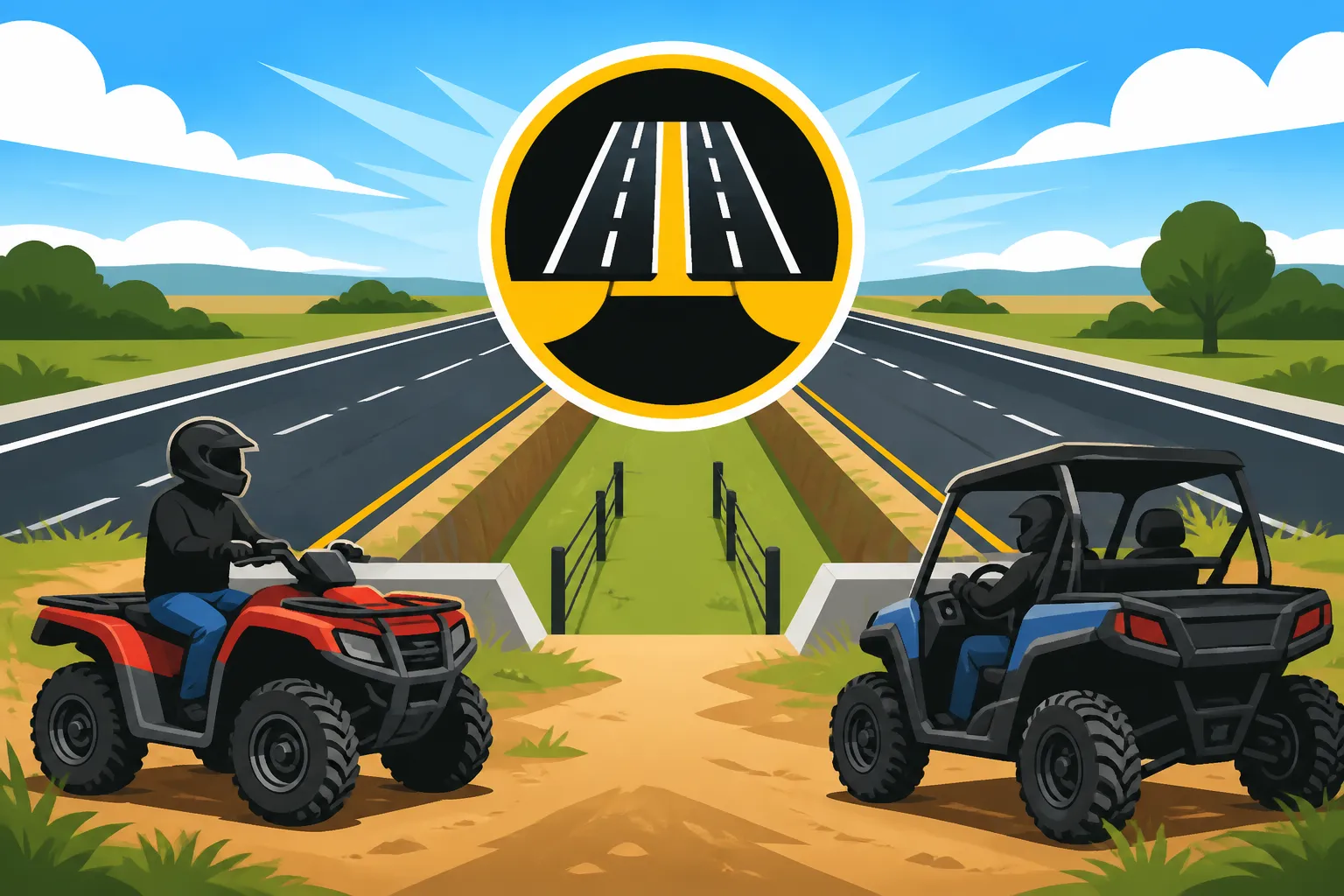
If you find yourself needing to cross a divided highway, Nebraska law is very clear: you must do so at a ninety-degree angle and only at an intersection. This means you can't angle across the road, merge diagonally, or cross anywhere other than a designated intersection where other traffic is also permitted to turn or cross. The ninety-degree rule is in place to minimize the amount of time your machine is exposed to crossing traffic and to make your intentions clear to other drivers. Imagine drawing a straight line directly across all lanes of traffic – that’s your path. This isn't a suggestion; it's a mandatory legal requirement. Attempting to cross a divided highway at any other point or angle is not only illegal but incredibly dangerous, as it creates an unpredictable situation for high-speed vehicles. It's a precise maneuver that demands your full attention and adherence to the law. Understanding [Nebraska Crossing Rules at Ninety Degrees] is paramount here.
Yielding to All Traffic: Your Absolute Priority
When making that ninety-degree crossing at an intersection, the law is equally clear that you must yield the right-of-way to all other traffic. This isn't a shared responsibility; the onus is entirely on the ATV or UTV operator to ensure the crossing is safe and does not impede or endanger other vehicles. You cannot pull out in front of oncoming traffic, even if you think you have enough time. This means waiting patiently for a clear break in traffic, which on a busy divided highway, might take some time. Remember, ATVs and UTVs accelerate and maneuver differently than cars and trucks, and assuming another driver will see you or anticipate your movement is a perilous gamble. Your priority is to complete the crossing safely without causing any disruption to the flow of traffic on the highway. This often means waiting for an ample gap, not just a bare minimum one.
Why Divided Highways Are Different from Other Roads
Divided highways are fundamentally different from local county roads or city streets, and Nebraska's laws reflect this distinction. These highways are designed for high-speed travel, often with multiple lanes in each direction and limited access points. Introducing slower-moving ATVs and UTVs into this environment creates a significant safety hazard. The speed differential between an ATV (which has a [Nebraska's 30 mph Road Limit] on public roads) and a car traveling at 65 or 75 mph is immense, leaving very little reaction time for other drivers. This is why [Nebraska Bans ATVs on State Highways] in most cases and has such stringent rules for even crossing them. It's not about making things difficult for ATV riders; it's about preventing potentially catastrophic accidents. The expectation is that you will avoid these roads whenever possible and, if a crossing is absolutely necessary, you will treat it with the utmost caution and adherence to every rule.
| Crossing Type | Allowed? | Conditions | Key Safety Rule |
|---|---|---|---|
| Divided Highway | Yes | Only at intersections, ninety-degree angle | Yield to ALL traffic, wait for clear gap |
| Undivided County Road | Yes | For farm use or by local ordinance | Follow speed limits, yield, maintain visibility |
| State Highway | No | Generally prohibited, even for crossings, unless specific exceptions apply | Avoid completely, seek alternative routes |
| City Street (Ordinance) | Yes | If local ordinance permits | Adhere to local rules, speed, and equipment needs |
Critical Safety Measures and Required Gear for Road Crossings
Beyond the legal requirements, there are practical safety measures and essential gear that every ATV and UTV rider should consider, especially when contemplating any kind of road use, let alone crossing a divided highway. Being prepared isn't just about compliance; it's about coming home safely.
Maximizing Visibility: Flags, Lights, and Reflectors
When operating on or crossing a public road, visibility is your best friend. We've already touched on the legal requirement for a five-foot safety flag and proper lighting, but let's talk about maximizing that visibility. Opt for the brightest day-glow orange or red-orange flag you can find. Consider adding reflective tape to your machine, especially if you anticipate operating near dawn, dusk, or in less-than-ideal weather conditions. Companies like SuperATV offer enhanced LED lighting kits that can significantly boost your presence on the road compared to standard factory lights. Bright, functioning headlights and taillights are non-negotiable. If your UTV has turn signals, use them. If your quad doesn't, make clear hand signals. Assume that other drivers might not see you, and actively take steps to make your machine impossible to miss. Every extra measure you take to be seen drastically reduces your risk.
The Non-Negotiable Need for Liability Insurance
While [Nebraska Has No State Decal] or statewide registration for ATVs and UTVs, the moment you take your machine onto a public road, even just for a crossing, liability insurance becomes a non-negotiable requirement. This isn't optional; it's mandated by state law, similar to operating a car. You need to have adequate liability coverage to protect yourself and others in the event of an accident. The minimum liability limits in Nebraska are typically expressed as 25/50/25, meaning $25,000 for bodily injury per person, $50,000 for bodily injury per accident, and $25,000 for property damage. It’s important to note that these minimums can change, so always check current regulations. Beyond the legal requirement, having insurance is simply smart. An accident can be financially devastating, and good coverage provides peace of mind. Many ATV and UTV owners already have this coverage through their existing vehicle or homeowner's insurance, but it's crucial to confirm that your specific policy extends to road use for your off-highway vehicle. Without it, you could face hefty fines and personal financial ruin if an incident occurs.
Driver Licensing and Age: Who Can Legally Drive on Roads
Operating an ATV or UTV on a public road in Nebraska, even for a brief crossing, requires a valid driver's license. This isn't a special "ATV license"; it's a standard Class O operator's license, the same one you'd use for a car. For agricultural purposes, a valid farm permit may also suffice. If you're a minor, the rules become even more stringent. Generally, someone under the age of 16 cannot operate an ATV on a public road, even with a farm permit, unless specific exemptions apply (such as riding directly across a public road adjacent to land owned by their parents/guardians, for agricultural purposes, and they hold a valid farm permit). These age and licensing requirements are in place to ensure that anyone operating a machine on public thoroughfares has the necessary training, judgment, and legal accountability. Always confirm the specific requirements, especially for younger riders, as compliance is not only a matter of law but also a critical safety factor. Be sure to check [Nebraska Requires a Class O License or Farm Permit] for detailed information.
Consequences of Non-Compliance and Common Mistakes
Ignoring Nebraska's road rules for ATVs and UTVs, especially when it comes to divided highway crossings, can lead to a host of problems—from costly legal penalties to severe safety hazards. It's vital to understand the ramifications of non-compliance.
Penalties for Illegal Road Operation
Operating an ATV or UTV illegally on a public road in Nebraska can result in significant penalties. These can include fines, court costs, and potentially having your machine impounded. If you're caught without the required liability insurance, the penalties can be even more severe, including higher fines, license suspension, and additional fees. Each violation can add up, turning what might seem like a minor infraction into a major financial burden. A deputy can ask to see [What Paperwork a Deputy Can Ask to See] and if you can't produce the required proof of insurance or a valid license, you're looking at trouble. Furthermore, if you are involved in an accident while operating illegally, your insurance company may deny coverage, leaving you personally responsible for all damages and injuries. It's a risk that simply isn't worth taking, especially when the rules for legal operation and crossing are clearly laid out.
The Myth of "Just a Quick Dash Across"
Many riders operate under the misconception that a "quick dash" across a road, or a momentary venture onto the shoulder, is harmless and won't lead to trouble. This is a dangerous myth. Law enforcement officers enforce the law, and even brief, unauthorized excursions onto public roads can result in citations. More importantly, even a "quick dash" can put you in harm's way. The speed and volume of traffic on a divided highway, for example, mean that even a few seconds of exposure can be enough for a tragic accident to occur. Other drivers simply aren't expecting an ATV or UTV to suddenly appear, and their reaction time might be insufficient. This casual attitude toward road laws is a leading cause of accidents involving off-highway vehicles. There's no such thing as "just a little bit" illegal or "just a quick moment" of danger.
Why State Highways Remain Largely Off-Limits
It bears repeating: Nebraska state highways are generally off-limits for ATVs and UTVs. This isn't an arbitrary rule; it's a critical safety measure. These roads are designed for high-speed, long-distance travel, and ATVs and UTVs simply aren't built for that environment. The legal framework surrounding these machines is designed to keep them on private property, designated trails, or in specific agricultural or local ordinance-approved scenarios. Attempting to ride on a state highway, beyond the very specific intersection crossing rule for divided highways, puts you and everyone else at extreme risk. If you need to travel a distance, use a trailer to transport your machine. This is the safest, most legal, and ultimately smartest way to get your ATV or UTV from point A to point B when public roads are involved. Trying to find a loophole in the system is not worth the potential cost.
Disclaimer
This article is for general informational purposes only and does not constitute professional advice. Laws, prices and regulations vary by location and change over time. Consult a qualified professional for guidance on your specific situation.