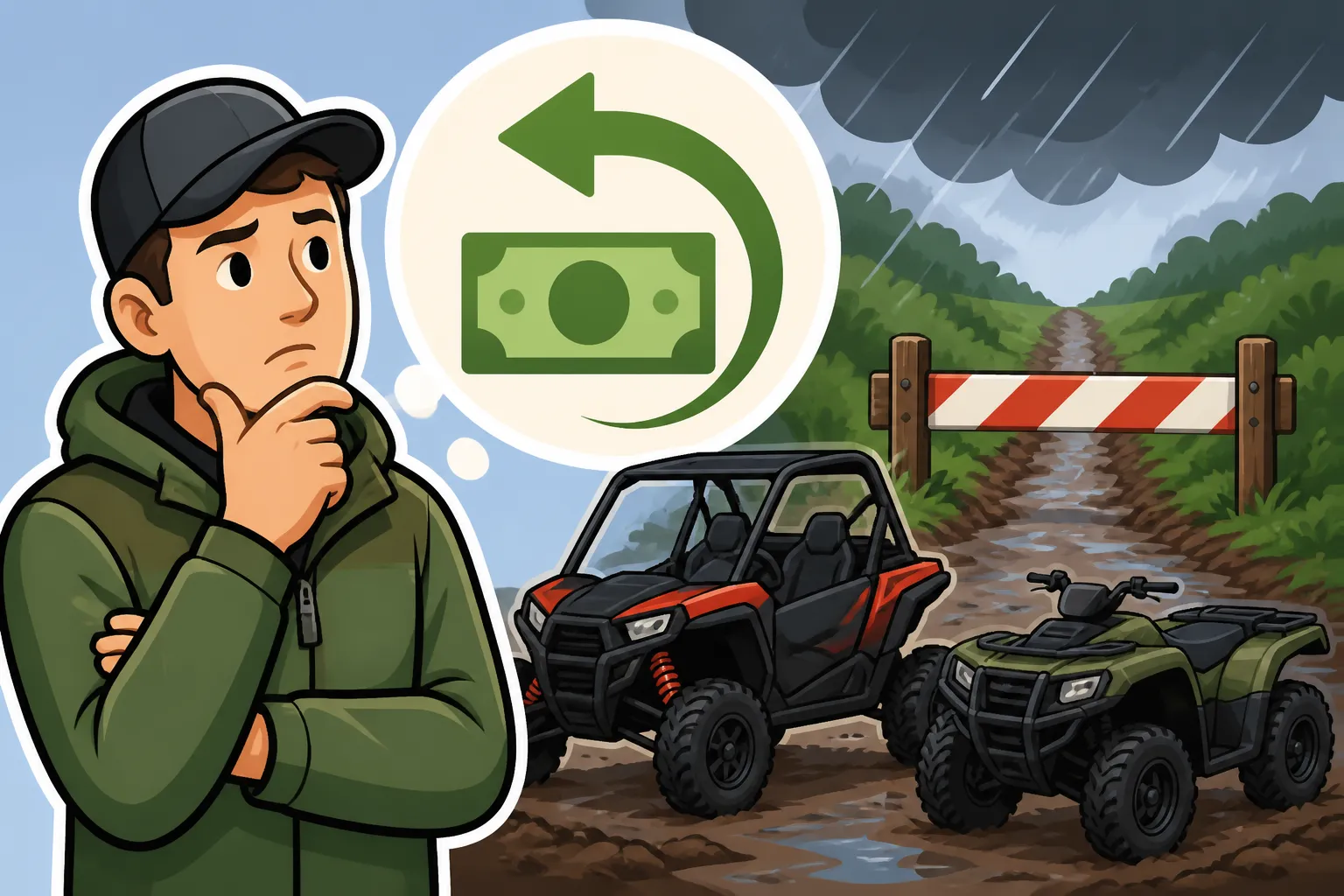
Do You Get a Refund When Rain Closes Trails?
A rainy forecast can turn a planned ATV or UTV trip into a long drive to a closed trailhead. Whether you get your money back depends on who collected the fee and what its weather policy says; Nebraska has no single refund rule covering every riding area. Here’s what to check before you leave, and what to do if trails close after you arrive.
Why a Rain Closure Does Not Automatically Mean a Refund
A trail closure and a refund are separate decisions. The manager may close a route to protect riders, prevent trail damage, or keep vehicles from getting stuck, without being required to return every fee paid for the visit. The outcome usually depends on the riding area’s policy, the type of payment, and when the closure happens.
That distinction matters because “the trails are closed” can mean different things. A whole riding area might be shut, or only certain routes may be off limits. A manager might close trails temporarily while leaving a staging area or campground open. In another case, the riding area may remain open, but conditions are too muddy for the kind of ride you planned.
A refund is more likely to be addressed explicitly when you paid a private park or event operator for a specific date, reservation, or admission. Even then, the operator’s posted terms determine whether it offers a refund, a rescheduled visit, or credit toward a later ride. A closure caused by weather does not necessarily trigger the same remedy as a closure initiated by the operator.
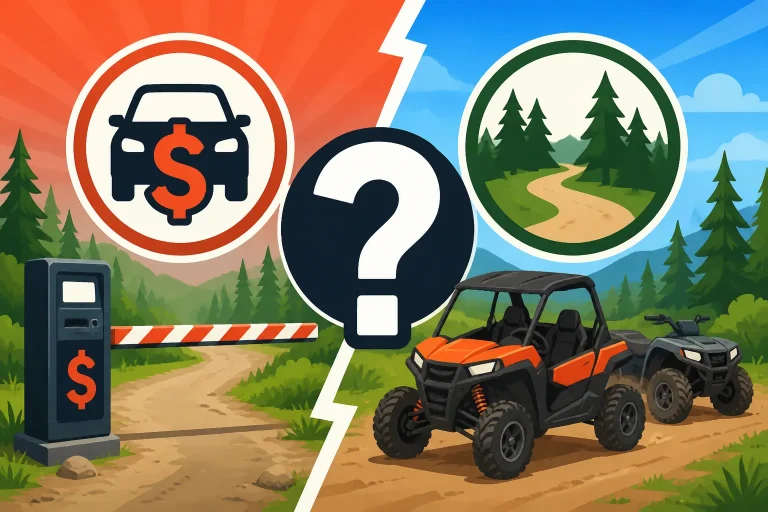
Public-land costs work differently. A parking fee, recreation permit, or campground reservation may be collected under rules that do not promise a refund when trails become unusable. The agency or site manager sets the terms for its own charge. Do not assume that a fee collected at one trailhead follows the same policy as a private park admission or a reservation made through a separate service.
Nebraska does not have one statewide ATV or UTV permit that guarantees access to every riding area. A state park entry permit, a parking fee, and a private park’s admission charge are not interchangeable. Check what each payment covers and who collected it before deciding whether a closure should result in a refund. For context on what permits do and do not provide, see Why a Park Permit Does Nothing for Your ATV.
How Refund Policies Differ by Riding Area and Fee
The first question to ask is not simply, “Are the trails closed?” It is, “What did I pay for, and which organization set the terms?” That helps you direct the request to the right place and understand whether the closure affects your purchase.
| What you paid for | Who sets the terms | What to check after a rain closure |
|---|---|---|
| Admission at a private riding park | The park operator | Its weather, closure, refund, and rain-check policy |
| A reserved riding date or event | The operator or event organizer | Whether cancellation, rescheduling, or credit applies |
| A campsite or cabin | The campground or reservation provider | The lodging cancellation terms, separate from trail access |
| Public-area parking or access | The managing agency or site | Whether the charge covers parking, access, or a specific activity |
| A permit or pass | The issuing authority or site | Whether it remains valid after the closure and whether refunds are allowed |
Private parks and organized rides
Private parks may set their own rules for weather closures, refunds, rain checks, and rescheduling. One operator may decide that a closure made before opening qualifies for credit; another may treat admission as nonrefundable once a reservation is confirmed. Some may close only particular trails and keep the facility open, which can affect whether the policy applies.
Read the rules before paying, especially if the visit requires a reservation or involves a group. Look for what counts as a closure, who makes the decision, how the operator will notify visitors, and what remedy is available. A waiver may address risks and rider responsibilities without explaining refunds, so do not treat the waiver as a substitute for checking the admission terms. Nebraska Private Park Waivers and Rules can help you understand why the waiver and the weather policy are separate questions.
For an organized ride, contact the organizer as well as the riding area if they are different. The park may control access while the organizer controls registration and event changes. Ask which party handles cancellations, and keep confirmation messages or receipts that show what you purchased.
Public areas, parking, and permits
On public land, the fee might be for parking or another form of access rather than a promise that every trail will stay open in all weather. A closure can therefore stop riding without automatically undoing a charge already paid. The refund or credit rules, if any, come from the agency or site responsible for the payment.
Do not assume a permit becomes refundable just because rain changes your plans. A permit may remain valid for its stated period even if you cannot use a particular visit, while a site-specific reservation may have separate cancellation terms. Confirm the distinction with the issuer or managing office. General information about fees and access is available in Nebraska Permit Questions Riders Ask, but the specific site’s current instructions should control your decision.
A closure notice may also apply only to a particular route or area. Check whether the entire riding site is closed, whether alternate trails remain available, and whether parking or camping is still open. If only some riding is restricted, the site may consider the facility open even if your preferred route is muddy.
Camping, lodging, and other bookings
A trail closure does not automatically cancel a campsite or lodging reservation. The campground may remain open even when riding is suspended, and its cancellation policy may be separate from the trail manager’s decision. If you booked a campsite near the trails, contact the campground directly and ask whether the closure changes your reservation or only your riding plans.
The same applies to rental equipment, guided rides, or other services booked through separate providers. Each business may have its own terms. Ask whether it will honor a cancellation, rescheduling, or credit, and get the answer in writing when possible.
What to Check Before You Leave Home
Weather can change quickly, and a forecast alone does not tell you whether a site has closed its trails. Make a short confirmation routine part of trip planning, particularly when you have prepaid or are towing a long distance.
- Check the riding area’s official status. Look for a current closure notice from the operator or managing agency. A general weather forecast is not a substitute for an actual status update. Nebraska Trail Closures After Rain explains why a site may restrict riding even when rain has stopped.
- Confirm what is closed. Ask whether the entire site is shut, only certain trails are closed, or whether access remains open with limits. Find out whether the staging area, parking, and campground are affected too.
- Read the terms tied to your payment. Check the receipt, reservation confirmation, event registration, pass instructions, and posted policy. Identify whether you paid for admission, a reservation, parking, or a permit.
- Ask what happens if the manager closes the site. Be specific: Does the policy allow a refund, credit, or date change? Does the answer depend on whether the closure is announced before arrival or after check-in?
- Find out how closure updates are delivered. Ask whether the site updates its website, social media page, phone recording, or reservation messages. Use the channel the operator identifies rather than relying only on an old post or a third-party listing.
- Save proof of the answer. Keep the receipt and any written message about a closure or refund. If an employee explains the policy by phone, note the time and the name or role of the person who spoke with you.
- Check other bookings separately. Contact the campground, rental company, or event organizer if someone other than the trail operator collected your payment.
A written policy is especially useful when you are coordinating several riders. Make sure the person who paid knows the terms and can access the confirmation. For a trip that depends on a reservation, Nebraska Riding Areas That Take Reservations is a useful starting point for planning, but always verify the specific operator’s current process.
If the site has no clear weather policy, ask before paying. Use plain questions: “If the park closes the trails because of rain, can I move my visit?” and “Does that apply if only some trails are closed?” Avoid relying on an assumption that a closure will be treated as a cancellation. A clear answer in advance can prevent a frustrating dispute after you have already made the trip.
What to Do If Trails Close After You Arrive
If you reach the site and find a closure, first confirm the scope and reason with the operator or site manager. Do not ride around a barricade or use an unmarked route to avoid the closure. Wet ground can be unstable, and riding through closed sections may damage trails or violate site rules. A posted closure should be treated as a safety and access restriction, not as an invitation to choose a route yourself.
Then ask what the closure means for the payment you made. Be calm and specific: identify the charge, when you paid it, and whether the whole site or only part of it is closed. Ask whether the operator offers a refund, credit, or date change under its policy. If you booked through a separate service or event organizer, contact that party too; the trail manager may not control the payment.
Keep records that make the issue easy to review. Save your confirmation, payment receipt, closure notice, and any messages you receive. If you are told that a refund or credit is available, ask how to request it and when to expect a response. If the policy says the payment is nonrefundable, you can still ask whether an exception or rescheduling option is available, but do not assume one will be granted.
If only some trails are closed, ask whether the remaining routes are suitable for your machine and skill level. A site being technically open does not mean the available riding is a good fit for every visitor. Check trail conditions and restrictions before unloading; Nebraska Trail Conditions Before You Tow can help you plan around access and surface conditions.
For future trips, treat the refund policy as part of the cost and access check, not a detail to sort out after rain arrives. Confirm the closure source, know which organization took your payment, and keep a backup plan if the ride is the main reason for the trip. If the policy is unclear, getting an answer before you leave is usually easier than trying to settle the issue at a closed gate.
Disclaimer
This article is for general informational purposes only and does not constitute professional advice. Laws, prices and regulations vary by location and change over time. Consult a qualified professional for guidance on your specific situation.