Reserving a Campsite Before a Riding Weekend
A campsite can look close to a Nebraska riding area on a map and still leave you with a long drive, the wrong kind of site, or no legal route to the trail. Reserve the site and check access together. A little preparation helps you avoid towing to a campground that cannot accommodate your rig or assuming a reservation includes riding permission.
Match the campsite to the riding area
Start with the riding area, not the campsite search. Identify where you plan to ride, then look for camping options that fit the route, your equipment, and the way you want to spend the weekend. “Nearby” can mean very different things on a road map than it does when you are towing a trailer and making repeated trips between camp and trail.
Nebraska has public and private riding areas, and their camping arrangements differ. Some places have campgrounds or designated camping nearby; others may require you to stay elsewhere and drive to the trailhead. Before booking, confirm that the riding area will be open for your planned dates and that camping is permitted at the location you have in mind. The overview of Nebraska OHV Camping With Trail Access can help you think through the relationship between a campsite and a place to ride.
For example, riders considering Bessey OHV Trails at Halsey in Nebraska should check camping options and current access details separately from trail information. The same principle applies to a trip around Cedar Run ATV Trail in Nebraska: knowing where the trail is does not by itself establish where you can camp, park, or leave a trailer overnight. For more nearby options, compare Nebraska Campgrounds Next to a Riding Area with the specific campground’s own rules.
A campsite reservation is permission to occupy a particular site under the campground’s conditions. It usually does not grant access to a trail, authorize riding across land between camp and the trailhead, or replace a permit required for a park or recreation area. Plan to transport your machine to a legal riding area unless the land manager or campground confirms a permitted connection.
| What to check | Why it matters | What to confirm before reserving |
|---|---|---|
| Distance to the riding area | A short map distance can still mean a long towing route | Driving time, road access, and where to park at the trailhead |
| Trail access from camp | A nearby campground may not connect legally to the trail | Whether riding from the site is expressly allowed |
| Site dimensions | A machine, trailer, and tow vehicle all need space | Length, width, surface, and whether extra parking is available |
| Camping type | Tent, electric, and other sites can have different rules | The equipment allowed at the specific site |
| Dates and operating conditions | Access or facilities can change with weather or seasonal operations | Open dates, closures, and check-in arrangements |
| Fees and permits | A reservation may not include other required charges | Which costs are included and what must be paid separately |
Keep your search focused on the actual site, not just the campground name. A campground can offer different site types, and a listing for one may not accommodate a long trailer or multiple vehicles. If you are traveling with a group, each person’s reservation may be separate, and the group might not be placed together automatically.
Confirm site fit, reservation rules, and backup options
Before you pay or finalize a booking, make sure the site works for the whole setup. Consider the length of the tow vehicle and trailer together, not just the length of the camper or tent area. Check whether the site has a firm, level surface and whether there is room to unload without blocking a road, neighboring site, or shared parking area. If site dimensions are unclear, contact the campground rather than guessing from a map.
Ask about the details that can turn a convenient reservation into a frustrating arrival:
- Is the site suitable for your type and length of vehicle or trailer?
- Can a second vehicle or trailer park at the site, or is separate parking required?
- Is there room to unload and secure the ATV or UTV?
- Are hookups available at the particular site, if you need them?
- Are there limits on generators, quiet hours, fires, or pets?
- What are the check-in and check-out procedures?
- What happens if weather, a trail closure, or a vehicle problem disrupts the trip?
- Can the reservation be changed or canceled, and what conditions apply?
Policies, availability, and costs vary by campground. Check the campground’s current information before booking, and save the confirmation along with any instructions for arrival. If a private campground is part of your plan, read its rules as carefully as the trail rules. A campground can set its own requirements for riders and vehicles; Nebraska Private Park Waivers and Rules offers useful context for questions to ask.
For public camping, check which agency manages the site and what its reservation system covers. A booking may secure a campsite but not necessarily a particular view, neighboring sites, trail access, or all required vehicle permits. Avoid relying on an old screenshot or a third-party description for operating details that may change. Confirm your dates, site number, arrival process, and any separate permit requirements through the responsible campground or agency.
Have a backup plan, especially if the trip depends on a busy weekend or a specific trail area. A sensible backup is another campground you have checked for site fit and driving distance, not merely a list of places found after the first booking falls through. Consider whether you could move the ride to another day or area if trail conditions change. Check Nebraska Trail Conditions Before You Tow close to departure, and make sure your alternate destination is actually open and suitable for your machines.
If the campground cannot tell you whether your trailer fits, or whether you can leave a machine there overnight, get a clear answer before you reserve. A brief phone call or written confirmation is more useful than trying to settle a site-rule question after arriving with a loaded trailer.
Keep campground reservations separate from permits and riding permission
Nebraska does not have a general state OHV sticker that turns a campsite reservation into permission to ride. The campground, the land manager, and local rules can each affect what you may do. Treat them as separate checks: where you will sleep, where you may ride, and what permits or permissions apply to the vehicle or land.
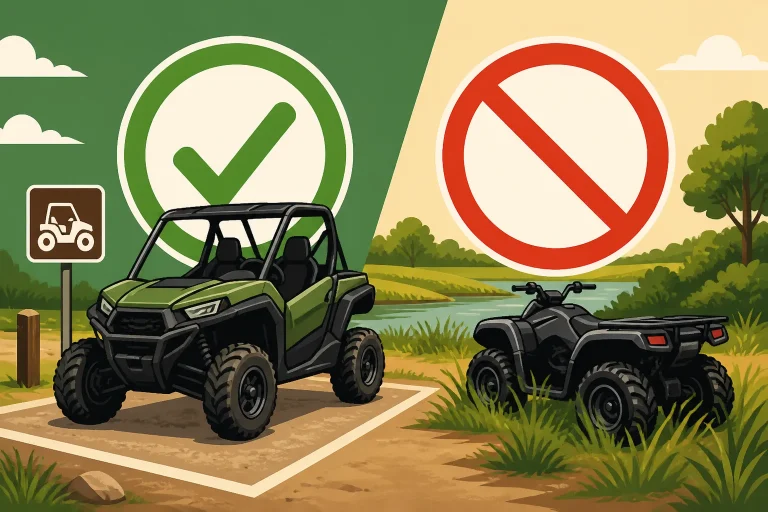
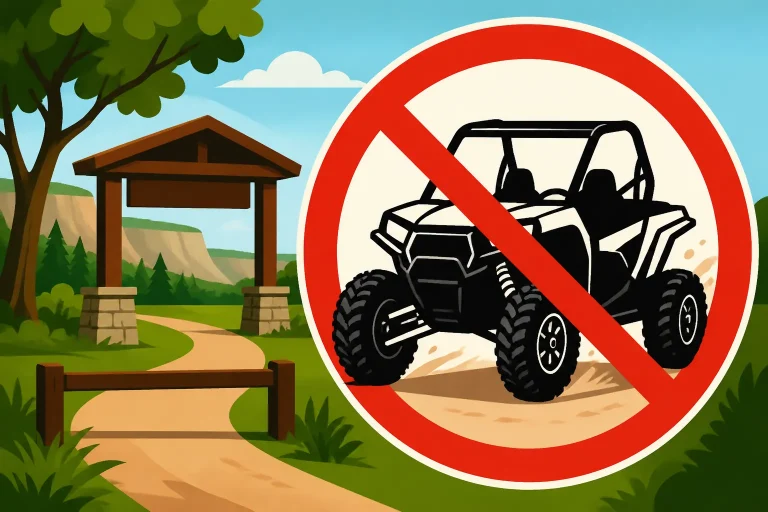
A state park or recreation-area entry permit is not the same as authorization to ride an ATV or UTV on trails there. Nebraska state parks do not allow ATVs, so do not book a state park site on the assumption that you can ride out from camp. You may be able to camp there and transport your machine to a separate legal riding area, but confirm access, parking, and applicable entry requirements before making that plan. See Nebraska State Park Entry Permits for the permit distinction, and Nebraska Parks Closed to ATVs for the riding restriction.
Permit rules can also depend on the destination and the vehicle used to enter it. If you are camping at a public recreation area, find out whether the permit applies to the tow vehicle or another vehicle, where it must be displayed, and whether the reservation includes it. Do not assume that an ATV’s title, a license plate from another state, or proof of an out-of-state registration substitutes for a site permit or permission to ride. For background, Nebraska Has No OHV Permit or Sticker and Nebraska Visitors Need No State Sticker address the state-level OHV sticker question; the specific campground and land rules still matter.
Private riding parks may have their own admission process, waivers, age requirements, and vehicle or passenger rules. A campsite reservation at a nearby business or campground does not automatically buy access to the riding park. Check both places’ requirements, including whether the riding park allows overnight parking or camping at all. If you are unsure which authority controls a particular property, ask the campground or land manager rather than relying on a map label.
For out-of-state visitors, make a short list of what each stop requires. A state permit, campground reservation, riding-area admission, and local rules are separate items. Confirm requirements for the actual destination instead of assuming that a permit or registration accepted somewhere else will be recognized. Nebraska Rules for a Visiting Iowa Rider and the corresponding visitor information for other neighboring states can help clarify the state-riding context, but they do not replace the destination’s current instructions.
Make the reservation part of your trip checklist
Once you have a site, organize the remaining details around arrival and trail access. Keep the reservation confirmation available offline in case cell service is weak. Write down the campground’s address, entrance or check-in instructions, site number, and a contact method. If you expect to arrive late, find out whether the campground requires advance notice or has a specific late-arrival procedure.
Then confirm the trailhead plan. Check whether the machine must be unloaded at a designated staging area, whether the tow vehicle can remain there, and whether the route between camp and trailhead is suitable for your trailer. Do not ride on a public road or across private land just because it appears to connect the campground to a riding area. Get landowner permission where needed and follow posted access restrictions.
A practical sequence is:
- Choose the riding area and check its operating status for your dates.
- Identify campgrounds that are legally and practically close to that area.
- Confirm site dimensions, parking, equipment rules, and arrival instructions.
- Ask what the reservation includes and what permits or fees are separate.
- Book the site and save the confirmation and cancellation terms.
- Check trail conditions, weather, and access again before departure.
- Bring the contact details for the campground and riding-area manager.
Before leaving home, review Nebraska Trail Etiquette Locals Expect and any rules posted by the specific trail or campground. Respect quiet hours, keep trailers out of shared access routes, and avoid riding in areas marked closed. If a site or trail is unsuitable when you arrive, contact the responsible staff rather than improvising a new route or parking arrangement.
The best reservation is not necessarily the closest site or the one with the most amenities. It is the one that fits your vehicle and trailer, complies with campground rules, and gives you a clear, lawful way to reach the place you intend to ride. Verify those details before you tow, and keep lodging, permits, and trail access as separate pieces of the plan.
Disclaimer
This article is for general informational purposes only and does not constitute professional advice. Laws, prices and regulations vary by location and change over time. Consult a qualified professional for guidance on your specific situation.