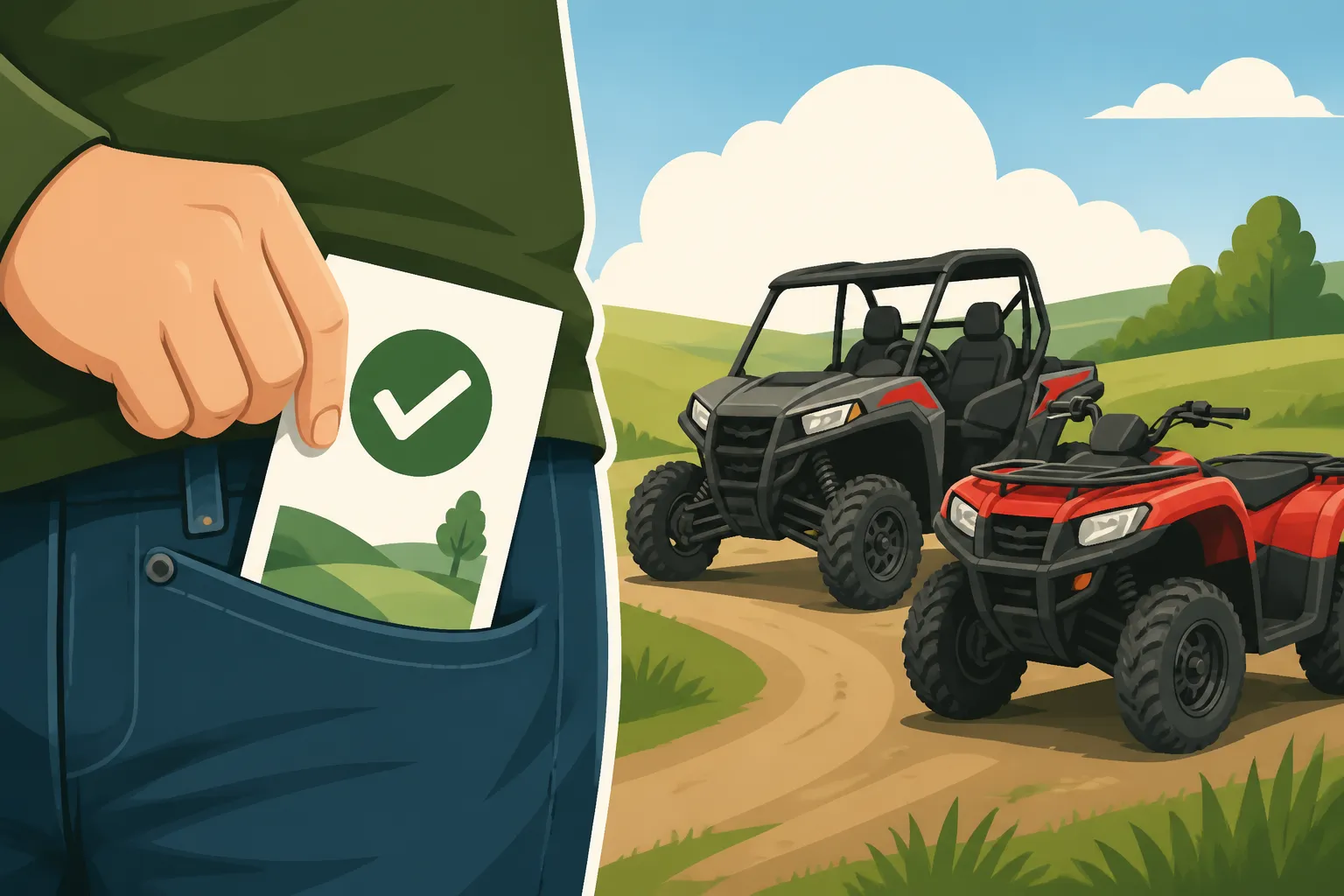
Carrying a Landowner’s Written Permission in Your Pocket
A friendly nod from a landowner can feel like permission to ride, but it is easy for details to get lost once you leave the driveway. A short written note helps you remember where you may ride, when access ends and which machines are covered. Here’s how to make that permission useful in Nebraska—and what it does not authorize.
What written landowner permission does and does not do
When a Nebraska landowner invites you to ride on private property, a written record can prevent misunderstandings. It can show that access was granted and clarify its limits if you are stopped, meet another person managing the property or return on a different day.
That does not mean Nebraska requires every ATV or UTV rider to carry a particular permission form. Nor does a note make riding lawful everywhere. It records an agreement between you and the person who controls the land; it does not replace other applicable rules, permits, licenses, insurance or road-use requirements.
For practical purposes, think of written permission as a clear, portable record of the landowner’s agreement—not as a pass that overrides signs, boundaries or public-land rules.
| A written permission note can help document | It does not automatically authorize |
|---|---|
| Who granted access and who may ride | Entry onto land outside the area described |
| Which property or route is included | Riding on public land or a neighboring parcel |
| Approved dates, hours and machines | Riding on a public road |
| Limits on passengers, guests or activities | Hunting or other activities not specifically allowed |
| Instructions for gates, parking and contact | Ignoring posted closures or safety requirements |
Permission matters most when the boundaries or conditions could be unclear. A large farm or ranch may include several parcels, leased ground, access lanes and areas that the owner wants kept off-limits. A rider who has permission for one pasture should not assume it covers every field with the same owner’s name on the fence.
The note is also useful when the landowner is not present. A farm employee, tenant or neighbor may see a machine and reasonably ask why it is there. Being able to show a clear record can help explain the arrangement without relying on a vague recollection or a text conversation that is difficult to find.
For general access principles, see Nebraska Landowner Permission Rules. If you are riding around working land, Nebraska Rules for Riding Farm Ground can help you keep permission separate from the rules that apply to the activity and location.
Permission is limited to what the landowner controls
A landowner can give permission only for property or access they have authority to manage. If a route crosses another owner’s field, a public right-of-way, a leased parcel or land managed by an agency, one person’s permission may not cover the whole trip. Ask where the permission begins and ends, especially if the route follows a fence line, drainage, road or trail.
Permission is also limited by its stated purpose. Approval to ride a machine does not necessarily include approval to hunt, camp, bring guests, build a fire or use a different route. If you want to do more than ride, ask specifically and record the answer. For hunting access questions, Nebraska Hunting Land Access by Machine is a useful related topic.
A written note cannot turn a closed trail or restricted public area into an authorized route. In particular, do not treat access to private land as permission to continue onto a wildlife management area, state recreation area or other public property. Check the rules for that land separately. Nebraska Walk-In Access Land Rules explains why access programs and private invitations should not be treated as interchangeable.
Permission does not make a road trip legal
Private-property permission is not road permission. If you need to travel on or cross a public road to reach the property, check the rules that apply to that specific road and trip. Nebraska’s road-use requirements are separate from an owner’s agreement to let you ride on private land. Start with Can You Drive an ATV on the Road in Nebraska? if your plan includes public-road travel.
Likewise, a written note does not replace ownership paperwork. If an officer or land manager asks for proof that a machine belongs to you, permission to ride someone else’s property is not proof of ownership. Keep the relevant machine documents separate and review Nebraska Proof of Ownership on the Trail if you are unsure what to carry.
What to put in a useful permission note
There is no advantage to making a simple note sound like a contract. The goal is to make the agreement understandable to both the rider and the landowner. A short, specific record is more useful than a long document full of vague phrases such as “ride anywhere” or “come by sometime.”
At a minimum, write down who is granting permission, who is receiving it and what property or route it covers. Add the dates or time period, the machines allowed and any limits the landowner has set. If access depends on conditions—such as staying on a marked trail, avoiding livestock or calling before each visit—include those conditions plainly.
A practical note can include:
- Landowner or authorized contact: Full name and a reliable way to contact them.
- Rider or riders: Names of the people allowed to enter. Do not assume permission for one rider automatically covers a group.
- Property description: A street address, parcel description, directions or a clear description of the entrance and riding area.
- Approved route or boundaries: Trails, fields or access lanes that are allowed, plus places to avoid.
- Machines: ATV, UTV or other vehicle types covered. Include any size or passenger limits the landowner wants.
- Purpose: For example, recreational riding, checking a route or another activity the owner has agreed to.
- Dates and hours: When permission starts and ends, and whether the owner expects a call before each visit.
- Conditions: Gate instructions, parking location, speed limits, livestock precautions, guest limits and any other property-specific rules.
- Confirmation: The landowner’s signature or another clear record that they approved the terms.
Avoid recording more personal information than needed. A phone number can make it easier to check a question or report a problem, but the note does not need sensitive details unrelated to access.
Be precise about the property and route
“Permission to ride on the ranch” may sound clear to the person who owns the land, but not to a visitor who does not know the fences, leases or access roads. Ask the landowner to identify the approved entrance and route. If a map is helpful, mark the permitted area and clearly distinguish it from neighboring ground or restricted sections.
Do not assume that a gate is an invitation. It may serve as an access point for farm work, or the road beyond it may cross land the person you spoke with does not control. Ask where to park, which gate to use and whether gates should be left open or closed. Leave them as directed, and do not create a new route around a locked gate or barrier.
If the landowner gives permission verbally first, follow up with a short text or note that repeats the important terms. Ask them to confirm that you have understood correctly. A message such as “Thanks for confirming that I can ride the marked trail on Saturday, and that the north pasture and livestock pens are off-limits” is clearer than a generic “Thanks for permission.”
For more detail on asking for access, see Getting Written Permission From a Ranch Landowner. If signs or boundaries are part of the arrangement, Reading Posted Signs on Ranch Land Before You Ride can help you avoid treating an old or ambiguous invitation as permission to cross a marked restriction.
Keep the permission current
A note from last season may not reflect this season’s boundaries, land management or ownership. Before each trip, check that the permission still applies. Ask again if the property has changed hands, the landowner has leased part of it, the usual route is closed or the agreed dates have passed.
If the landowner changes the conditions, update your copy rather than relying on a secondhand summary. A new instruction might limit the group size, close a pasture while livestock are present or require riders to use a different entrance. Make sure everyone riding with you gets the updated information.
How to carry and use permission on a ride
A permission note only helps if you can find it when you need it. Carry it in a place that is accessible but protected from rain, mud and wear. A folded copy in a waterproof sleeve works; some riders use a document pouch or small dry bag. If you shop for a sleeve on Amazon, choose one that fits the paper without forcing you to unfold or damage it. A purchased pouch is optional—the important part is keeping the permission readable and available.
Keep a backup photo or saved copy on your phone, but do not rely on a phone alone. A device can lose power, break or have no service. A paper copy is useful in those situations. Conversely, a paper copy can be lost, so a digital backup can help you recover the details or contact the landowner.
Before setting out:
- Confirm that the permission is still valid. Check the date, the approved area and any requirement to call ahead.
- Tell every rider the conditions. A guest should know where to enter, where not to ride and what to do with gates.
- Check the route. Make sure it does not quietly extend onto another parcel, public land or a road where separate rules apply.
- Carry the permission with your other documents. Keep it easy to reach, but secure enough that it will not blow away or get soaked.
- Have a contact plan. Save the landowner’s number and know how to reach them if you discover a blocked route, livestock issue or other problem.
If someone asks why you are on the property, stay calm and explain the arrangement. Show the note if appropriate, identify the landowner or contact person and follow any reasonable instruction to stop or leave while the situation is checked. Do not argue that the paper gives you a right to continue if the person managing the property tells you access is not allowed.
A note should not be altered to cover new riders or new dates without the landowner’s approval. If friends join, ask whether they are covered and record their names or the group terms. “I’m allowed to ride here” does not necessarily mean “my entire group is allowed to ride here.”
If the landowner wants to change or end access, treat that as a change in permission. A document is useful evidence of the terms that were agreed, but it is not a reason to ignore a clear instruction from the person controlling the property. Leave by the agreed route and follow up later if you need to clarify what happened.
For rides that involve public property or trailheads, do a separate rules check. Private landowner permission does not satisfy public-area requirements. See Nebraska Proof of Ownership on the Trail for a related document question, and Nebraska Ordinance Lookups Before You Ride if your route may involve a city or village with local rules.
Common mistakes to avoid
A written note is most helpful when it reflects the actual agreement. These common shortcuts can create trouble even when the landowner intended to be helpful.
Assuming permission covers neighboring land
A property may look like one continuous block, but ownership and control can change at a fence, road or waterway. Ask the landowner to identify the exact area covered. If you cannot tell whether a route crosses onto someone else’s property, stop and check instead of assuming.
Treating a casual invitation as unlimited access
Permission may be for one day, one machine or one specific activity. Do not interpret “come ride sometime” as permission to bring a group whenever you choose. Confirm the details, particularly if a long time has passed or the landowner is not present.
Forgetting guests and passengers
Permission for you does not necessarily include friends, family members or additional vehicles. Confirm how many people may come and whether passengers are allowed on the machine. Make sure each rider understands the route and property rules.
Using the note as a substitute for other requirements
A landowner’s note is not an ATV title, an insurance policy, a public-land permit or a road-use authorization. Each requirement serves a different purpose. Keep documents organized so that you do not mistake one form of permission or proof for another.
Ignoring signs or changing conditions
The landowner may post a closure, close a gate or ask riders to avoid an area after the note was written. Follow current instructions. If a sign conflicts with what you understood, contact the landowner before riding through.
Carrying a vague or unreadable copy
A permission slip that says only “OK to ride” may not answer basic questions about who is included or where access is allowed. A soaked, faded or crumpled note is not much better. Make a legible copy and keep a backup, but do not add new terms on your own.
The best permission note is simple, specific and current. Ask the landowner to describe the property, route, dates and conditions; carry a readable copy; and treat every other legal or land-access rule as a separate question. That approach makes the agreement easier to follow and helps keep a welcome invitation from turning into an avoidable boundary dispute.
Disclaimer
This article is for general informational purposes only and does not constitute professional advice. Laws, prices and regulations vary by location and change over time. Consult a qualified professional for guidance on your specific situation.