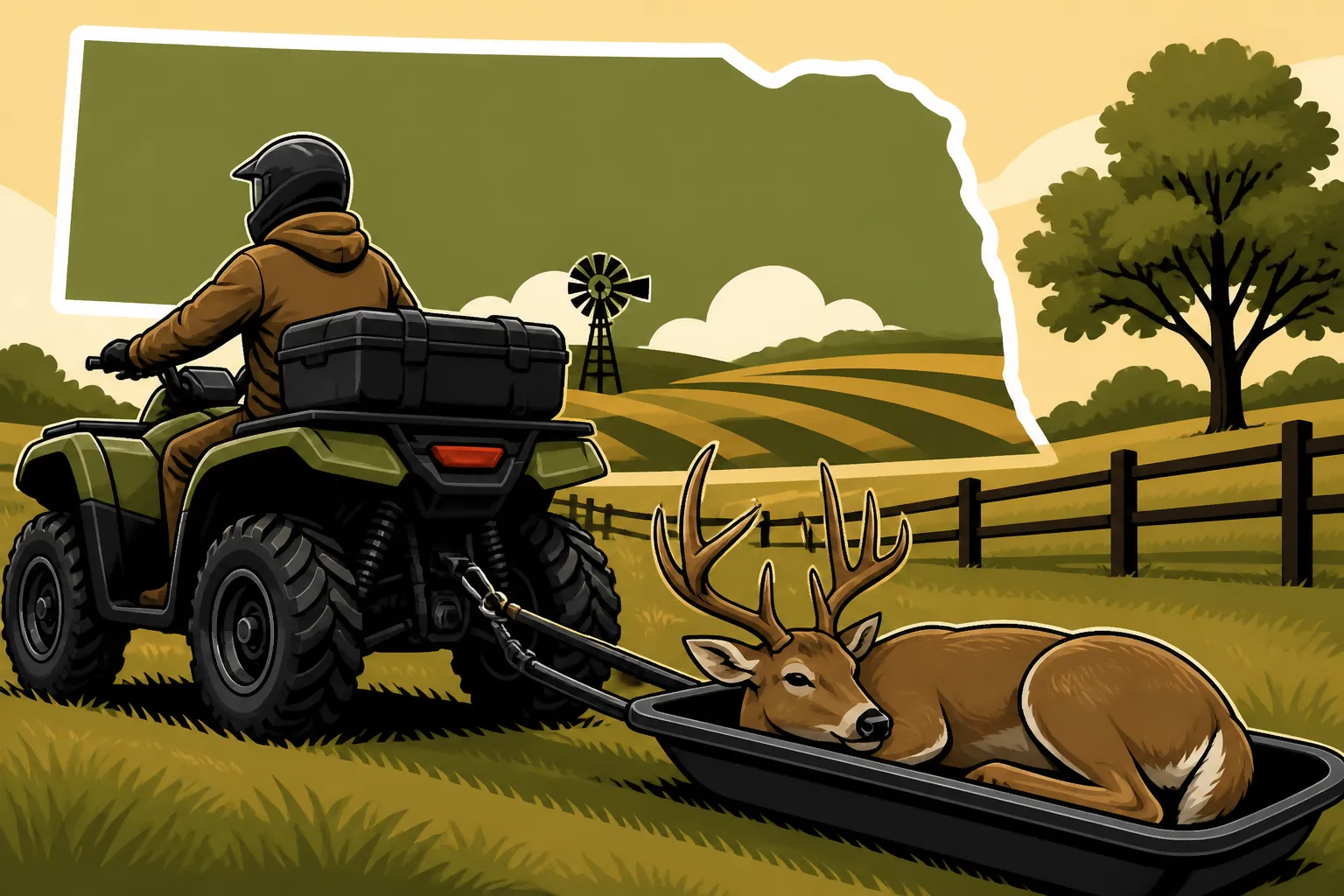
Using an ATV to Retrieve a Deer on Pasture
Retrieving a deer from pasture with an ATV can save time and effort, but a hunting license does not automatically give you permission to cross someone’s land or drive wherever you need. The key is to separate access permission from hunting and vehicle rules, then agree on a route before the machine leaves the trail or road.
Get permission for the machine, not just the hunt
Permission to hunt and permission to drive an ATV are related, but they are not necessarily the same thing. A landowner might allow you to hunt on foot while limiting motorized travel to a farm lane, or might approve ATV use only for a specific retrieval after the deer is down. Ask before riding, and be clear about the purpose and route.
Nebraska’s hunting license does not grant access to private pasture. Nor does permission to enter a property necessarily mean permission to use a motor vehicle across it. For background on how those permissions differ, see Nebraska Hunting License and Land Access and Nebraska Landowner Permission Rules.
Before the hunt, ask the landowner or the person who controls the property:
- May you use an ATV or UTV to retrieve a harvested deer?
- Which gates, lanes, or parts of the pasture may you travel?
- Is off-lane travel allowed, or must you stay on established tracks?
- Are there areas to avoid, such as wet ground, crops, livestock, or sensitive habitat?
- May a passenger come along to help with the recovery?
- Should you call or text before entering and after leaving?
- Are there limits on the time of day or the machine you may use?
If permission is limited to retrieval, treat it that way. Don’t use the trip as an opportunity to scout, pursue another animal, or explore other parts of the ranch. If the landowner’s directions change, stop and get clarification rather than guessing.
It can help to get the route and limits in writing, especially when several people manage the property or different hunters have separate permissions. A text message can record the agreed route and purpose, but it does not replace any permission required by law. Getting Written Permission From a Ranch Landowner covers what to clarify, and Carrying a Landowner’s Written Permission in Your Pocket offers a practical way to keep the details available in the field.
| Situation | What to confirm before riding |
|---|---|
| Deer is on private pasture | Permission to enter and use the ATV for retrieval |
| Landowner allows hunting but has not discussed vehicles | Whether motorized retrieval is permitted, and where |
| Deer is near a boundary or on another parcel | Permission from the person who controls that land |
| Retrieval route uses a public road | Whether the machine may legally use that road |
| Deer is on public hunting land | The area’s vehicle and game-retrieval rules |
| Permission is limited to a lane | Whether leaving the lane is allowed to reach the deer |
The landowner’s permission is especially important if the deer crosses a fence or property line before it is recovered. Don’t assume the permission for one parcel carries over to the next. Identify the property boundary and contact the neighboring landowner or property manager before entering. If you cannot confirm access, ask for help instead of riding across the boundary.
Check hunting rules and the exact recovery location
A machine used after a deer is harvested is not automatically exempt from hunting rules. The applicable requirements can depend on where the animal is, how the machine is being used, the season, and the rules for that property. Before the hunt, check current Nebraska Game and Parks hunting regulations and ask the relevant land manager about any site-specific restrictions. Pay particular attention to rules about motor vehicles, access routes, and retrieving game.
This distinction matters on public land. A rule that allows a machine on a designated roadway does not necessarily allow it to travel cross-country to reach a downed deer. Nebraska Wildlife Management Areas have vehicle restrictions, and access may be limited to designated roads or other specifically allowed locations. Review Nebraska WMA Vehicle Rules and Nebraska WMA Designated Roadways Only before planning to use an ATV on a management area.
The same caution applies to other public properties. Land managers may set rules that differ from those for private pasture, and a road or trail open to one type of vehicle may not be open to an ATV or UTV. Confirm the rules for the exact unit or property rather than relying on a general understanding of where machines are usually allowed. A hunting license or a park permit does not, by itself, authorize motorized travel wherever you want; Why a Park Permit Does Nothing for Your ATV explains that distinction.
On private pasture, landowner permission does not erase hunting regulations. Follow the rules for tagging, transporting, and possessing the deer, and make sure the animal was taken legally before arranging the recovery. If there is uncertainty about how a particular rule applies to a motorized retrieval, ask Nebraska Game and Parks or the property manager before the hunt. Don’t wait until the deer is down and the machine is already moving to resolve a question that could have been checked ahead of time.
Also consider how you will reach the pasture. Riding over private ground is different from riding along a county road or crossing a highway. If your route includes a public road, check the separate road-use requirements first; Nebraska Rules for Riding a County Road and Nebraska Rules for Crossing a Highway address those situations. A route that is allowed across a pasture with permission may still be unlawful on a public road.
Plan a low-impact retrieval route
A short conversation before the hunt can prevent damage to pasture and conflict with the landowner. Agree on a route from the nearest practical access point to the recovery area, and use established tracks where possible. Don’t cut across wet ground, planted fields, or areas the landowner has asked you to avoid. An ATV can leave ruts quickly when the soil is soft, even when the distance seems short.
Check conditions before you ride. Recent rain, snowmelt, irrigation, or a steep slope can turn a familiar track into a damaging or unsafe route. If the ground is saturated, ask whether the landowner would rather you wait, use a different route, or recover the deer by hand. Protecting the property is part of honoring access permission. Reading Posted Signs on Ranch Land Before You Ride is also useful when signs or gates mark boundaries and restrictions.
Keep the recovery focused and controlled:
- Confirm the animal’s location and the route with the landowner or property contact.
- Make sure the machine is appropriate for the terrain and the load. A passenger, cargo, or trailer can affect handling and stopping distance.
- Ride slowly, avoid sudden turns, and leave room around livestock, people, and other hunters.
- Stay on the agreed route. If the route is blocked or conditions are worse than expected, stop and ask before making a new one.
- Secure the deer and any equipment before moving. Keep the load balanced, visible, and within the machine’s capacity.
- Close gates as instructed and tell the landowner when you are out.
If you need a winch or another recovery aid, use it only when you know how to operate it safely and the landowner has approved the plan. Don’t pull from a fence, gate, tree, or other object without permission and a safe setup. A difficult recovery is a reason to pause and reassess, not to push the machine beyond its limits.
Prepare for the return trip and keep access in good standing
Before bringing an ATV to the property, make sure it is in suitable condition. Check the tires, brakes, lights, fuel, and tie-down or cargo equipment you expect to use. Carry what is needed for the trip, but avoid making the machine so heavily loaded that it becomes hard to steer or stop. If the deer will be carried on the ATV, follow the machine manufacturer’s load guidance and keep the animal secured so it cannot shift into the wheels or controls.
Use safe handling practices around the animal and the machine. Park on stable ground, shut off the engine before loading, and keep hands and clothing away from moving parts. If another person is helping, agree on who controls the ATV and who handles the load before anyone starts moving. Don’t let a passenger ride in a position that interferes with the driver’s control or creates an unstable load.
After the recovery, follow current requirements for the deer’s tag and transport. Keep required documentation with the animal, and don’t assume that permission to retrieve it also settles questions about tagging or possession. If you are unsure what must accompany the deer or how a rule applies, confirm with Nebraska Game and Parks.
Leave the property as you found it: close gates, avoid disturbing livestock, remove litter, and let the landowner know if you encountered a damaged fence, rut, or other problem. A quick, honest update can help preserve access for future hunts. If the deer cannot be reached without leaving the agreed route, crossing onto another property, or damaging the pasture, pause and get permission for a different plan.
The simplest approach is to settle the details before hunting: who may ride, where the ATV may go, what to do if the deer crosses a boundary, and which rules apply to the land where it falls. Treating permission, hunting regulations, and vehicle access as separate checks makes retrieval safer and reduces the chance of turning a successful hunt into a dispute.
Disclaimer
This article is for general informational purposes only and does not constitute professional advice. Laws, prices and regulations vary by location and change over time. Consult a qualified professional for guidance on your specific situation.