Nebraska Private Park Age Minimums
Nebraska Private Park Age Minimums
A child may be old enough to ride an ATV but still not meet a private park’s admission rules. Nebraska does not give every private riding park one shared age cutoff, so families need to check the individual park’s minimums, supervision rules, waiver process and machine limits before towing out. The practical answer is to verify each rider’s eligibility directly with the place you plan to visit.
Who Sets Age Minimums at a Private Riding Park?
A private riding park can set entry conditions for its property, including minimum ages for riding, supervision requirements and rules for passengers. Those policies may differ from one facility to another. A child who can ride at one park may not be admitted to another, even if both parks are in Nebraska.
There is no single private-park age chart that applies statewide. A park may use different minimum ages for different activities or machines, and it may revise its rules. Check the park’s current written policy rather than relying on a friend’s past visit, an old social media post or a general claim about Nebraska law.
It helps to separate three questions:
- May the child enter the property? A park can set admission rules for minors.
- May the child ride a particular machine or trail? The park may have a separate age threshold or equipment restriction.
- May the child ride without an adult alongside? Supervision rules may depend on age, vehicle type or the park’s own policy.
The answers do not necessarily match. A park could allow a young rider on a small machine only with an adult supervising, while setting a higher age for independent riding or for a larger vehicle. Another park could use one minimum age for all riders. Ask what each rule means instead of treating “minimum age” as a complete description.
A private park’s policy is also not the same thing as a statewide road-use rule. A park may allow an age group to ride on its private trails, but that does not automatically authorize the same child to operate the machine on a public road. Likewise, a rule that applies to public land or a road does not automatically become the private park’s admission policy. For road-use questions, see Nebraska ATV Age Requirements and Nebraska Rules for a Teen Rider.
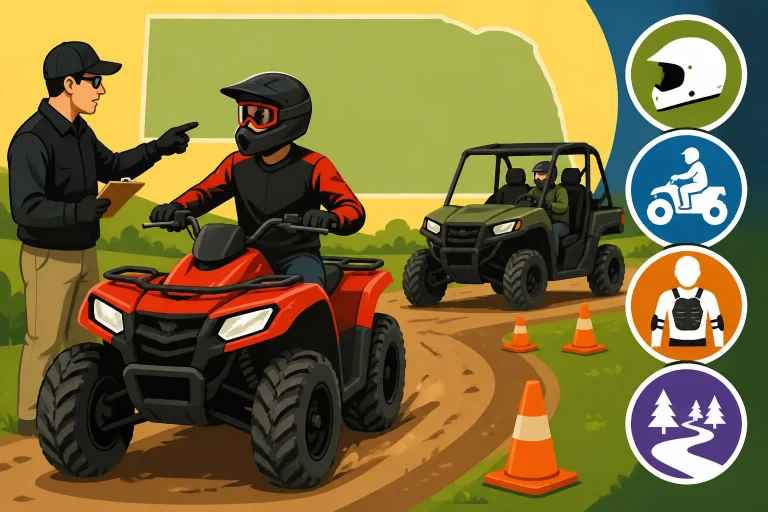
Nebraska does not require every ATV rider to complete a statewide safety course, but that does not prevent a private park from requiring training, an orientation or a demonstration before a minor rides. A park may also decide not to admit a rider who does not meet its own safety conditions. The distinction is important: a general state requirement and a venue’s admission policy are separate things. See Nebraska Has No Mandatory Safety Course for the statewide course issue.
Age, Supervision and the Machine Being Ridden
The number on a child’s birthday is only one part of a park’s decision. A facility may consider whether a rider can control the machine, what type of vehicle the rider will use, whether an adult is present and where the rider intends to go. Policies can be written as a simple age cutoff, or they can combine several conditions.
Admission age is not always riding age
Some parks may allow a minor onto the property with a parent or guardian but restrict which activities the minor can take part in. Do not assume that permission to enter means permission to ride. Confirm whether the age rule covers:
- Entry onto the property
- Riding on designated beginner areas
- Riding on all trails
- Riding independently
- Riding a side-by-side as a driver
- Riding as a passenger
- Participating in an organized event
If the park uses separate age rules, ask for the minimum that applies to the child’s planned activity. “Can my child come with us?” is not as useful as “Can my child ride this machine on this part of the property, and what adult supervision is required?”
A parent nearby may not meet the supervision rule
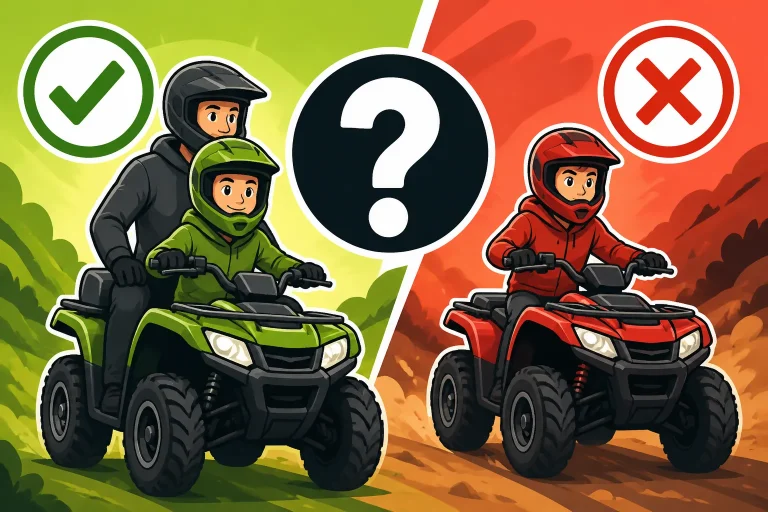
“Adult supervision” can mean different things. One park may expect an adult to stay with the child on the trail. Another may require the adult to ride along, follow in a separate vehicle or remain within a specified area. A parent waiting at the campsite or parking lot may not count as supervision if the park expects the adult to be physically present during the ride.
Ask who qualifies as the supervising adult, how close that person must remain and whether the adult must ride. If a child is riding with a group, confirm whether the park allows another responsible adult to supervise or requires a parent or legal guardian.
Do not assume an adult can supervise from a different machine if the park has not said so. A child who needs help may be difficult to reach quickly on a crowded trail, and the park may have a specific policy for keeping minors with adults.
Machine type and size can change the answer
A park may distinguish among youth ATVs, adult-sized ATVs and side-by-sides. Even when a child meets an age threshold, the park may require the child to use an appropriate machine or stay within a designated area. Ask whether there are separate rules for vehicle type, engine size, seating capacity, trail width or passenger position.
A youth quad and a side-by-side are not interchangeable simply because both are off-highway vehicles. A facility may permit a child to operate one but not the other, or may set a higher driver minimum for a side-by-side. It may also require a child to be a passenger rather than a driver. See Nebraska Private Park Minimum Ages for related questions about how age cutoffs can be structured.
| Question to confirm | Why it matters |
|---|---|
| What is the minimum age to enter? | Admission does not necessarily include permission to ride. |
| What is the minimum age to operate this machine? | Rules may differ between a youth ATV, adult ATV and side-by-side. |
| Can a minor ride alone? | A park may require an adult to accompany the child. |
| Does the adult need to ride too? | Being present at the property may not satisfy an on-trail supervision rule. |
| Are any areas restricted by age or skill? | A park may separate beginner riding from more difficult terrain. |
| Can the child ride as a passenger? | Passenger rules may differ from driver rules and depend on the vehicle. |
| What documents must the guardian bring? | Waivers and proof of authority may be required before entry. |
A manufacturer’s suggested age for a youth machine can be useful when selecting equipment, but it is not a substitute for the park’s admission rules. Nor does an age printed in a vehicle description guarantee that the park will approve that rider or machine. Confirm the park’s rule for the actual vehicle you intend to bring.
Waivers, Guardians and Preparing Before You Arrive
Many private recreation facilities use waivers or other forms to set out visitor responsibilities and acknowledge the risks of riding. A minor generally cannot handle the same paperwork on their own as an adult participant, so the park may require a parent or guardian to complete or sign documents. The exact process is the facility’s to explain.
Before a trip, ask whether the park requires a waiver for every rider, including minors, and who must sign it. Find out if the parent or guardian must be present in person, whether forms are available online and whether an adult needs to show identification. If a child is attending with a relative, family friend or organized group, confirm what authorization the park will accept rather than assuming that the accompanying adult can sign.
The park may also require a separate release for a passenger, a driver, or each person in a vehicle. It may have a different form or process for minors. For more on this practical issue, see Who Signs the Waiver for a Rider Under 18 and Nebraska Private Park Waivers and Rules.
A waiver does not make age restrictions optional. Signing a form should not be treated as a way to override a minimum age, supervision requirement or vehicle restriction. If the child does not qualify under the park’s rules, ask whether there is another activity available or plan a different visit.
Call with specific details
A short call or message before leaving can prevent a long drive that ends at the entrance. Be ready to give the park:
- The child’s age
- The type of vehicle the child would ride
- Whether the child would drive or be a passenger
- Whether an adult would ride with the child or follow separately
- The planned riding area or activity
- Whether the child is attending with a parent, guardian or another adult
Ask the staff member to explain any age rule in practical terms. If the policy says a rider must be “supervised,” ask where the adult must be and whether the adult must operate a separate machine. If the park says children need a suitable youth vehicle, ask what standards it uses and whether it inspects vehicles.
For group visits, do not rely on one general answer for every child. Ages, vehicles and supervision arrangements may vary across the group. Share the details for each rider, particularly if some children will be passengers and others will drive.
Bring the right information
The park’s website or booking materials may list age and waiver rules, but call if the wording is unclear. Before departure, save or print the relevant policy and confirmation. Pack any forms the park tells you to bring, and make sure the adult who must sign them is attending.
If the park offers an orientation or requires a safety briefing, plan time for it. A child arriving after the briefing may not be allowed to ride until a later session, or could be turned away if the facility cannot make an exception. Ask about arrival times and check-in procedures when you confirm age eligibility.
A practical pre-trip checklist:
- Confirm the minimum age for entry and for operating the specific machine.
- Ask whether the child may ride independently or needs an adult alongside.
- Confirm driver and passenger rules separately.
- Ask who must sign the waiver and whether the guardian must attend.
- Check whether a safety briefing, equipment check or training is required.
- Ask whether the child’s machine is permitted on the intended area or trails.
- Recheck the policy close to the visit if the rules were discussed well in advance.
Private Park Rules Versus Permits and Public-Land Rules
An age minimum at a private riding park is only one part of planning a ride in Nebraska. A private facility’s permission to use its trails does not replace any permit, land-access rule or vehicle requirement that applies somewhere else. Conversely, a public-land rule does not necessarily decide whether a privately operated park admits a particular rider.
A private riding park may charge an admission or riding fee and require its own forms. Public areas may have separate entry permits, access restrictions or designated-road rules. The permit for a vehicle or truck is not necessarily permission for the ATV itself to ride everywhere. Check the rules for the exact property and activity, not just the county or state in which the park is located. Nebraska Private Park Waivers and Rules covers the venue-specific side; Nebraska Permit Questions Riders Ask can help distinguish permit questions from other riding rules.
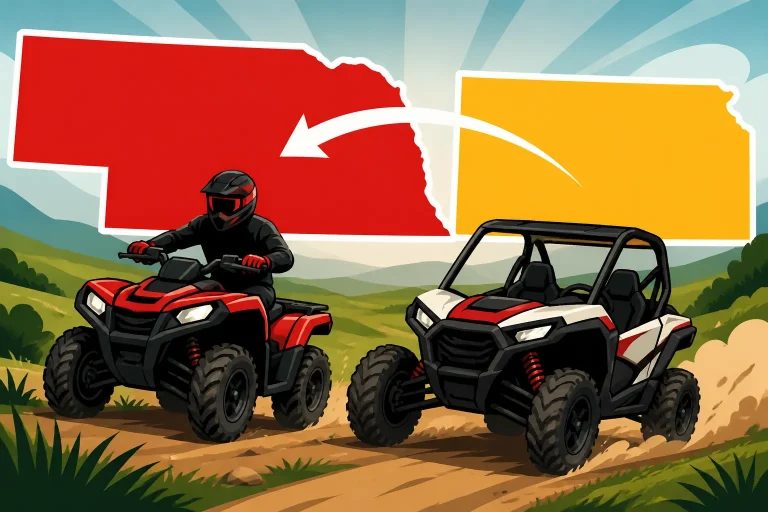
The same separation applies to visitors from another state. A child’s age, a home-state registration document or a safety card does not automatically displace the private park’s policies. If you are bringing a machine from outside Nebraska, verify both the park’s admission conditions and any rules that apply to the machine while it is in Nebraska. Start with Nebraska Rules for an Out-of-State Machine and Do Out-of-State Riders Need a Permit to Ride?.
For an out-of-state family, the questions are still specific: Will the park admit a rider of this age? Is the machine allowed? Does the park accept the waiver process you can complete? Are there separate requirements for public roads or public riding areas on the route or during the visit? A state permit and a private park’s permission solve different problems.
Do not use a private park’s age policy to infer whether a child may ride on a county road, city street, wildlife management area or national forest trail. Those locations can have rules that differ from the park’s own. Check the land manager or local authority for the place where you plan to ride, and verify access before unloading.
A Reliable Way to Decide Whether Your Child Can Ride
The safest approach is to treat the park’s current rules as the final word on admission, while separately checking any statewide or public-land requirements that apply. Avoid decisions based on informal assumptions such as “kids can ride anywhere with a parent” or “the age printed on the machine is the legal minimum.” Either statement can be wrong for a particular park.
Use this sequence:
- Choose the venue first. Age rules are not uniform across private parks, so identify the specific property before making plans.
- Describe the actual rider and machine. Give the child’s age, vehicle type and whether the child will drive or ride as a passenger.
- Clarify supervision. Ask whether a parent must ride, follow nearby or simply remain on the property.
- Confirm paperwork. Find out who signs the waiver and what the park requires for a minor.
- Ask about activity limits. Check for age-based trail, area, training or event restrictions.
- Check other rules separately. If the trip involves public roads or public land, contact the relevant authority or land manager about those rules.
- Reconfirm before departure. Policies can change, and the park can explain the current requirements.
If staff provide an answer that seems unclear, ask them to point you to the written policy or explain the rule in an email. This is especially useful when one adult is supervising several children, when a child will ride as a passenger or when the family is bringing a vehicle that the park does not commonly see.
When the child does not meet the park’s riding minimum, do not try to solve the problem by having an adult sign a waiver or by letting the child ride briefly. Ask whether the park has a viewing area or another activity for younger visitors. If it does not, choose a venue whose rules fit the child’s age and riding experience.
The key takeaway is straightforward: Nebraska does not have one private-park age minimum that settles admission everywhere. Each facility may set its own age, supervision, waiver and machine rules. Confirm all four before you travel, and check public-land or road requirements separately.
Frequently Asked Questions
Is there one minimum age for every private ATV park in Nebraska?
No single age cutoff applies to every private park. Each facility can set its own admission and riding policies, so contact the park you plan to visit.
Can a parent’s permission override a park’s minimum age?
Do not assume so. A waiver or parental permission does not necessarily override the park’s age, supervision or machine restrictions. Ask the facility directly.
Does adult supervision always mean a parent must ride alongside?
No. The park defines what supervision means under its policy. It may require an adult to ride with the child, follow in another vehicle or remain nearby. Confirm the exact expectation.
Can a child who meets the park’s age rule ride on public roads too?
Not automatically. A private park’s permission applies to its property and does not establish that a child may operate the same vehicle on a public road. Check the rules for the specific road or area.
Disclaimer
This article is for general informational purposes only and does not constitute professional advice. Laws, prices and regulations vary by location and change over time. Consult a qualified professional for guidance on your specific situation.