Do You Have to Stop Before Crossing a Highway?
It’s a common scenario for many Nebraska ATV and UTV owners: you’re out enjoying a ride, perhaps moving from one field to another, or transitioning between trail systems, and suddenly a paved highway looms ahead. That moment can bring a lot of questions to mind, especially regarding safety and legality. Navigating state highways with an off-road vehicle isn't like driving a car, and making the wrong move can have serious consequences. This guide will walk you through exactly what Nebraska law requires when an ATV or UTV encounters a highway, focusing on the critical act of crossing, to keep you safe and legal on your journeys.
The Strict Rules for Crossing Highways in Nebraska
When you're operating an ATV or UTV in Nebraska and find yourself needing to cross a state highway, there's absolutely no room for guessing or making assumptions about what's allowed. The rules are clear, strict, and designed with safety in mind, primarily because these machines are not built for highway speeds or traffic conditions. Failing to follow these regulations can lead to dangerous situations, severe accidents, and legal trouble. It's a moment that demands your full attention and adherence to the letter of the law.
The Mandatory Stop Requirement
Let's cut right to the chase: yes, you absolutely must come to a complete and full stop before crossing any paved highway in Nebraska. This isn't a suggestion or a guideline; it's a non-negotiable legal requirement. Think of it exactly like a stop sign at an intersection, but with even higher stakes due to the speed and volume of highway traffic. Your tires need to cease rolling entirely, and you need to bring your machine to a standstill at a point where you have a clear, unobstructed view of traffic approaching from both directions, without encroaching on the highway itself.
This mandatory stop serves several critical purposes. First, it forces you to pause and shift your focus from your off-road environment to the much faster and more unpredictable highway environment. Second, it gives you the crucial time needed to thoroughly scan for oncoming vehicles, which often travel at significantly higher speeds than you're accustomed to. A momentary glance isn't enough; you need to assess the speed and distance of all approaching traffic to ensure there's an ample, safe gap for you to cross. Remember, other drivers on the highway might not expect to see an ATV or UTV, so you need to be hyper-vigilant and prioritize your safety above all else. This rule is foundational to [Nebraska Complete Stops Before Crossing].
The Ninety-Degree Crossing Rule
Beyond the complete stop, Nebraska law specifies how you must cross a highway. You are required to cross at as close to a ninety-degree angle as practicable. This means you should approach the highway, stop, and then proceed straight across, perpendicular to the flow of traffic. You shouldn't be angling down the road or making a sweeping turn as you cross; the goal is to get from one side to the other in the most direct and expeditious manner possible.
Why this specific angle? It's all about predictability and minimizing your time in the lanes of travel. Crossing at a ninety-degree angle ensures that you are exposed to the highway traffic for the shortest possible duration. Any diagonal crossing prolongs your presence in the road, making you a moving obstruction for a longer time and increasing the risk of a collision. It also makes your intentions clearer to any drivers who might see you. Imagine trying to predict the path of a vehicle cutting across at an odd angle versus one moving in a straight line; the latter is much easier to anticipate. This is explicitly covered under [Nebraska Crossing Rules at Ninety Degrees].
Yielding to All Traffic
This point cannot be overstated: when crossing a highway, an ATV or UTV operator must yield the right-of-way to all approaching traffic. You are entering a flow of vehicles that have the absolute right to be there, traveling at speeds often exceeding 60 miles per hour. Your responsibility is to ensure that your crossing does not impede or endanger any other vehicle on the highway. This means waiting for a clear break in traffic, often a much larger gap than you might think is necessary.
Empathy plays a role here too. Put yourself in the shoes of a driver traveling down the highway at speed. They are not expecting an ATV to suddenly appear in their path. Their reaction time is limited, and their ability to swerve or brake abruptly is impacted by their speed and surrounding traffic. Therefore, the burden of safety rests squarely on the ATV/UTV operator to make sure the coast is absolutely, unequivocally clear. If there's any doubt, if a vehicle is approaching faster than you estimated, or if the gap feels tight, you wait. Patience is paramount. This rule is consistent with [Nebraska Yielding at Every Crossing] and applies even when performing [Nebraska Farm Trips Outside City Limits].
Understanding Nebraska's Limited Road Use Laws for ATVs & UTVs
It's crucial to understand that crossing a highway is a specific, limited exception within Nebraska's broader restrictions on ATV and UTV use on public roads. These machines are fundamentally designed for off-road environments, and the state's laws reflect that reality. While there are a few scenarios where limited road use is permitted, the general rule is that ATVs and UTVs are not street legal for general transportation on state highways.
When Road Use is Permitted (and Restricted)
Generally speaking, [Nebraska Bans ATVs on State Highways] for routine travel. This means you can't just hop on your quad and drive it down a major highway to get to the next town or trail system. The primary exceptions to this widespread prohibition typically revolve around agricultural purposes, where an ATV or UTV might be needed to cross a road to access fields, move equipment, or tend to livestock. Even in these cases, the use is highly restricted to specific conditions and routes, usually county roads, and only for the shortest distance necessary to accomplish the task.
Beyond agricultural use, some Nebraska cities and counties have adopted specific ordinances that permit ATVs and UTVs on certain municipal streets or county roads. These are highly localized rules and do not override state highway laws. They often come with their own set of requirements, such as city registration, insurance, and specific operating hours or speed limits. It's imperative to check with local authorities for these specific ordinances. However, even if a local ordinance allows you to ride on a city street, it almost certainly won't permit you to travel along a state highway; it would only allow for a direct crossing under strict conditions.
Equipment Requirements for Road-Legal Crossings
Since an ATV or UTV is not inherently designed for highway visibility, Nebraska law mandates specific equipment when these machines are used on public roads, even for a brief crossing. These requirements are all about making you as visible as possible to other drivers who may not be expecting to encounter an off-road vehicle.
Here’s a breakdown of what you’ll need:
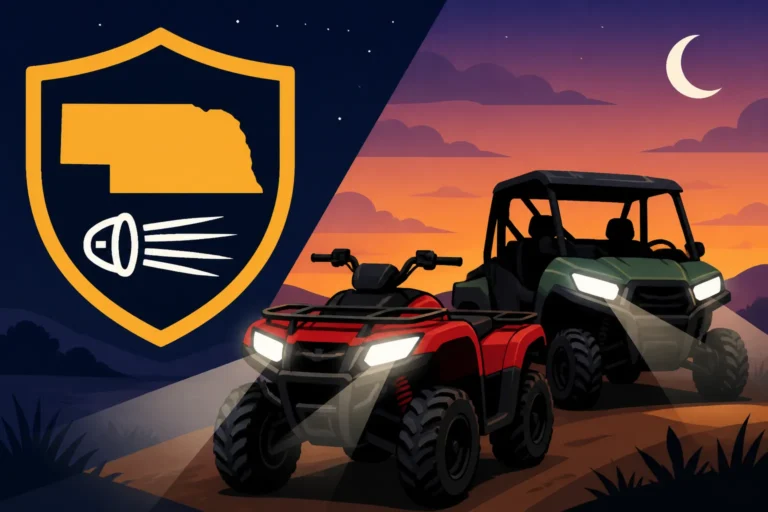
- Headlights and Taillights: Your machine must be equipped with working headlights and taillights. These aren't just for night riding; they need to be on during daylight hours when on public roads, including during a highway crossing. This significantly increases your visibility, especially as you approach and enter the highway lanes. It’s covered under [Nebraska Requires Head and Tail Lights].
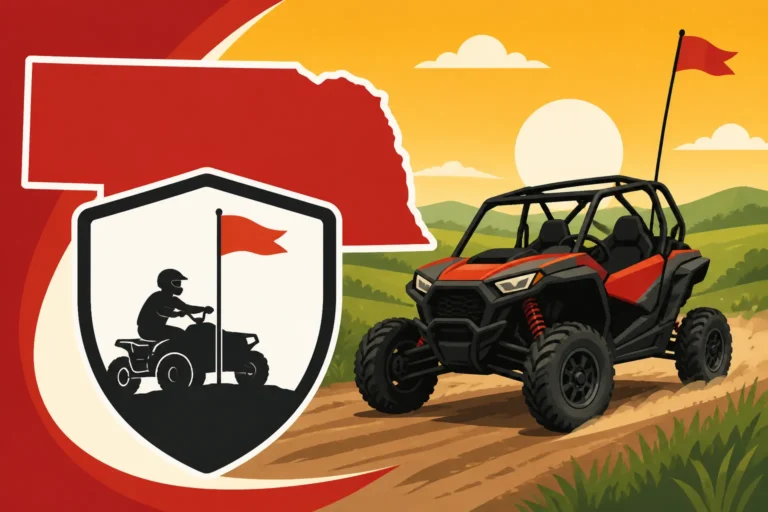
- Safety Flag: A brightly colored, day-glow triangular flag that is at least 30 square inches in size must be mounted on your ATV or UTV. This flag needs to extend at least five feet above the ground on a mast or pole. The purpose of this flag is to provide an additional visual cue for other drivers, particularly those in larger vehicles or those approaching over hills, to see you from a distance. The bright color and height make it stand out. You can find robust flag kits and mounts from retailers like SuperATV, ensuring your flag meets the height and visibility requirements for safety. For specifics, see [Nebraska Safety Flag Dimensions].
- Mirrors: While not explicitly mandated for every single crossing scenario, having at least one rear-view mirror is highly recommended for situational awareness, allowing you to check for traffic behind you before and during your approach to the highway.
- Brakes: Your braking system must be in good working order, capable of bringing your machine to a quick and controlled stop. This is vital for the mandatory stop before the highway and for any unexpected situations.
Having all this equipment in place isn't just about avoiding a ticket; it's about making yourself visible and predictable to other motorists, drastically reducing the risk of a severe accident during that critical highway crossing.
Practical Steps and Safety Tips for Highway Crossings
Knowing the rules is one thing, but actually executing a safe highway crossing requires a careful, methodical approach. It's not a maneuver to be rushed or taken lightly. Every time you approach a highway, you need to engage in a deliberate process to ensure your safety and the safety of others.
Pre-Crossing Checklist and Assessment
Before you even get close to the highway, slow down and prepare yourself. Here's a mental checklist to run through:
- Stop Completely: As discussed, bring your ATV or UTV to a full, unequivocal stop at a safe distance from the edge of the highway, but close enough to have a clear line of sight in both directions. Never creep forward onto the shoulder or lane before you're ready to cross.
- Look, Listen, and Assess: Turn off any loud music or communication devices. Look left, then right, then left again. Actively listen for the sounds of approaching traffic, which can sometimes be heard before a vehicle is seen, especially in areas with curves or hills. Assess the speed of any approaching vehicles. Are they traveling at highway speeds? Are there any semi-trucks or larger vehicles that have longer stopping distances?
- Ensure Ample Gaps: This is the most critical part. You need to identify a gap in traffic that is more than sufficient for you to accelerate, cross the highway at a ninety-degree angle, and clear the lanes safely. Don't underestimate how quickly highway traffic closes distances. A gap that looks big from your stationary position can shrink rapidly. If there's any doubt about the size of the gap or the speed of approaching vehicles, you wait. Period.
- No Obstructions: Make sure your path across the highway is clear. Are there any pedestrians, animals, or debris in the crossing zone?
- Be Decisive: Once you've determined it's safe to cross, accelerate smoothly and cross directly at the ninety-degree angle. Hesitation once you've committed to crossing can be just as dangerous as rushing. Do not dawdle, and do not make any sudden, unpredictable movements.
Remember, a highway crossing on an ATV or UTV should be a rare event, only undertaken when absolutely necessary and with the utmost caution. It’s a moment of heightened risk that requires your full focus.
What Happens If You Don't Stop (Consequences)
Ignoring the mandatory stop, the ninety-degree rule, or failing to yield to highway traffic can lead to a cascade of negative outcomes, ranging from legal penalties to life-altering accidents. [Nebraska Penalties for Illegal Road Riding] can be significant.
Here's what you could face:
- Traffic Citations and Fines: Law enforcement officers take highway safety very seriously. Failing to stop or yield is a serious traffic offense. You could receive a hefty citation, incurring significant fines and potentially points on your driver's license. This can impact your insurance rates and even lead to license suspension in some cases.
- Accidents and Injuries: This is the most severe and terrifying consequence. Collisions between ATVs/UTVs and highway vehicles often result in catastrophic injuries or fatalities for the off-road vehicle occupants. The difference in mass, speed, and protection between an ATV/UTV and a car or truck is immense. Even a minor collision can be devastating.
- Property Damage: Your machine, and potentially the highway vehicle, could sustain extensive damage. Repair or replacement costs can be astronomical, especially if your insurance doesn't cover accidents resulting from illegal road use.
- Insurance Implications: If you are involved in an accident while illegally crossing a highway or failing to adhere to the rules, your insurance company may deny coverage for damages or injuries. Most off-road vehicle policies have strict exclusions for accidents occurring during illegal road operation. This could leave you personally responsible for medical bills, vehicle repairs, and potential liability claims from other parties. For example, if you've purchased a robust accessory like a windshield from SuperATV for your UTV, it could be damaged beyond repair in such an incident, and getting it replaced might be entirely out of pocket.
- Legal Liability: In the event of an accident where you are found at fault, you could face civil lawsuits for damages, injuries, and even wrongful death claims. These legal battles can be financially ruinous and emotionally draining.
The risks far outweigh any perceived convenience of skipping a stop or trying to beat traffic. Always prioritize safety and legality.
Common Misconceptions and Additional Considerations
There's a lot of misinformation and misunderstanding surrounding ATV and UTV use on public roads. It's easy to assume certain things, but when it comes to legal compliance and safety, assumptions can be dangerous. Let's clarify a few key points.
Farm Use vs. Recreational Use on Roads
A common misconception is that "farm use" automatically grants full immunity from road rules. While Nebraska law does provide specific exceptions for ATVs and UTVs used for agricultural purposes, particularly regarding travel on certain county roads and, critically, highway crossings, these exceptions are not a blanket pass. Even for bona fide farm use, the mandatory stop, ninety-degree crossing rule, and yielding to all traffic still apply without exception when crossing a state highway.
The distinction is important because recreational riders typically have even fewer allowances for road use. A recreational rider cannot simply decide to cross a highway just because a farmer might be able to in a specific context. The purpose of your ride matters. If you're using your ATV or UTV for checking cattle, hauling feed, or maintaining fence lines, and a highway crossing is essential to access another part of your property or a connected field, then the agricultural exception applies, but the strict crossing rules remain. If you're heading out to a trail for fun, your road use options are much more limited, and highway crossings should be considered an absolute last resort, if at all.
Local Ordinances and Their Limits
As mentioned, some Nebraska cities and counties have enacted ordinances that allow ATVs and UTVs on their streets. This is a progressive move for many communities, offering greater access for residents. However, it's crucial to understand the hierarchy of laws. A local city or county ordinance cannot override state statutes that prohibit ATVs on state highways or dictate the rules for crossing them.
For example, a town like Yutan might allow ATVs on its city streets, but that doesn't mean you can then ride your ATV on Highway 92 through town, or ignore the rules when crossing it. The local ordinance typically only applies to the specific roads under that municipality or county's jurisdiction. When you encounter a state highway, even within a town that allows ATV street riding, you are subject to state law for that highway section. Always verify the specific rules for the type of road you're on. You can find out more about how towns open their streets in [Nebraska City Ordinances That Open Streets] and how counties might allow riding in villages in [Nebraska County Board Resolutions for Villages].
Here's a quick comparison of the rules:
| Aspect | State Highway Crossing | Local City/County Streets (if permitted) |
|---|---|---|
| Stop Requirement | Mandatory Complete Stop | Varies by local ordinance (usually stop signs/lights) |
| Crossing Angle | Mandatory 90-degree angle | Normal traffic turns/intersections |
| Yield Requirement | Yield to all highway traffic | Yield as per standard traffic laws |
| Purpose of Use | Primarily agricultural exception, or immediate access | Recreational, utility, short-distance travel |
| Legal Authority | Nebraska State Statutes | City/County Ordinances (cannot supersede state highway) |
| Speed Limit | Limited to crossing, not travel on highway | Set by local ordinance (often 30 mph or less) |
| Required Equipment | Lights (day/night), 5-foot safety flag | Lights, sometimes flag, local registration, insurance |
This table makes it clear that highway crossings are treated with a much higher degree of caution and restriction than general street use, even where that street use is permitted. Always err on the side of caution and assume the most restrictive rules apply when interacting with state highways.
Disclaimer
This article is for general informational purposes only and does not constitute professional advice. Laws, prices and regulations vary by location and change over time. Consult a qualified professional for guidance on your specific situation.