Crossing a Divided Highway Only at an Intersection
It's a common scenario for many Nebraska ATV and UTV enthusiasts: you're out enjoying a ride, perhaps on a network of county roads or even just moving from one field to another, and suddenly, a divided highway stands between you and your destination. The temptation to just zip across the median might be strong, but it's not just risky; it's explicitly against the law in our state. This guide is here to walk you through exactly how Nebraska law dictates you must navigate these major thoroughfares, ensuring you stay safe and legal.
The Strict Rule for Divided Highways in Nebraska
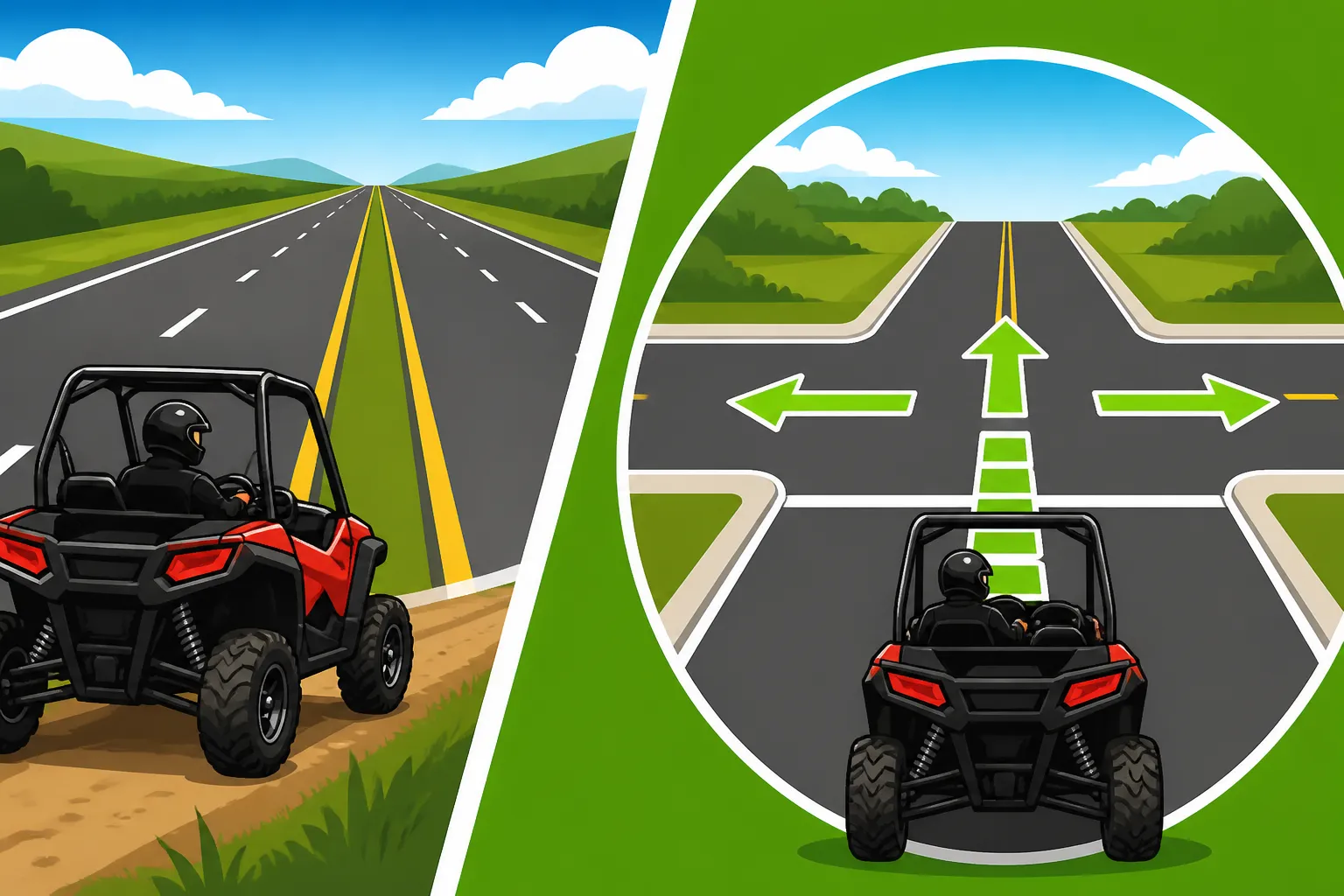
Let's cut right to the chase: when you're riding your ATV or UTV in Nebraska and encounter a divided highway, the law is very clear and leaves no room for improvisation. You absolutely cannot simply cross the median or try to jump across lanes of traffic. The only legal way to traverse a divided highway is by using a designated intersection. This isn't just a suggestion; it's a critical safety regulation designed to protect you and other motorists. Ignoring this rule puts you in direct conflict with the law and, more importantly, in grave danger.
Imagine you're on a county road that dead-ends into a major four-lane divided highway. Your riding area, or even your home, is directly across the highway. While it might look like a short, straight shot, the risks are immense. Vehicles on a divided highway are often traveling at high speeds, and they simply won't expect an ATV to suddenly appear in their path, especially not from a median or an unmarked crossing. This is why Nebraska law mandates a very specific approach, prioritizing safety above all else. [Nebraska Bans ATVs on State Highways] is a fundamental principle, and this crossing rule is a direct extension of that.
What Constitutes a Divided Highway in Nebraska?
In Nebraska, a divided highway generally refers to any roadway with two or more lanes of traffic flowing in opposite directions, separated by a median. This median can be a grassy strip, a concrete barrier, or even just a wide, unpaved area designed to keep opposing traffic streams distinct. It's not just about the number of lanes; it's about that physical separation. A simple two-lane county road with traffic moving in both directions, even if it has a wide shoulder, is not a divided highway. The key element is that separation between directions of travel.
For example, think of a major state highway like Highway 30 or Highway 2 near a larger town. These often have wide medians, sometimes even with turnaround points for emergency vehicles, but they are absolutely not meant for recreational ATV crossings. The same goes for sections of I-80, though ATVs are completely prohibited on interstates anyway. Even a seemingly minor road can be considered divided if it has this distinct physical barrier. Understanding this distinction is crucial, as the rules for crossing a simple two-lane road are different from those for a divided highway.
Why the Intersection Rule? Safety, Visibility, and Legal Ramifications
The intersection rule isn't some bureaucratic hurdle; it's rooted deeply in principles of safety and traffic management. Intersections are designed for vehicles to cross or turn, often equipped with traffic signals, stop signs, and clearer sight lines that allow all parties to see and anticipate movements. When you approach a designated intersection, drivers on the divided highway are more likely to be slowing down, paying attention to cross-traffic, and generally prepared for other vehicles to enter or cross their path.
Consider the alternative: trying to cross a divided highway mid-block. Not only are you dealing with high-speed traffic, but there are also no designated turning lanes, no traffic signals, and often very limited visibility, especially if the median has landscaping or dips. You'd be pulling out into fast-moving lanes from an unexpected location, creating a high risk for a severe collision. Furthermore, failing to adhere to this rule can lead to significant legal consequences, including fines and potential charges for reckless operation or even more serious offenses if an accident occurs. It's simply not worth the risk to your safety or your wallet.
Understanding Nebraska's Road Use Laws for ATVs
While our main focus today is on crossing divided highways, it's vital to remember that this specific rule operates within the broader framework of Nebraska's laws regarding ATV and UTV use on public roads. These machines are not designed or generally permitted for extensive road travel, but specific exceptions exist, primarily for agricultural purposes or if a local municipality has passed an ordinance allowing them. Even when an exception applies, there are strict conditions you must meet.
Many riders get frustrated with the patchwork of rules, thinking, "Why can't I just take the shortest path?" The reality is that the laws are there to prevent accidents involving vehicles that behave very differently from cars and trucks. ATVs and UTVs have different acceleration, braking, and handling characteristics, and they often aren't as visible as standard vehicles. This makes any road travel, especially crossing major thoroughfares, a high-risk activity that needs to be approached with extreme caution and full compliance with the law.
General Road Use Restrictions and Exceptions
Nebraska law, specifically statute 60-6,356, lays out the limited circumstances under which ATVs and UTVs can be operated on public roads. Primarily, these exceptions revolve around agricultural purposes, such as moving between fields or for ranching operations, or within city limits if a local ordinance permits it. Even then, you're usually restricted to certain types of roads (not state highways), a maximum speed of 30 mph, and required to have a safety flag. [Nebraska's 30 mph Road Limit] is one of those crucial details often overlooked, but it applies even during a quick crossing maneuver.
When you're preparing to cross a divided highway at a legal intersection, all these other rules still apply. You must still adhere to the speed limit, ensure your machine is equipped with the necessary safety flag (at least five feet above the ground, day-glow orange or red-orange), and operate only during daylight hours, unless you're engaged in snow removal. [Nebraska Daylight Riding Rule] is especially important; attempting to cross a major highway after dark, even at an intersection, compounds the danger exponentially due to reduced visibility for everyone. Make sure your machine's headlights and taillights are functioning, and consider additional visibility enhancements like reflective tape or auxiliary lights, perhaps from SuperATV, to make your presence undeniable.
The Importance of a Class O License and Insurance
Before you even think about putting a tire on any public road in Nebraska, including to make a legal crossing, you need to ensure you meet the operator requirements. This means holding a valid Class O operator's license (a standard driver's license) or, if you're operating for agricultural purposes and are a minor, a valid farm permit. [Nebraska Requires a Class O License or Farm Permit] is not optional. You can't just be a competent rider; you need the proper legal credential.
Equally important, if you're using your ATV or UTV on public roads, you must carry liability insurance. [Nebraska Requires Liability Insurance on Roads] to protect yourself and others in the event of an accident. This isn't just a good idea; it's a legal mandate. A deputy who pulls you over for any reason, including an observed traffic violation during a crossing, will ask for proof of your license and insurance. Being unprepared can quickly turn a quick trip into a costly citation. Make sure your insurance card is readily accessible, perhaps with your registration paperwork.
Practical Steps for a Safe Divided Highway Crossing
Okay, so you know you can only cross at an intersection. Now, how do you actually do it safely and legally? This isn't just about following the letter of the law; it's about applying common sense and extreme caution to minimize risk. A divided highway crossing, even at a proper intersection, is one of the more hazardous maneuvers an ATV or UTV operator might undertake on public roads in Nebraska.
Identifying a Legal Intersection
Not every place where two roads meet is created equal, especially when it comes to divided highways. A legal intersection for crossing purposes will be clearly marked with traffic control devices, such as stop signs, yield signs, or traffic lights. It will often have dedicated turn lanes, clear sight lines, and may even feature a break in the median designed for crossing traffic. What you're looking for is a place where other vehicles are expected to cross or turn.
Avoid attempting to cross at unmarked field entrances or where a minor road simply dead-ends into the divided highway without proper signage or a clear crossing point in the median. If there's any doubt, err on the side of caution. It's always better to travel an extra mile or two down the road to a well-defined intersection than to risk a dangerous and illegal crossing. You can even check local maps or satellite imagery before your ride to identify the safest and most legal crossing points.
Executing the Crossing Safely
Once you've identified your legal intersection, here's a step-by-step approach to executing the crossing safely:
- Approach with Caution: Slow down well in advance of the intersection. Scan for other traffic on the divided highway and any cross-traffic.
- Stop Completely: Come to a full and complete stop before entering the intersection. Even if there's no stop sign, yield to all traffic on the divided highway.
- Look Both Ways (and Again!): Double-check traffic from all directions. Divided highways mean high-speed traffic, so look for breaks in both directions. Remember that ATVs are small and less visible; make sure drivers see you and that you have ample time to cross. Consider adding high-visibility flags or even an aftermarket horn from
SuperATVfor improved communication with other drivers. - Signal Your Intentions: If your ATV or UTV has turn signals, use them. If not, use clear hand signals to indicate you intend to cross.
- Cross at a Ninety-Degree Angle: Once traffic is clear, proceed directly across the highway, aiming for a ninety-degree angle to the flow of traffic. Do not attempt to angle across lanes or try to make a rolling stop. A straight path is the safest and most predictable for other drivers. [Nebraska Crossing Rules at Ninety Degrees] is a specific regulation for this very reason.
- Yield to All Traffic: Always remember that as an ATV or UTV operator on a public road, you are generally required to yield to other vehicles. This means even if you have a green light, proceed with caution and be prepared for unexpected movements from other drivers.
| Rule Category | Rule Description | Applicability to Divided Highway Crossing |
|---|---|---|
| Location | Only at a designated intersection | Mandatory |
| Angle | Must cross at a ninety-degree angle | Mandatory |
| Speed Limit | Maximum 30 mph on public roads | Applies during crossing |
| Visibility | Daylight only (unless snow removal exception) | Applies to crossing |
| Safety Flag | 5-foot flag, day-glow orange/red-orange | Applies during crossing |
| Operator License | Class O or Farm Permit | Mandatory for operator |
| Insurance | Liability insurance required for road use | Mandatory for machine |
| Highway Type | No state highways (except for crossing) | State highways can be crossed at intersections |
| Yielding | Must yield to all traffic | Mandatory |
Common Misconceptions and Risks
Even with clear rules, misconceptions about ATV and UTV use on roads persist. These misunderstandings can lead to dangerous situations and legal trouble. It’s important to dispel these myths and understand the very real risks involved in ignoring Nebraska’s laws, particularly concerning divided highways.
The Myth of the "Quick Dash" Across the Median
One of the most dangerous myths is the idea that a quick dash across a grassy median or a brief cut across a few lanes of traffic on a divided highway is acceptable, especially if there's no immediate traffic. This simply isn't true, nor is it safe. As we've discussed, divided highways are designed for high-speed, unimpeded traffic flow. Drivers on these roads are not scanning for vehicles emerging from a median or cutting across multiple lanes. They are focused on the road ahead and the predictable patterns of other cars and trucks.
Attempting a "quick dash" not only violates [Nebraska Bans Crossing a Controlled-Access Highway] where applicable, but it also eliminates your crucial decision-making time and the visibility advantages of a designated intersection. The speed difference between your ATV/UTV and highway traffic can be massive, closing gaps faster than you can react. Even if you don't get hit, you could cause another driver to swerve violently, leading to a multi-vehicle accident. This kind of maneuver is a recipe for disaster, and it's best avoided at all costs.
Penalties for Illegal Crossing
Ignoring Nebraska's road use laws for ATVs and UTVs, especially something as critical as illegally crossing a divided highway, can result in significant penalties. These aren't just minor inconveniences; they can hit your wallet hard and potentially impact your driving record. [Nebraska Penalties for Illegal Road Riding] can include fines, court costs, and potentially even impoundment of your machine depending on the severity and local ordinances.
Consider this: a simple citation for an illegal crossing could mean a hefty fine, plus additional court costs, making a "shortcut" incredibly expensive. If your actions lead to an accident, even a minor one, you could face much more severe charges, liability for damages, and a significant increase in your insurance premiums. The state takes these rules seriously because of the inherent dangers involved. It's always a better, safer, and ultimately cheaper option to follow the law and take the extra time to find a legal intersection. A deputy isn't going to look the other way because you were "just trying to get home." Always assume that what you do on a public road is under observation. [What Paperwork a Deputy Can Ask to See] includes your license and proof of insurance, and if you're not legal, those costs will pile up.
Disclaimer
This article is for general informational purposes only and does not constitute professional advice. Laws, prices and regulations vary by location and change over time. Consult a qualified professional for guidance on your specific situation.