Nebraska Visitors Need No State Sticker
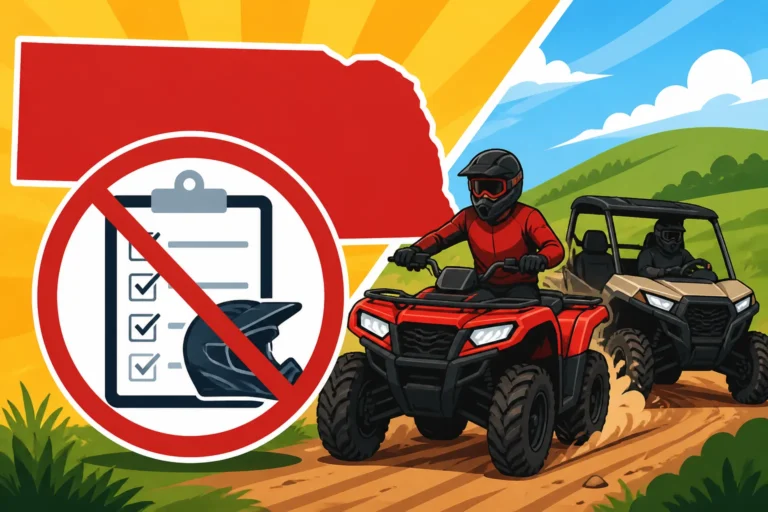
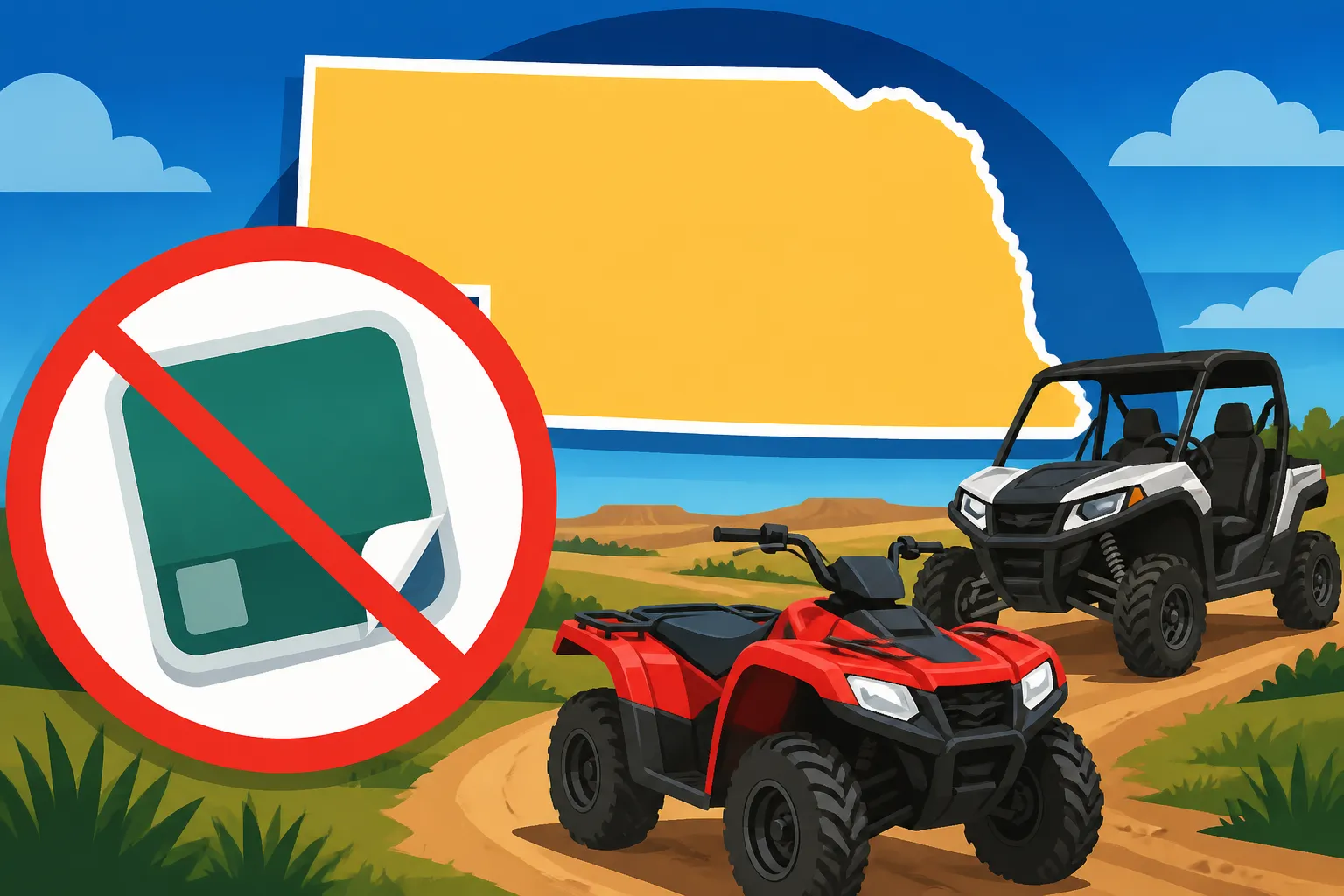
If you’re bringing an ATV or UTV into Nebraska, it’s easy to assume you need the same sticker or registration required at home. Nebraska does not require visiting riders to buy a statewide ATV sticker. That answers only the state-sticker question, though: land access, local rules, trail fees, and road-use laws still affect where you can ride.
What Nebraska’s no-sticker rule means
Nebraska does not have a statewide OHV permit or sticker that visitors must obtain to ride an ATV or UTV. You do not need to buy a Nebraska state decal just because your machine has crossed the state line. This applies to visitors from neighboring states as well as riders traveling from farther away.
The absence of a sticker requirement is not a visitor exemption from every rule. It means there is no general statewide ATV sticker to buy; it does not create a right to ride on land that is closed, private, or limited to other uses. A trail system, private riding park, local government, or land manager can still set requirements for its property or facility.
Nebraska also does not have a statewide ATV registration system for an out-of-state registration to replace or transfer into. An ATV registration or sticker issued by your home state does not function as a Nebraska state permit. At the same time, Nebraska’s lack of a state sticker does not automatically cancel whatever home-state requirements apply to your machine while it is registered or kept there. Check your home state’s rules if you are unsure what you must maintain.
For a quick distinction:
| Requirement or document | What it generally addresses | Does it replace a Nebraska state ATV sticker? |
|---|---|---|
| Nebraska statewide ATV sticker | No statewide ATV sticker is required for visitors | Not applicable |
| Home-state ATV registration or decal | Your machine’s status under your home state’s rules | No |
| Proof of ownership | Helps show that you own or are authorized to use the machine | No, but it may be useful to carry |
| Park or trail access requirement | Entry to a particular area or facility | No; it applies to that destination |
| City or road-use requirement | Whether and how a machine may use certain public streets or roads | No |
This is why “no state sticker” should not be read as “no paperwork” or “ride anywhere.” Nebraska has no statewide ATV permit or sticker, but destination rules can still matter. For more background on the state-level distinction, see Nebraska Has No OHV Permit or Sticker and Do Out-of-State Riders Need a Permit to Ride?.
Check the place where you plan to ride
The most useful next question is not whether Nebraska requires a sticker. It is whether the particular land or facility you plan to visit allows your machine, and what conditions it sets. A public trail, wildlife management area, national forest, private park, or town street can each have a different answer.
Public land is not one single system
Rules for one public-land area do not automatically apply to another. Public land may be managed by different agencies, have designated motorized routes, restrict vehicles to certain roads, or close to ATVs altogether. Check the current rules for the exact area before unloading. A Nebraska state park entry permit, where applicable to a vehicle entering a park, is also different from an ATV riding sticker; it does not by itself authorize riding an ATV there.
Nebraska state parks generally are not places to take an ATV for trail riding. Do not assume that a park entry permit, an out-of-state registration, or the lack of a Nebraska sticker makes the machine legal on park roads or trails. Review Nebraska Park Rules for ATVs and Why a Park Permit Does Nothing for Your ATV before planning a ride at a state park or recreation area.
Wildlife management areas have their own limits as well. A machine may be restricted to designated roadways, parking areas, or specific exceptions rather than being allowed across the property. A hunting license, permission to hunt, or out-of-state ATV registration does not automatically open every route. Use the current area-specific rules and signs, and see [Nebraska WMA Roadway Rules] for the distinction between access and riding permission.
National forest riding is different from riding in a state park or wildlife management area. Some forest areas have designated routes or OHV opportunities, while other roads and land may have different restrictions. Before towing to a forest trailhead, verify which routes are open to your machine and whether that site has parking, fee, or equipment requirements. Nebraska National Forest Riding and Which Public Land a Visitor Can Ride in Nebraska can help you narrow down the options.
Trail fees and facility rules can still apply
A trail system or recreation site may charge a parking or access fee, or use a local pass system. That is not the same thing as a statewide Nebraska ATV sticker. It applies to the specific destination and may be required whether you are a Nebraska resident or a visitor.
Check whether the fee is for the rider, the machine, the vehicle used to tow it, or parking at the trailhead. Also confirm how payment works, what hours the site operates, and whether a fee or pass covers the area you plan to use. A pass for one recreation area does not necessarily cover another. If a location has a website or posted contact information, use the details for that specific site rather than relying on an old forum post or an assumption based on another trail.
Privately operated riding parks can set their own entry, waiver, age, helmet, passenger, and equipment rules. Those conditions may apply even though Nebraska has no statewide ATV sticker. Read the facility’s rules before the trip, especially if you are bringing a youth rider, a passenger, or a side-by-side that might not fit every trail. See Nebraska Private Park Waivers and Rules for more on why a state sticker and a private park’s admission rules are separate questions.
Private land still requires permission
An ATV or UTV does not gain access to private property simply because it has no Nebraska sticker requirement. Get permission from the landowner or an authorized person before riding. Stay within the area and routes you have been allowed to use, and follow any limits on gates, livestock, crops, or timing.
This matters on farms, ranches, hunting ground, and rural property where a route may look open but still cross private land. A county road or public right-of-way is not permission to turn onto a nearby pasture, field, or ranch road. If you are invited to ride, clarify where you may go and whether the permission covers passengers or other machines in your group.
What to carry and what to verify before leaving home
A state sticker is not on the visitor’s checklist, but basic preparation can prevent a frustrating conversation at a trailhead or county road. Carry information that helps establish who you are, what machine you brought, and where you are allowed to ride.
Bring useful ownership and travel documents
Consider carrying proof of ownership or authorization to use the machine, such as the title or another document appropriate to your circumstances. If the machine is borrowed, rented, company-owned, or part of a household fleet, make sure you can explain who owns it and that you have permission to use it. Keep documents protected from water and damage, and avoid leaving irreplaceable originals exposed on the machine.
For an out-of-state machine, bring any home-state paperwork you normally use or are required to carry. That paperwork does not become a Nebraska sticker, and it does not grant access to closed land. It can still help resolve questions about ownership or the machine’s status. See Nebraska Proof of Ownership on the Trail for practical guidance on the ownership-document question.
If you are visiting from Iowa, Kansas, South Dakota, or Colorado, do not assume that another rider’s advice applies to your exact destination. The statewide sticker issue is straightforward, but local land access and facility rules can differ. The state-specific visitor pages, such as Nebraska Rules for a Visiting Iowa Rider, offer a starting point for checking what is particular to a trip across the border.
Confirm the destination, not just the state
Before loading the trailer, check the following with the land manager, trail operator, or local authority responsible for the place you plan to ride:
- Is the ATV or UTV class you are bringing allowed there?
- Which routes, roads, or riding areas are open to it?
- Is there a site-specific pass, parking charge, or other access condition?
- Are there equipment, sound, age, passenger, or safety requirements?
- Are there current closures, seasonal limits, or weather-related restrictions?
- Is the route open to visitors, or is access limited to a particular use or group?
This check is especially useful when your trip includes more than one destination. A machine allowed on a designated forest route may not be allowed in a nearby park or wildlife area. A private riding park may admit a side-by-side but restrict its width on some trails. Treat each property as its own decision instead of carrying one “Nebraska permission” from place to place.
For destinations with no reliable cell service, save the rules and directions before you leave. Keep a paper map or offline map as a backup, and note the access point and parking area. These steps do not replace the land manager’s rules, but they reduce the chance of ending up at a closed entrance or taking a route that is not open to motorized use.
The state sticker does not make an ATV road-legal
Trail access and public-road use are separate issues. The fact that a visiting rider does not need a Nebraska ATV sticker does not make an ATV or UTV legal on a Nebraska road. Nor does a registration decal from another state automatically authorize road use here.
Nebraska’s road rules are limited and depend on the type of road, the purpose of the trip, applicable state requirements, and local ordinances. Some cities may allow certain ATV or UTV use on specified streets under local rules; that does not mean every city does. County roads and highways raise different questions, and state highways have restrictions that should not be guessed at from a vehicle’s home-state registration.
Before using any public road, identify who controls it and check the rules for that specific route. Do not treat a shoulder, ditch, section line, or farm access road as an open trail without confirming its status. A road-use exception, where one applies, is not a general license to travel wherever the machine can physically go. For the state-law overview, start with Can You Drive an ATV on the Road in Nebraska?, then check any city ordinance or local authorization that may apply.
Road use may also bring requirements that do not apply to ordinary off-road riding, including licensing, insurance, equipment, and route restrictions. A home-state plate or decal does not necessarily satisfy Nebraska’s requirements. Verify each requirement before the machine reaches a public road, and do not rely on the no-sticker rule as evidence that road travel is allowed.
If you only plan to tow the ATV or UTV to a legal riding area and use it there, focus on the site’s access and trail rules. If you intend to ride on streets or roads between locations, treat that as a separate legal question and confirm it before the trip. Nebraska Has No Registration to Reciprocate explains why another state’s registration should not be mistaken for a Nebraska authorization.
A simple visitor checklist
The short answer is simple: visitors do not need a Nebraska statewide ATV sticker. The practical answer is to verify the destination, because the state-level sticker question does not settle local access, trail fees, land permission, or road use.
Use this checklist when planning:
- Skip the Nebraska state ATV sticker search. Nebraska does not require visitors to buy a statewide ATV sticker.
- Check home-state obligations. Nebraska’s no-sticker rule does not determine what your home state requires for a machine registered or kept there.
- Choose a legal riding location. Confirm that ATVs or UTVs are allowed on the specific property and route.
- Check site-specific costs and conditions. A trail or parking fee is not a state ATV sticker, but it may still apply.
- Carry useful ownership information. Have appropriate paperwork or authorization available, particularly if the machine is borrowed or owned by a business.
- Get landowner permission. Do not ride on private property without permission.
- Check road rules separately. A state decal from elsewhere does not establish road legality in Nebraska.
- Recheck before travel. Closures, access conditions, and local rules can change, so confirm with the responsible agency or facility.
If you are bringing a group, send everyone the same destination details and rules. That avoids the common mismatch where one rider assumes a state sticker is the only requirement while another expects a trail fee or local pass. The most reliable plan is to know the exact access point, route, and rules before you unload.
Frequently Asked Questions
Do visitors need a Nebraska ATV sticker?
No. Nebraska does not require visiting ATV or UTV riders to obtain a statewide ATV sticker. A particular trail, private facility, or land manager may still have its own access conditions.
Does my home-state ATV registration work as a Nebraska permit?
No. Nebraska does not have a statewide ATV registration system that visitors need to join, and an out-of-state registration does not serve as a Nebraska riding permit. Keep any home-state documents you are required to maintain, and check the rules for the specific place where you plan to ride.
Does a Nebraska park entry permit let me ride my ATV in a state park?
No. A park entry permit, when required for entry by a vehicle, is not an ATV riding authorization. Check the rules for the park and its roads or trails before taking a machine there.
Can I ride on Nebraska roads because I do not need a sticker?
No. The sticker rule does not determine whether road use is allowed. Check Nebraska road requirements and any city or local rules that apply to the exact route.
Disclaimer
This article is for general informational purposes only and does not constitute professional advice. Laws, prices and regulations vary by location and change over time. Consult a qualified professional for guidance on your specific situation.