Do Out-of-State Riders Need a Permit to Ride?
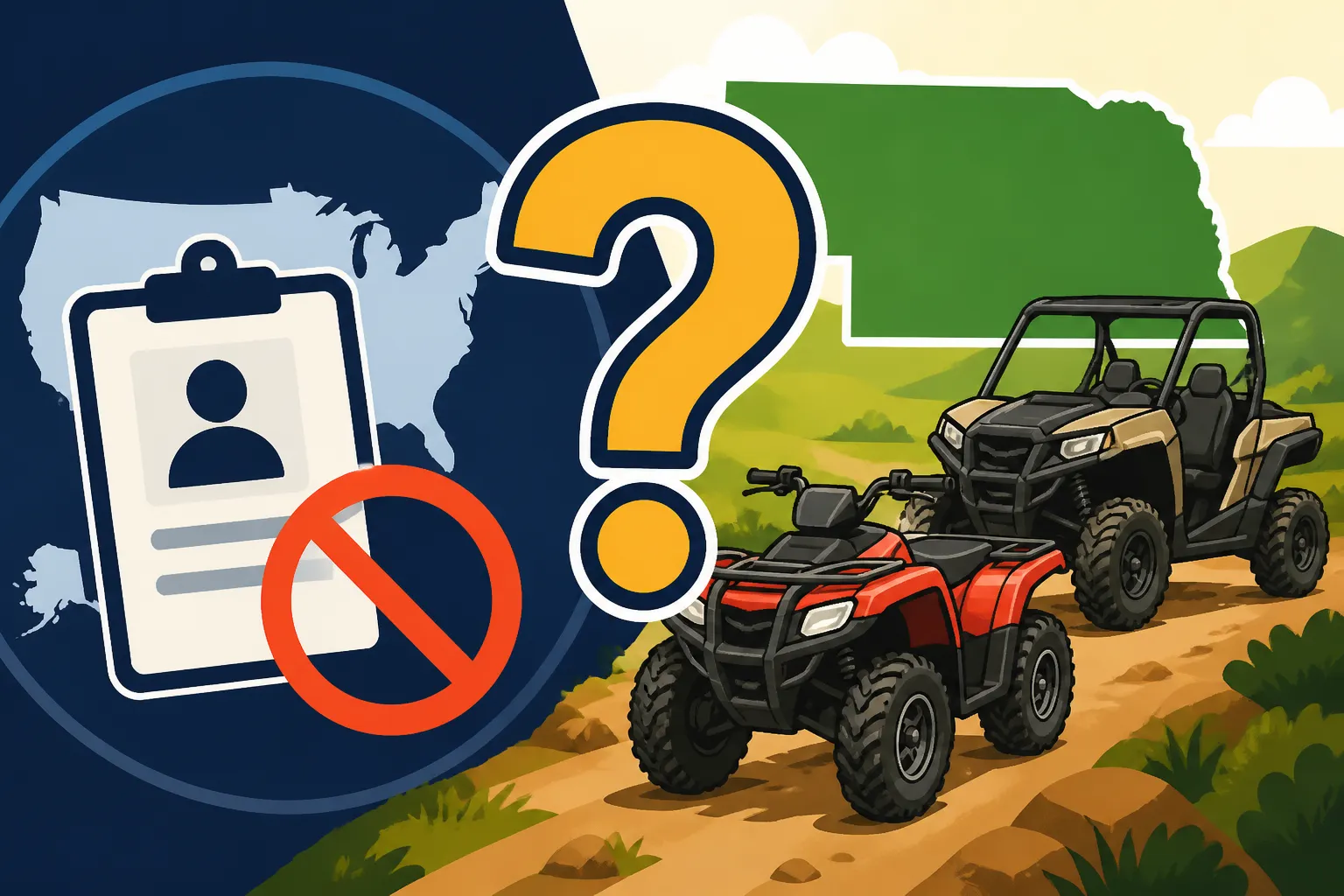
An out-of-state registration sticker can look like a Nebraska riding permit, but it does not automatically open trails or roads. Nebraska generally does not require a state OHV permit or sticker for an ATV or UTV. What matters instead is where you plan to ride: public-land rules, local road laws, private-park requirements, and any vehicle-entry or parking fees.
Nebraska does not require a state ATV or UTV permit
For ordinary off-road riding, Nebraska does not issue a statewide ATV or UTV permit or trail sticker that visiting riders must buy. That is different from states that require a registration decal or OHV permit to ride public trails. Nebraska also does not have a state ATV registration system that can recognize another state’s registration in return.
An out-of-state registration card or decal may still be useful as supporting paperwork, but it is not a Nebraska riding permit. It does not establish that a particular Nebraska trail is open to your machine, and it does not give you permission to ride on land where ATVs are prohibited. The same is true of a Nebraska title: ownership paperwork is not a trail pass.
For a closer look at the state’s basic setup, see Nebraska Has No OHV Permit or Sticker and Nebraska Visitors Need No State Sticker. If your machine is registered where you live, review Nebraska Has No Registration to Reciprocate and Nebraska Rules for an Out-of-State Machine before assuming that your home-state paperwork changes Nebraska access rules.
| What you may need | What it applies to | Does it authorize ATV or UTV trail riding? |
|---|---|---|
| Nebraska OHV permit or sticker | No statewide OHV permit or sticker is generally required | No state trail decal is required, but land rules still control |
| Out-of-state registration | Paperwork issued under another state’s rules | Does not automatically authorize riding in Nebraska |
| State park entry permit | A motor vehicle entering a state park or recreation area, subject to current rules | No; park entry is not ATV access |
| Trailhead or parking fee | A specific riding area or parking location | Only satisfies the fee requirement; it does not override closures or vehicle limits |
| Private riding park pass or waiver | Entry to a privately operated facility | Only under that park’s own rules |
The practical answer is therefore not simply “no permit, no problem.” You may not need a statewide OHV permit, but you do need to check the rules for the specific place you intend to ride. Some areas do not allow ATV or UTV use at all. Others allow it only on designated routes or within a defined riding area.
Check the riding location before you travel
Nebraska’s access rules depend on land ownership and management. A machine that is allowed on one designated trail may be prohibited on nearby public land. Confirm that the exact riding area allows your type of machine, not just that the property is open to visitors.
National forest trails and designated riding areas
Some Nebraska riding opportunities are on designated routes or in specific OHV areas. The fact that land is part of a national forest does not mean every road, trail, or open space is available to ATVs. Check current route maps, seasonal closures, vehicle-width limits, and any parking or staging requirements before unloading.
For area-specific information, start with Nebraska National Forest Riding and Which Public Land a Visitor Can Ride in Nebraska. If you are heading to a trailhead, also check Nebraska Trail Fees Worth Checking. A fee may cover parking or use of a particular facility; it should not be treated as a general Nebraska permit.
State parks and recreation areas
A state park entry permit is not an ATV permit. Nebraska state parks and recreation areas generally do not allow ATVs as recreational riding vehicles, so buying a park entry permit does not make park roads or trails open to your quad or side-by-side.
You may still need a park entry permit for a tow vehicle entering a state park or recreation area, depending on the location and how you access it. That requirement concerns entering the park with a motor vehicle; it does not grant permission to unload and ride an ATV. Review Nebraska State Park Entry Permits and the specific area’s current rules before choosing it as a staging point.
Wildlife management areas
Wildlife management areas have their own access limits. ATV use is generally not a free-roaming option: vehicle travel may be restricted to designated roadways, parking areas, or a particular posted exception. Some rules can also change with conditions, such as ice access or temporary closures.
Do not assume a hunting license, a vehicle registration from another state, or permission to enter the property lets you ride wherever you want. Check Nebraska WMA Vehicle Rules and read signs at the entrance and along the route. If signs or posted notices conflict with an online map, follow the on-site restrictions and contact the managing agency for clarification.
Private parks and land
A private riding park can set its own entry conditions. It may require a day pass, a reservation, a signed waiver, proof of insurance, or compliance with age, helmet, passenger, noise, and machine-size rules. Those are facility requirements, not statewide Nebraska OHV permits.
Likewise, a landowner’s permission is needed before riding on private property. Permission to enter does not necessarily include permission to operate a machine across every field, road, or pasture. Confirm the route, dates, and any restrictions with the landowner or park operator before unloading.
Out-of-state registration does not replace local road requirements
Trail access and road operation are separate questions. A visitor may ride on a designated off-road route without a Nebraska state OHV sticker, but that does not mean the ATV or UTV can be driven on any public road to reach the next trail.
Nebraska allows road use only in circumstances defined by state law and, where relevant, local ordinances. Some roads may be open under a local ordinance or county action; other roads remain off-limits. Road use may also come with equipment, licensing, insurance, speed, lighting, flag, and crossing rules. Your home-state plate or registration does not automatically satisfy Nebraska’s rules.
Before planning a road segment, check Can You Drive an ATV on the Road in Nebraska? and the rules for the city, village, or county involved. Be especially careful about a short connector between a parking area and a trail: a route that looks convenient on a map is not necessarily legal for an ATV or UTV.
For a road trip, check each requirement separately:
- Confirm the route is legally open to your machine. A county road, city street, or farm road may have different restrictions.
- Check local ordinances. A municipality may allow certain road use under local rules, while another may prohibit it.
- Review required equipment and documents. Rules for road operation can include lighting, a safety flag, insurance, and an appropriate driver’s license or farm permit.
- Plan crossings carefully. Permission to use a road does not mean every highway or intersection can be crossed in the same way.
- Ask if the rule is unclear. Contact the local authority or land manager rather than relying on a registration sticker from another state.
A machine’s status at home can also differ from its status in Nebraska. A state may register an ATV for road or trail use, while Nebraska may not have an equivalent statewide registration category. Treat the out-of-state document as evidence of your home-state status, not as a substitute for checking Nebraska’s operating rules.
A practical permit and access checklist for visitors
Use this checklist before loading the machine. It helps separate the statewide permit question from the requirements of a specific destination.
Before leaving home
- Identify the exact trail, riding area, or private park you plan to visit.
- Confirm that the area is open on your intended dates and allows your machine type.
- Check whether the facility requires a reservation, waiver, pass, or proof of insurance.
- Ask whether a parking or trailhead fee applies and how it is paid.
- Bring ownership paperwork and any out-of-state registration documents you normally carry.
- If you intend to use public roads, verify road access and local requirements separately.
At the destination
Read posted signs before unloading. A trailhead sign may identify a seasonal closure, a restricted route, a machine-width limit, a fee station, or a rule that applies only to a certain part of the property. Do not assume that an open parking area means the adjoining land is open to riding.
If the area requires a pass or fee, make sure you understand what it covers. A park entry permit may cover the vehicle entering a park, while a trailhead fee may apply to parking at a particular riding area. Neither one necessarily permits ATV use on land that otherwise prohibits it.
If you are not sure
Call the managing agency, county office, city, landowner, or private park before you travel. Describe the machine and your plan rather than asking only, “Do I need a permit?” A useful question is: “Can I ride this ATV or UTV on this specific route, and do I need a separate entry pass, parking payment, reservation, or waiver?”
That wording gets at the real issue. In Nebraska, the lack of a statewide OHV sticker does not settle whether your chosen destination allows riding. The place, route, and type of use determine what you need.
Disclaimer
This article is for general informational purposes only and does not constitute professional advice. Laws, prices and regulations vary by location and change over time. Consult a qualified professional for guidance on your specific situation.