Nebraska Online Safety Courses
An online ATV safety course can help Nebraska riders build better habits, but it does not automatically qualify you to ride every trail or satisfy a private park’s rules. The key is knowing what Nebraska requires, what a course can teach, and what to check before paying for training or heading out.
What an Online ATV Safety Course Does in Nebraska
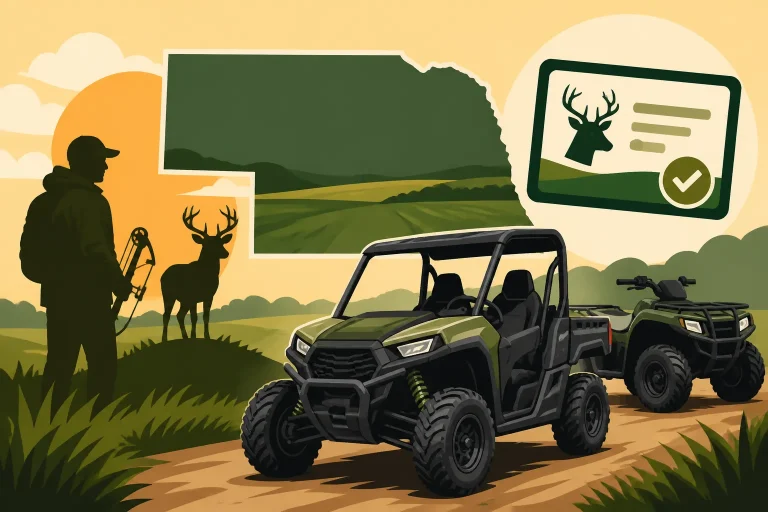
Nebraska does not require riders to complete a state ATV safety course as a general condition of operating an off-highway vehicle. A course is usually a voluntary way to learn safe riding practices, especially for a new rider, a young person, or someone moving from casual yard use to longer trail rides. See Nebraska Has No Mandatory Safety Course and Nebraska Safety Course Options for the state-level context.
An online course can cover useful fundamentals: controls, protective gear, speed management, terrain awareness, passenger risks, and what to do if a machine rolls or breaks down. It may also explain why riders should inspect a machine before use and how to avoid damaging land or putting other trail users at risk. The course can provide structure and help a rider spot gaps in their knowledge, but it cannot replace practice on the machine.
Most importantly, course completion is not the same as a Nebraska permit, registration, or authorization to use a particular trail. Nebraska does not issue a general statewide OHV permit or sticker, and a safety certificate does not create one. It also does not grant access to private land or override rules for a public riding area. Nebraska Has No OHV Permit or Sticker
A certificate may still be useful. A parent can use course material to start a conversation with a young rider, and an experienced rider can review topics they have not thought about recently. If a park, club, event, insurer, or other organization asks for training, confirm exactly what course or proof it accepts before enrolling. A generic online certificate may not meet a venue’s specific requirement.
| Question | What an online course may do | What it does not automatically do |
|---|---|---|
| Teach safe riding basics | Explain controls, protective equipment, and risk awareness | Provide supervised practice on your particular ATV or UTV |
| Provide proof of completion | Give you a certificate or record, depending on the provider | Guarantee that a park, event, or insurer will accept it |
| Help a young rider prepare | Give families material to review together | Replace adult supervision or venue age rules |
| Help with trail planning | Introduce responsible riding habits | Grant access to land or make a closed area legal to ride |
| Support a safety routine | Give you a checklist of topics to revisit | Replace the owner’s manual or machine-specific instruction |
Before enrolling, distinguish among three things that are often blurred together: a course, a permit, and a site rule. A course is instruction. A permit, where one is required, is an access or use authorization. A site rule is a condition set by the land manager or private operator. A certificate in one category does not automatically satisfy the others.
Choosing a Course and Checking Its Certificate
Online courses vary in their audience, length, format, and proof of completion. Some are designed for beginners; others are refreshers or introductions to riding with children. A course may use videos, reading, quizzes, or a final assessment. The right choice depends on who will take it and what practical decision the training is meant to support.
Start by deciding whether the goal is general learning or meeting a specific requirement. If a private riding park, organized event, insurer, or club asked for a course, ask that organization what it accepts before signing up. Find out whether it requires a particular provider, a minimum age, an in-person component, or a certificate that identifies the rider. Do not assume that any course marketed as an ATV safety course will count.
For general learning, look for material that addresses the kind of machine and riding the person will actually do. ATV handling differs from UTV operation, and a course aimed at young beginners may not cover every issue an adult faces on a utility machine. A useful course should give clear, practical instruction rather than only broad safety slogans. What an ATV Safety Course Actually Teaches You
Check the provider’s information before enrolling:
- Who is the course for? Confirm the intended age range and whether the content is aimed at a first-time rider, a parent, or an experienced operator.
- What machines does it cover? Look for an explanation of whether instruction applies to ATVs, UTVs, or both.
- How is completion documented? Check whether the provider issues a certificate, a completion record, or no formal proof.
- Who recognizes the certificate? If someone asked you to take the course, confirm acceptance with that organization directly.
- What does the course leave out? Online instruction cannot demonstrate your posture, braking, steering, or judgment in real conditions.
- Can you review the material later? A course is more useful when you can return to key safety points before a ride.
Avoid treating a certificate as proof that someone is ready for every riding situation. A novice who passes an online quiz may still need hands-on instruction in a controlled area before riding on uneven ground, sand, mud, or a narrow trail. Practice should begin slowly, with the right-sized machine, protective gear, and supervision appropriate to the rider.
The machine’s owner’s manual is another important source of instruction. It covers the specific controls, warnings, maintenance checks, and operating limits for that model. A general course can teach broad principles, but it cannot know the condition of your machine or replace model-specific directions.
If the course is for a child, involve the responsible adult. Review the material together, check the machine’s fit, and make a plan for where the child may ride and who will supervise. A completed course does not change Nebraska’s rules for where a machine may operate, and it does not replace a private park’s minimum-age policy. See Nebraska Private Park Age Minimums and Do Nebraska Kids Need a Permit? for related questions.
What a Certificate Does Not Replace
A course certificate does not make an ATV or UTV road legal. Nebraska’s road-use rules are separate from safety training, and permission to use a road depends on the applicable law and local requirements. Likewise, an online course does not authorize riding on land where motorized vehicles are prohibited.
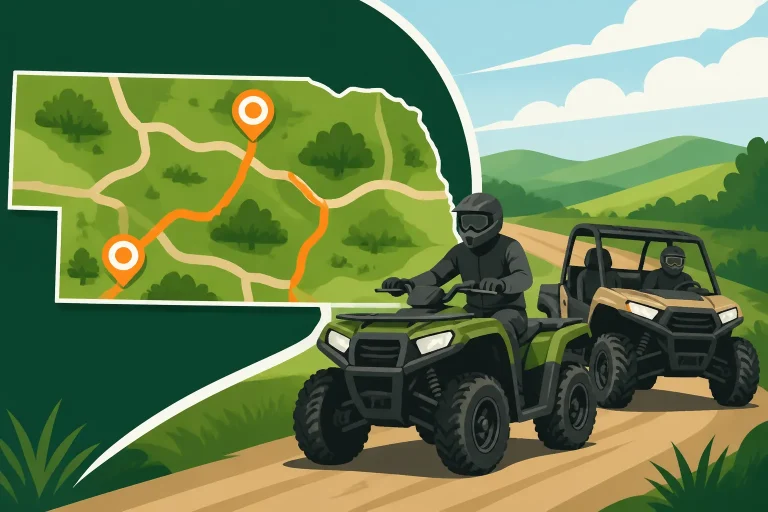
Public areas can have rules that differ by land type and managing agency. A machine that is properly titled may still be barred from a particular location. A rider who has completed training may still need to follow designated routes, posted closures, parking restrictions, or other site rules. Nebraska state parks, recreation areas, wildlife management areas, national forest land, private riding parks, and privately owned property should not be treated as one interchangeable system.
Before you load the machine, check the rules for the exact destination. Confirm that the area allows your type of vehicle, that the route is open, and that any required access permit applies to the right person or vehicle. A park entry permit, for example, is different from an ATV safety course; neither should be assumed to substitute for the other. Nebraska Park Rules for ATVs
The same separation applies to ownership and paperwork. A course certificate does not prove that you own the machine, clear a lien, or replace title documents. If a land manager or law enforcement officer asks for proof of ownership, training records are not a substitute. Nebraska Proof of Ownership on the Trail
A practical way to keep the categories straight is to ask four questions before riding:
- Is the machine properly documented? Check the title and any paperwork required for your situation.
- Is this location open to this kind of machine? Verify the land manager’s rules and posted restrictions.
- Does this ride require a permit or other authorization? Confirm the requirement with the agency or property operator.
- Is the rider prepared for the conditions? Use training, appropriate equipment, supervision, and gradual practice.
When a private facility or event sets its own training requirement, follow that rule even if Nebraska does not impose a general course mandate. Private operators may set conditions for entry, including age limits, helmet requirements, waivers, or instruction. Ask before traveling, especially if you are bringing a young rider or a machine that may not fit a facility’s track or trail limits.
Turning Online Lessons Into Safer Riding
An online course is most useful when its lessons turn into habits. Before each ride, take time to inspect the machine, check that the rider understands the controls, and talk through the plan. For a group ride, make sure everyone knows the route, meeting points, and what to do if someone gets separated.
A simple pre-ride routine can include:
- Check tires, brakes, throttle, steering, lights, and visible damage.
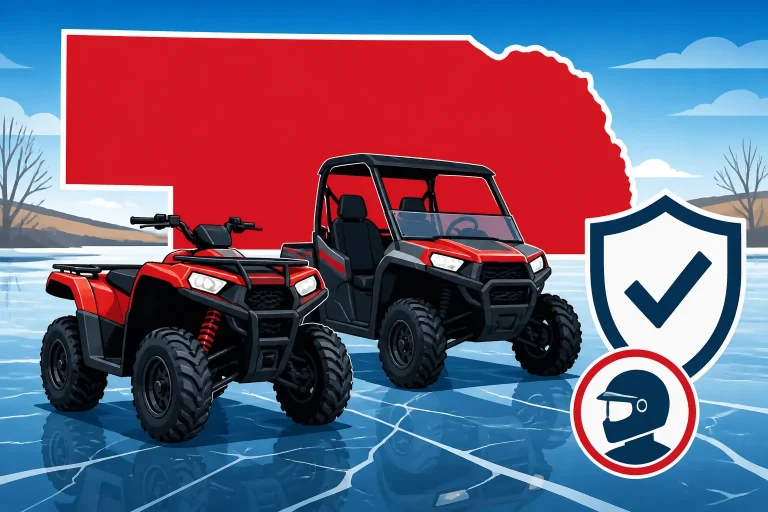
- Confirm that the rider has a properly fitting helmet and other suitable protective gear.
- Review the terrain and weather, and choose a route suited to the least experienced rider.
- Agree on riding distances, rest stops, and a way to communicate.
- Set expectations about speed, following distance, passing, and stopping.
- Tell someone who is not riding where the group is going and when it expects to return.
For younger riders, skill-building should be gradual. Begin in a permitted, open area with room to stop and turn without obstacles. Keep the pace controlled, avoid carrying a passenger unless the machine is designed for one and the applicable rules allow it, and stop when the rider is tired or distracted. A course can help explain why these choices matter, but an adult still needs to supervise and make sound decisions.
For adults, the same basics matter. Familiarity with one machine does not mean every machine handles the same way. A utility ATV, sport quad, and side-by-side can respond differently to steering, braking, slopes, and loads. Read the manual, understand the machine’s limits, and take time to adjust when switching models or riding in unfamiliar conditions.
It is also worth reviewing training before a change in riding conditions. Sand, steep slopes, mud, snow, water crossings, and riding with a group each introduce different hazards. Online lessons can prompt a useful refresher, but do not treat a short module as hands-on qualification for difficult terrain. If you are uncertain about a maneuver, choose an easier route or seek supervised instruction.
Keep a course certificate if the provider issues one, but store it as a training record rather than as a substitute for required vehicle or access documents. If a park or organization asks for proof, bring the format it specifies and confirm whether a digital copy is acceptable. For all other trips, check the destination’s current rules and bring the paperwork that actually applies to that ride.
The bottom line is straightforward: an online safety course can improve knowledge and help riders prepare, but it does not grant permission to ride, replace practice, or override Nebraska’s location-specific rules. Use it as one part of a wider safety plan: understand the machine, practice within your ability, check the destination, and follow the requirements that apply there.
Disclaimer
This article is for general informational purposes only and does not constitute professional advice. Laws, prices and regulations vary by location and change over time. Consult a qualified professional for guidance on your specific situation.