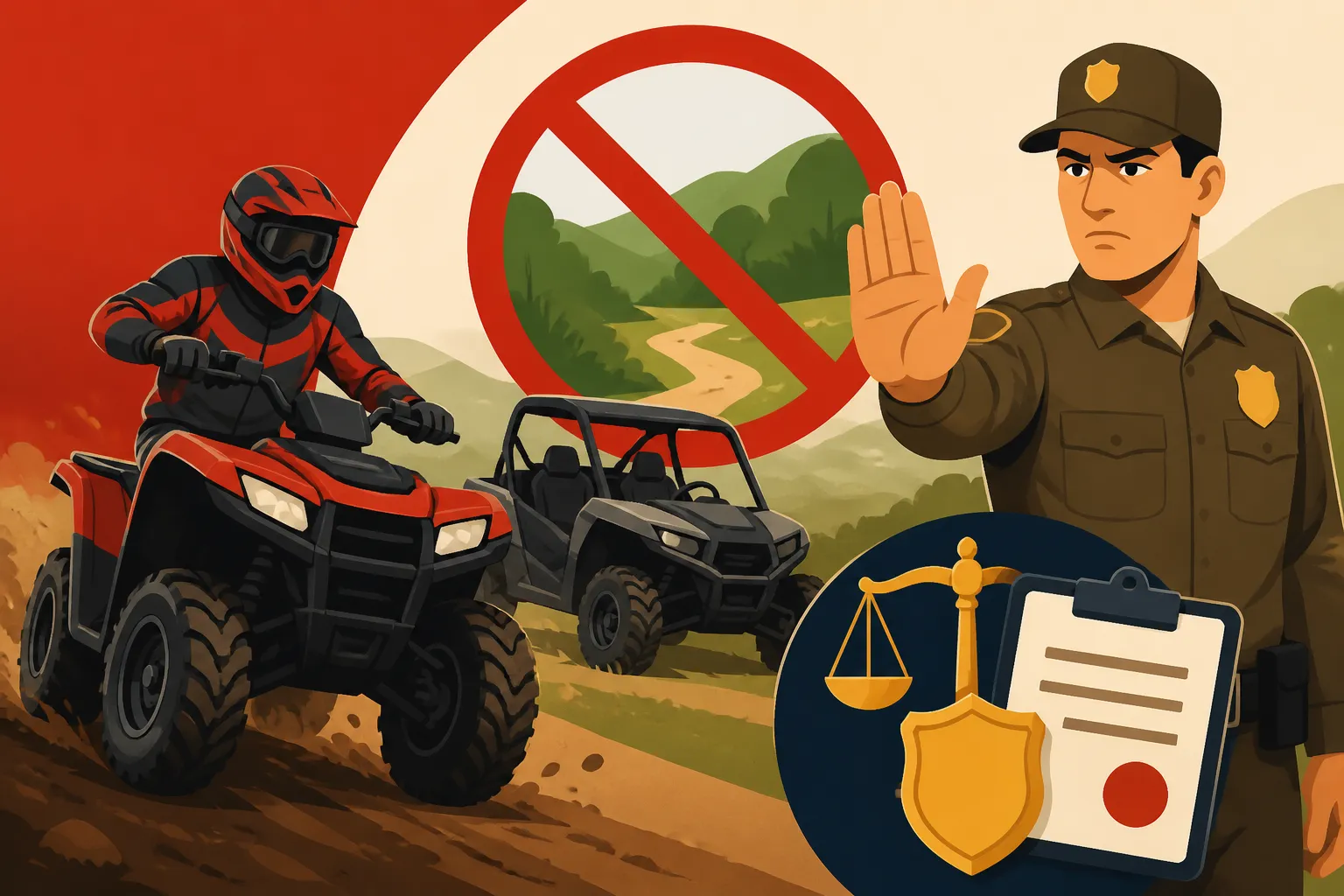
Nebraska Penalties for Riding a Closed Area
A closed trail or riding area in Nebraska is not a low-risk shortcut, even if it looks passable or you see tire tracks. The consequences depend on who manages the land, why it is closed, and whether riding caused damage or ignored a posted restriction. Here’s how to assess the risk, what to do if you receive a citation, and how to avoid turning a ride into a costly dispute.
What “closed area” can mean in Nebraska
A closure can apply to a whole property, a particular trail, a road, or a specific type of use. It may be permanent or temporary. Land managers may close routes because of wet conditions, fire danger, maintenance, wildlife protection, or other safety and resource concerns. Private owners and riding parks can also restrict access under their own rules.
The agency or owner responsible for the land matters. A state recreation area, wildlife management area, national forest, county road, and private riding park do not all use the same rules or enforcement process. There is no single penalty that applies to every Nebraska ATV or UTV rider who enters a closed place.
For example, Nebraska state parks generally do not allow ATVs. Wildlife management areas have their own vehicle rules, which limit riding to designated roadways where motorized access is allowed. National forest access depends on the routes and areas open to motor vehicles. See Nebraska State Parks Ban ATVs, Nebraska WMA Designated Roadways Only, and Nebraska National Forest Riding for more on those distinct settings.
A route that is open one day may close temporarily. Recent rain can make a trail especially vulnerable to ruts and erosion, while seasonal restrictions may protect habitat or respond to changing conditions. Check current notices before unloading, not just an old map or a route someone recommended last season. Nebraska Trail Closures After Rain explains why a trail can be closed even when it appears rideable.
| Where you are riding | What can establish a closure | Why consequences vary |
|---|---|---|
| State park or recreation area | Property rules, signs, maps, or agency notices | The property’s rules may bar ATVs or restrict vehicle use to certain places |
| Wildlife management area | Designated-road rules, posted restrictions, or temporary notices | Access may depend on the specific area and permitted route |
| National forest | Motor-vehicle route designations and closure orders | Rules can differ by road, trail, season, and type of vehicle |
| County or local land | Road status, local rules, or a closure notice | The responsible local authority and the specific restriction matter |
| Private property or riding park | Owner permission, posted terms, or park rules | Access can depend on permission, waiver terms, and property policies |
Do not assume that a lack of a gate means the route is open. Nor does seeing another rider’s tracks establish permission. Check the land manager’s current information, posted signs, and the route designation for the exact area you plan to use. If the status is unclear, ask the managing office before riding.
Also distinguish a closed riding area from a road that is legally open to limited ATV use. Nebraska’s road-use rules have separate requirements and restrictions; a road exception does not give riders permission to leave the road and continue onto closed ground. For the difference, see Can You Drive an ATV on the Road in Nebraska? and Nebraska Penalties for Illegal Road Riding.
What penalties or other consequences can follow
The consequences depend on the controlling rule and the facts. A rider might receive a citation for violating a land-use or closure restriction. If the land is private, entering without permission can also raise trespass concerns. If riding damages a trail, crops, fences, habitat, or other property, the land manager or owner may seek payment for repairs or loss in addition to any citation.
On public land, the responsible agency may handle a suspected violation through its own enforcement process or refer it for further action. Different rules can apply on federal, state, and local property. A violation involving a temporary closure, a restricted route, or damage to the land may be treated differently from a misunderstanding that is corrected immediately. Repeat conduct or refusing to leave when directed can make the situation more serious.
There is no reliable one-size-fits-all fine to quote for “riding a closed area.” The amount, if a monetary penalty applies, depends on the specific rule, the location, and the enforcement process. Other practical costs can include towing or recovery, repairs, time spent responding to a citation, and loss of access to a place you planned to ride. A private park may also deny entry or remove a rider under its rules. Read the park’s terms before riding; Nebraska Private Park Waivers and Rules covers why private facilities can set their own conditions.
A closure can also overlap with other restrictions. Riding on a closed public road, crossing onto private land, damaging a protected area, or ignoring a separate safety rule may each create a different issue. A machine’s title does not make a closed trail legal to use, and Nebraska having no general state OHV sticker does not mean every public area is open to riding. See Nebraska Has No OHV Permit or Sticker for the distinction between statewide permitting and land-specific access rules.
If you are told to leave, leave by the route the official indicates and do not continue riding elsewhere on the property unless that route is confirmed open. Do not move a closure barrier, ride around a gate, or treat a temporary closure as optional. Those choices can make it harder to show that you were trying to comply.
What to do if you are stopped or cited
Keep the interaction calm and practical. Do not argue on the trail or attempt to hide the machine. Ask which rule or closure applies and which agency or owner manages the area. If you are directed to leave, comply. You can ask how to obtain the written rule or citation details without trying to settle the dispute roadside.
Afterward, write down what happened while the details are fresh. Record the date and time, the route you took, the location of signs or barriers, what the official told you, and the names or contact details provided. Keep any citation, closure notice, map, photographs, messages, or riding-area information connected to the incident. If other people were with you, ask them to make their own notes.
Be accurate when describing what you saw. A photo can document a sign or route, but it does not by itself prove that the area was open or that the sign applied to your location. Preserve original files where possible, and avoid editing or posting images in a way that strips out useful details such as timing or location.
Read the citation or notice carefully. It should identify the alleged violation and explain how to respond. Pay attention to any response date or hearing instructions printed on it; missing a deadline can create a separate problem. If you do not understand the allegation, contact the issuing agency or court using the information on the document. For a serious allegation, alleged property damage, or a disputed boundary, consider getting advice from a qualified attorney familiar with the relevant jurisdiction.
Do not assume that paying a citation resolves every issue. A property owner may separately seek compensation for damage, and an agency or private park may have a separate access or enforcement process. Ask what the notice covers and whether another process is involved.
If you think the closure was unclear or incorrectly applied, make a concise record of why. For instance, note whether a sign was missing, obscured, or placed at a different access point. Raise those facts through the stated appeal or review process rather than returning to the closed area to recreate the situation. For questions about who to contact on public land, Questions Worth Asking a Ranger District Office can help you prepare a focused inquiry.
How to avoid riding into a closure
A few checks before the ride can prevent most access problems. Confirm the property boundary and manager, check current route information, and look for temporary notices on the day you ride. If you are headed to a private park, read its current rules and contact the operator if a route or vehicle restriction is unclear.
Use this process before unloading:
- Identify the land manager. Confirm whether the riding area is public, private, or part of a managed recreation property. Do not rely solely on a trail name or a pin on a map.
- Check the exact route. Look for route designations and closures for the road or trail you intend to ride. A property can allow access in one place and prohibit it nearby.
- Check for temporary changes. Rain, fire danger, maintenance, and other conditions can affect access. Recheck notices close to the time of your trip.
- Read signs as you enter. A sign at a trailhead or junction may apply to the route ahead. If the notice is confusing, stop and verify rather than guessing.
- Stay on the permitted route. Do not cut around a gate or ride onto a closed spur because it looks convenient. Ask the manager if the approved route is uncertain.
- Get permission for private land. Permission for one parcel or purpose does not automatically extend to neighboring land or a different route. Keep any written permission available during the ride.
If a route closes while you are there, turn around safely and follow directions from the land manager. Avoid making a new track around a closure or using an unmarked route as a detour. Even when the closure seems inconvenient, the legal and practical risk of ignoring it is usually greater than the delay of choosing another open area.
Keep your riding plan flexible. Before towing, identify an alternate legal riding location and check its access rules independently. A nearby trail is not automatically governed by the same manager or open under the same conditions. For public land, use current information from the responsible agency; for a private riding area, confirm directly with the operator. When the status remains uncertain, do not ride there until you have a clear answer.
Disclaimer
This article is for general informational purposes only and does not constitute professional advice. Laws, prices and regulations vary by location and change over time. Consult a qualified professional for guidance on your specific situation.