Does a National Forest Check Your Spark Arrestor?
If you’re planning to ride in a Nebraska National Forest, the spark-arrester question is about more than whether someone checks your machine at the trailhead. The equipment rule matters even when no inspection is apparent. Here’s what the Forest Service requires, what the available rules do—and do not—say about inspections, and how to prepare before hauling your ATV or UTV out.
The short answer: bring compliant equipment
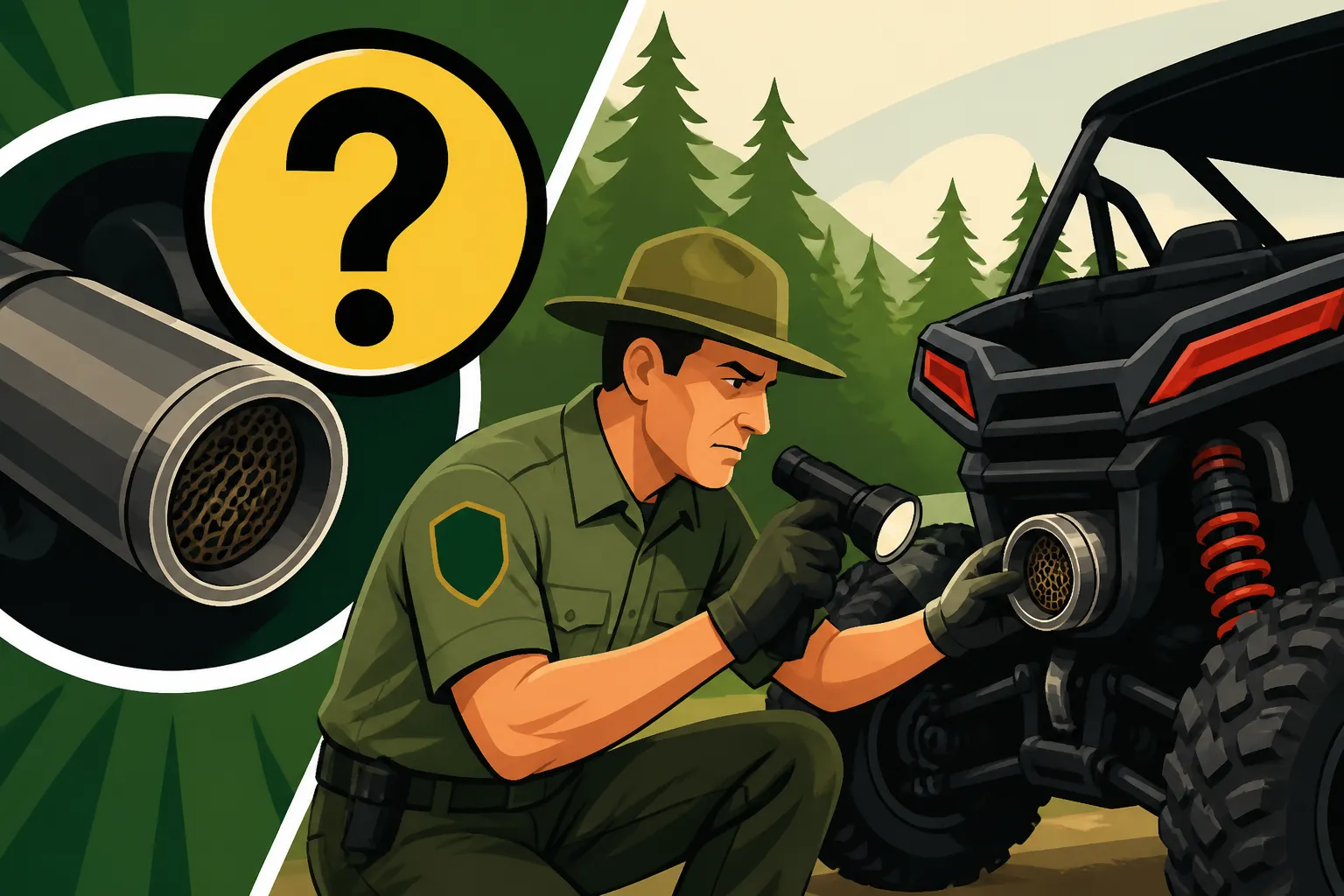
Yes, you should have the required exhaust equipment before riding. The Forest Service says vehicles must be equipped with a state-approved muffler and/or spark arrester. That is the key requirement; the available Forest Service information does not describe a universal inspection checkpoint or explain exactly how a device is checked.
So the practical answer to “Will someone check?” is not to assume that nobody will. Make sure the machine meets the equipment rule, and contact the ranger district if you need help confirming that your setup is appropriate for the area you plan to ride.
A spark arrester is a device intended to prevent hot particles from escaping through a vehicle’s exhaust. The rule is relevant on forest land, where a spark from motorized equipment can create a fire risk. A muffler and a spark arrester serve different purposes, even though the Forest Service’s wording allows a state-approved muffler and/or spark arrester. Don’t assume that a quiet exhaust automatically proves a machine has a qualifying spark arrester, or that adding a part advertised as one automatically makes the machine compliant.
The NDOT Highway Safety Office also lists a U.S. Forest Service-qualified spark arrester as required equipment for ATVs and UTVs. Treat that as a reason to verify the actual equipment on your machine, rather than relying on appearance, a seller’s description, or an assumption about what came installed at the factory.
What the requirement means for your machine
Start by checking the exhaust system and any documentation that came with the vehicle or replacement part. If the machine has been modified, if the exhaust is damaged, or if you are unsure what equipment is installed, resolve that question before riding. A replacement part’s product description alone may not establish that it meets the relevant approval requirement.
If you are shopping for a replacement, including on Amazon, look for clear information about the specific part and its qualification. If the listing is vague, ask the manufacturer or the ranger district what documentation will answer the question. A marketplace listing is not the same as confirmation from the Forest Service that a particular setup is accepted.
The rule calls for approved equipment, not merely something that looks like a screen or insert. Keep any product information or installation paperwork with your vehicle records. That won’t substitute for a compliant part, but it can make it easier to answer questions about what is fitted to the machine.
| What to check | Why it matters |
|---|---|
| The installed exhaust equipment | Forest Service rules require a state-approved muffler and/or spark arrester. |
| The part’s approval or qualification information | A generic product description may not establish that the part is approved. |
| Whether the exhaust has been changed or damaged | A modified or faulty setup may not match the equipment information you relied on. |
| The trail’s vehicle-width limit | A machine may meet the equipment rule but still be too wide for a particular trail. |
| The current area rules and map | Forest Service travel is limited to designated roads, trails, and areas. |
Don’t confuse a spark arrester requirement with a general vehicle inspection. The information provided establishes an equipment rule, but it does not say that every rider is stopped, that every trailhead has a checkpoint, or that the same inspection process is used across the Nebraska National Forests and Grasslands. If your concern is whether a specific location conducts inspections, ask that ranger district directly. Either way, being ready to show what equipment you have is more sensible than planning around the possibility of not being asked.
Where the rule fits into Nebraska forest riding
Nebraska has several different kinds of riding areas, and they don’t all work the same way. Forest Service rules require OHVs to stay on roads, trails, and areas designated on the motor vehicle use map. That means a compliant spark arrester doesn’t give you permission to ride wherever the ground looks open. Check the map and the local rules for the exact area you’re visiting.
The Bessey and Pine Ridge Ranger Districts are the two places with true OHV motorized trails, according to the Forest Service. Both allow vehicles 64 inches wide or less on their trails. The Forest Service describes the Bessey OHV Trail System as having about 36 miles of trails, and its designated trails are open to vehicles 64 inches or less in width. Those width limits are separate from the exhaust-equipment requirement: meeting one doesn’t mean you meet the other.
Nebraska’s vehicle definitions can also make width worth checking. The Nebraska Department of Motor Vehicles defines an ATV as 50 inches or less in width and a UTV as 74 inches or less in width. The Forest Service’s 64-inch trail limit is narrower than the state’s UTV definition, so a vehicle that fits Nebraska’s UTV definition may still be too wide for a designated trail. Measure the machine as configured for riding and confirm the specific route’s restrictions before you tow it there.
For more on where riding is allowed, see Nebraska National Forest Riding and Nebraska ATV Trails: Where to Ride. If Bessey is your destination, Bessey’s 36 Miles of Forest Trail at Halsey can help you understand the trail system. Use the current motor vehicle use map as your route authority; the Forest Service says the map contains the rules for motorized travel. Paper maps are available at the Forest Service office in Chadron.
Other motorized areas have different access rules. Railroad Buttes and the Hill Climb are popular designated areas where cross-country driving is allowed, according to the Forest Service. The Railroad Buttes OHV Area has three large open-riding areas covering 1,745 acres in total. The Baja OHV Area covers approximately 1,335 acres and is open to motorized cross-country travel within its boundary; once outside that boundary, visitors must stay on designated trails. These areas are not a reason to ignore equipment requirements or posted restrictions.
Nebraska also has no fees specific to OHV riding across the National Forests and Grasslands, according to the Forest Service. That does not mean every part of a trip is free: the Forest Service requires a day-use fee for highway vehicles used to transport OHVs at the Bessey Recreation Complex. Check the current arrangements for your destination and distinguish a fee for parking or transport from a riding permit. For more on the state’s permit picture, see Nebraska Has No OHV Permit or Sticker.
How to prepare before you head out
A little checking before departure can prevent a frustrating trip, especially if your machine has an aftermarket exhaust, you are borrowing someone else’s vehicle, or you are choosing a trail for a wide UTV.
- Identify the riding area and route. Decide whether you’re going to Bessey, Pine Ridge, Railroad Buttes, Baja, or another location. Read the relevant area rules and use the official motor vehicle use map to confirm which roads and trails are open to your vehicle.
- Check the machine’s exhaust equipment. Look at what is installed and review the vehicle or part documentation. If you cannot tell whether the equipment meets the approval requirement, ask the manufacturer or the ranger district rather than guessing.
- Confirm width and vehicle access separately. A vehicle can have acceptable exhaust equipment and still exceed a trail’s width limit. The Forest Service limits Bessey and Pine Ridge trail access to vehicles 64 inches wide or less.
- Ask about inspection procedures if that is your concern. The general equipment rule does not establish whether a particular trailhead conducts checks. Contact the relevant ranger district for information about the site and current operating conditions.
- Recheck conditions close to your trip. Closures, access, and site details can affect your route. Nebraska Trail Conditions Before You Tow is useful for planning, and Planning for No Cell Service on a Forest Ride can help you prepare for a remote outing.
Also keep road travel separate from off-highway riding. Nebraska’s public-road rules are not a substitute for Forest Service trail rules. The Nebraska government says authorized ATV and utility vehicle operation on public roadways is limited to between sunrise and sunset, and operators must have liability insurance and a valid Class O operator’s license or farm permit. Those conditions concern authorized roadway operation; they do not make an ATV or UTV road-legal everywhere, and they do not replace the Forest Service’s equipment and designated-route requirements.
The same distinction applies to riding fees and permits. A state sticker, a fee for a vehicle used to transport OHVs, and the permission to use a particular trail are different things. Check each separately. For trip-planning basics, Nebraska Trail Etiquette Locals Expect can help with shared-use considerations, while the motor vehicle use map remains the essential reference for where motorized travel is allowed.
The simplest takeaway is to arrive with a compliant setup, not to plan around whether anyone will inspect it. The Forest Service equipment rule applies regardless of whether a checkpoint is mentioned, and riding access depends on the specific area, map, and vehicle limits. When the part, route, or local procedure is unclear, confirm it with the ranger district before loading up.
Sources
- Nebraska Department of Motor Vehicles — ATVs, Minibikes and UTVs | Nebraska Department of Motor Vehicles (checked November 3, 2026)
- Forest Service — Nebraska National Forests and Grasslands | Off-Highway Vehicles (OHV) | Forest Service (checked November 3, 2026)
- Nebraska government — Vehicles-ATVs-Slow-Speed-Vehicles-Golf-Carts-Flyer-PDF?bidId= (checked November 3, 2026)
- Nebraska Department of Motor Vehicles — Driver's License (Class O) | Nebraska Department of Motor Vehicles (checked November 3, 2026)
- NDOT- Highway Safety Office — nebraskas-all-terrain-vehicle-atv-law.pdf (checked November 3, 2026)
- Forest Service — Nebraska National Forests and Grasslands | Bessey OHV Trail System | Forest Service (checked November 3, 2026)
- Forest Service — Nebraska National Forests and Grasslands | Recreation | Forest Service (checked November 3, 2026)
- Forest Service — Nebraska National Forests and Grasslands | Baja OHV Travel Management Area | Forest Service (checked November 3, 2026)
- Nebraska National Forests and Grasslands — Motorized%20Trail%20Map%20for%20Bessey%20Ranger%20District.pdf (checked November 3, 2026)
Disclaimer
This article is for general informational purposes only and does not constitute professional advice. Laws, prices and regulations vary by location and change over time. Consult a qualified professional for guidance on your specific situation.