Sound Testing at the Gate of a Riding Park
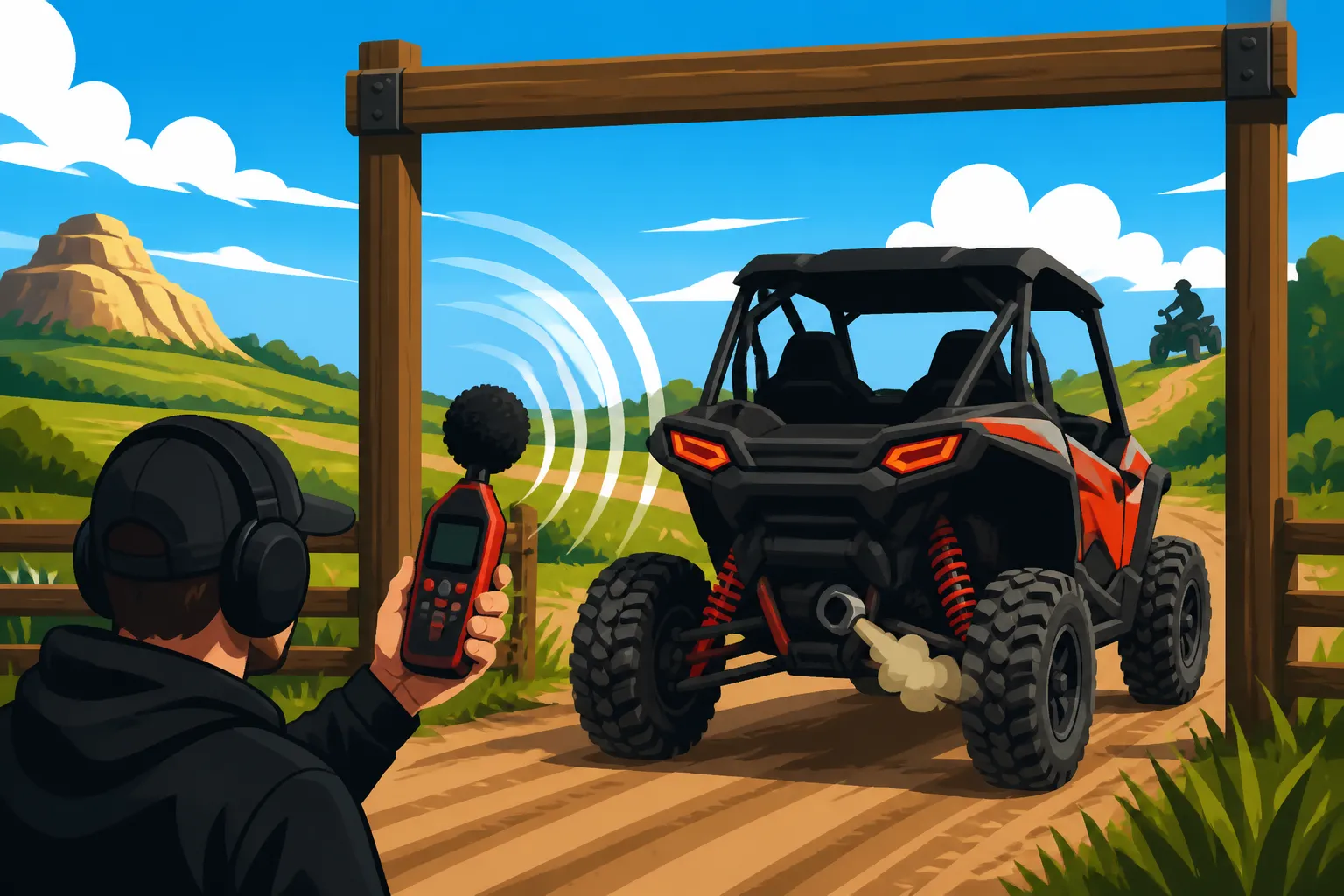
A sound check at a riding park gate can catch you off guard, especially if your ATV or UTV has an aftermarket exhaust. Nebraska parks may set their own access rules, and a machine that sounds acceptable at home could be turned away under a park’s test procedure. Find out what the park checks before you tow, then inspect and prepare your machine accordingly.
Why a riding park might test your machine’s sound
A riding park may use a sound check to manage noise for nearby visitors, neighbors, wildlife, or other land users. The test can be part of a private park’s admission or operating rules, rather than a statewide ATV permit requirement. A riding permit, an out-of-state registration, or permission to ride elsewhere does not automatically exempt you from a park’s noise policy.
Nebraska’s public-land requirements and a private park’s entry conditions are not interchangeable. Before riding on public land, check the applicable rules, including Nebraska Sound Limits on Public Land. Before visiting a privately operated park, read its current entry instructions and waiver information, such as the details covered in Nebraska Private Park Waivers and Rules. A park can set its own conditions for access, within the rules that apply to its property and operation.
Not every park tests every machine, and testing procedures can differ. One facility might rely on posted rules or staff judgment; another may use a sound meter at the entrance. A park’s policy may also specify what happens if a machine does not pass, such as requiring repairs, retesting, or leaving the riding area. Do not assume a park uses a particular national standard or threshold unless it tells you so.
A sound check is also separate from a mechanical or safety inspection. A machine could meet a park’s noise rule and still be refused entry for another reason, such as an unsafe condition, an equipment restriction, or a width that does not suit the trail. If you are bringing a side-by-side, check rules such as When a Side-by-Side Is Too Wide for a Trail as well as noise requirements.
How the sound check may work
There is no single gate procedure that applies to every Nebraska riding park. The park should be your source for the specific process it uses. Ask whether testing is required, whether all machines are checked, and what the staff expects you to do when you arrive.
A sound meter reports sound level, usually in decibels. That reading depends on more than the exhaust itself. The distance and angle between the meter and machine, the engine speed, surrounding noise, wind, and the test environment can all affect a measurement. A reading taken beside a running generator or in a sheltered spot may not be comparable to one taken in an open, quiet area.
| What can affect a reading | Why it matters | What to ask the park |
|---|---|---|
| Test location | Walls, buildings, and other surfaces can reflect sound | Where does the test take place? |
| Meter position | Distance and angle can change what the meter receives | Does staff position the meter, or should the rider? |
| Engine operation | The result may differ at idle versus a specified engine speed | What should the rider do with the throttle? |
| Background noise | Other engines, wind, and nearby activity can interfere | What happens if the area is too noisy for a reliable check? |
| Machine setup | Exhaust condition and installed accessories affect sound | Are aftermarket exhausts or inserts restricted? |
| Retest procedure | A first reading may not settle the question | Can the machine be checked again after an adjustment? |
A phone sound-level app can help you notice that a machine is louder than expected, but it is not a dependable substitute for the park’s test. Phone microphones and apps vary, and a reading at home may use a different setup from the one at the gate. A standalone meter bought through a retailer such as Amazon may offer a more useful rough comparison, but do not treat a personal reading as proof that you will pass. Ask the park what equipment and procedure it uses before spending money on a meter.
If staff asks you to hold a particular engine speed or position the machine in a certain way, follow the instruction rather than revving harder or repeatedly testing on your own. If you cannot hear the direction clearly, ask them to repeat it. A calm, consistent test is more useful to both sides than an argument over a reading produced under different conditions.
How to prepare before you tow
The best preparation is to contact the park and inspect the machine before travel. Policies can be updated, and an old social media post or another rider’s account may describe a different process. Ask for the current sound policy in writing if the details are unclear.
Before your trip:
- Ask what the park actually tests. Confirm whether it checks every ATV and UTV, only certain machines, or machines that staff considers unusually loud.
- Request the test method and entry consequence. Ask whether there is a stated sound limit, how the machine is operated during the check, and whether a failed reading means a retest or no riding that day.
- Check the exhaust system. Look for loose parts, visible damage, leaks, missing components, or signs that the system has been modified. A damaged or altered system can be louder than intended.
- Confirm the right parts are installed. If your exhaust uses a removable insert or other noise-control part, make sure it is fitted as intended and secure. Do not rely on a temporary fix that could loosen or create a safety problem.
- Avoid making last-minute changes without checking fit and safety. An improvised insert or obstruction may affect performance or create heat and exhaust problems. Use parts designed for the machine and follow the manufacturer’s instructions.
- Plan to arrive with time to spare. If staff needs to check the machine or explain a rule, arriving at the last moment can make a manageable issue more stressful.
- Check the rest of the park’s conditions. Review trail access, machine-size limits, waiver requirements, age rules, and any other entry conditions. Nebraska Trail Conditions Before You Tow can help with trip planning, while Nebraska Trail Etiquette Locals Expect covers practical conduct once you are riding.
If you are unsure whether your machine is likely to be a problem, describe its make, model, exhaust setup, and any modifications when you contact the park. A vague question such as “Is my ATV too loud?” may not give staff enough information to answer usefully. If the machine has an aftermarket exhaust, say so directly and ask whether that type of setup is allowed.
Do not assume that a stock exhaust guarantees entry, either. Damage, missing parts, poor maintenance, or a park-specific restriction can still matter. The goal is not to guess a result from the badge on the muffler; it is to understand the actual rule and arrive with a machine in sound condition.
What to do if your machine does not pass
If a staff member says the machine exceeds the park’s sound limit, first ask them to explain the result and the next step. Confirm whether they can repeat the check under the park’s normal procedure, especially if wind, nearby engines, or a misunderstanding about engine operation may have affected the test. Stay courteous: the person at the gate is applying the park’s access policy, and a dispute is unlikely to make the machine quieter or get you on the trail.
If the park permits a retest after a straightforward adjustment, make only a safe, appropriate change and follow staff directions. Do not remove parts, block an exhaust outlet, or make an unsafe roadside repair just to chase a passing reading. If the machine needs a proper repair, stop and arrange that before riding.
If there is no way to meet the park’s rule that day, ask whether the park offers an alternative, such as returning after repair or rescheduling. Do not leave the machine running near other visitors while discussing the issue. If you decide to leave, secure it for transport and check that the trailer and tie-downs are safe.
A failed park test does not necessarily establish that the machine violates every rule in Nebraska, just as passing a private park’s test does not prove it meets every rule on public land. The test answers the question under that park’s policy and procedure. For public riding, check the rules that apply to the specific land and riding area. For another private venue, check that operator’s requirements rather than assuming the result carries over.
The most reliable approach is simple: confirm the park’s policy before departure, keep the exhaust system intact and maintained, and arrive ready to follow the staff’s test procedure. That can prevent a long haul from ending at the entrance and keeps the focus on choosing a legal, suitable place to ride. If the park’s instructions are vague, Questions Worth Asking a Ranger District Office may help with public-land questions; for a private park, contact the operator directly.
Disclaimer
This article is for general informational purposes only and does not constitute professional advice. Laws, prices and regulations vary by location and change over time. Consult a qualified professional for guidance on your specific situation.