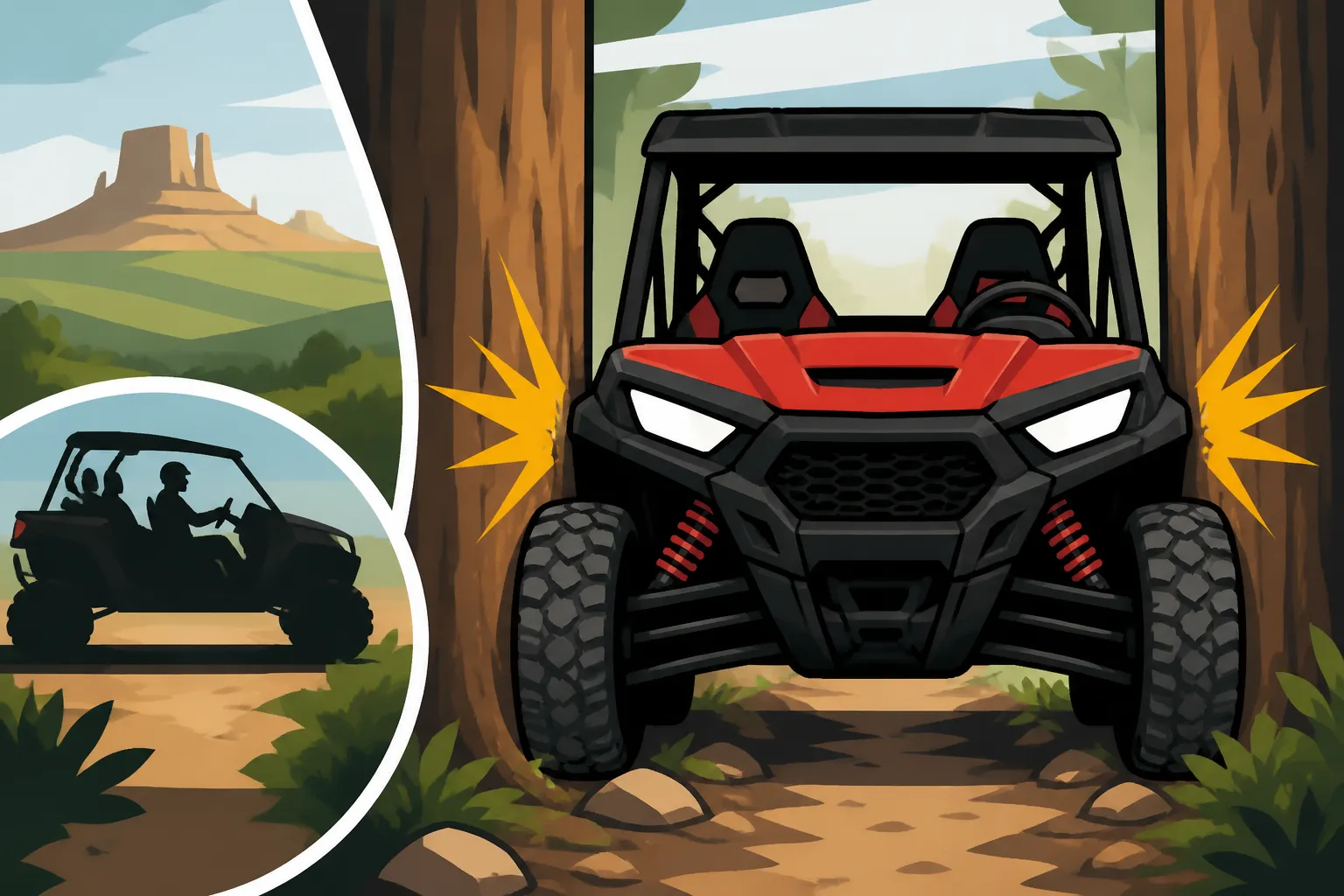
When a Side-by-Side Is Too Wide for a Trail
A side-by-side can fit Nebraska’s definition of a UTV and still be too wide for a designated trail. That difference matters when you’re choosing where to ride or deciding whether to haul your machine across the state. The key is to compare your vehicle’s actual width with the specific area’s limit, then confirm which routes and open areas are allowed.
Why a UTV can be legal but too wide for a trail
Nebraska’s vehicle categories and a trail’s access rules answer different questions. One defines the type of machine; the other determines which vehicles may use a particular route.
According to the Nebraska Department of Motor Vehicles, a utility type vehicle, or UTV, is a motorized off-highway vehicle no more than 74 inches wide. The agency defines an ATV as a motorized off-highway vehicle no more than 50 inches wide that travels on three or more non-highway tires. A UTV travels on four or more non-highway tires.
But a vehicle’s classification does not guarantee that it can use every trail. The Forest Service limits vehicles on the designated trails in the Bessey and Pine Ridge Ranger Districts to 64 inches wide or less. A side-by-side that meets Nebraska’s UTV definition may therefore exceed the width allowed on those trails.
| What you’re checking | Width or rule | What it means |
|---|---|---|
| Nebraska UTV definition | 74 inches or less | A machine within this width may fit the state’s UTV definition, according to the Nebraska Department of Motor Vehicles. |
| Bessey and Pine Ridge designated trails | 64 inches or less | The Forest Service says vehicles wider than this cannot use these trails. |
| Nebraska ATV definition | 50 inches or less | This is the state’s width limit for the ATV category, according to the Nebraska Department of Motor Vehicles. |
In practical terms, “UTV” does not mean “fits on a UTV trail.” The trail’s stated limit is the deciding factor. The 64-inch limit applies to the designated trails in those ranger districts; don’t assume it is the width rule for every riding area in Nebraska.
That distinction is especially important when a manufacturer describes a model as trail-capable or gives a width measurement that sounds close to the limit. Check the exact measurement for your machine and the specific access rules for your destination. For a broader look at local trail options, see Nebraska Trails That Allow Side-by-Sides and Nebraska National Forest Riding.
How to check your side-by-side’s width before you go
Start with the machine’s manufacturer specifications, but don’t rely on a model name or a general description. Different configurations of a similar machine can have different measurements. Accessories or changes made after purchase may also affect the machine’s widest point.
If the published width is near a trail’s limit, verify the measurement rather than guessing. A tape measure, including one purchased through Amazon, can help you check the vehicle at its widest point. Measure the machine as it will be hauled and ridden, with any installed parts that extend its width. If you’re uncertain whether a particular accessory counts toward the Forest Service’s measurement, ask the relevant ranger district how it applies the limit before traveling.
A useful pre-trip check is:
- Find the exact model and configuration in the manufacturer’s specifications.
- Compare that measurement with the destination’s posted or published width limit.
- Check the vehicle as equipped, especially if it has added parts that extend beyond the body.
- Ask the ranger district if the measurement is close to the limit or the rule is unclear.
- Confirm that your intended route is open to your vehicle, not just that the area permits OHV use.
The last step matters because access can vary within one recreation area. An open riding area, a road, and a designated trail may have different rules. A site that allows broader riding in one location does not necessarily allow a wider machine onto trails outside that boundary.
The Forest Service says OHVs must stay on roads, trails, and areas designated on the motor vehicle use map. It also identifies the Bessey and Pine Ridge Ranger Districts as the two places in Nebraska National Forests and Grasslands with true OHV motorized trails. Check the official motor vehicle use map for the routes you plan to ride; the Forest Service says the map contains the rules for motorized travel. Nebraska ATV Trail Map Downloads can help with trip planning, but confirm current route access with the official map and ranger district before you tow.
Where width limits matter in Nebraska
The Bessey OHV Trail System is a clear example of why the measurement matters. The Forest Service says its designated trails are open to vehicles 64 inches wide or less. A side-by-side wider than that should not be planned for those trails, even if it falls within Nebraska’s definition of a UTV.
Bessey also has open areas, including the Hill Climb and the Dismal. The Forest Service identifies those as open areas within the trail system, but an open area is not a blanket permission to drive wherever you choose. Check the map and local rules to understand where cross-country travel is allowed and where you must stay on designated routes. For more detail on planning around Bessey’s routes and open areas, see Bessey’s 36 Miles of Forest Trail at Halsey, What to Expect at the Hill Climb Open Area, and Riding the Dismal Open Area at Bessey.
Other Forest Service areas may have different riding arrangements. The Railroad Buttes OHV Area has three large open-riding areas, and the Baja OHV Area allows motorized cross-country travel within its designated area. Those facts do not mean every nearby route is open to every vehicle, or that the Bessey and Pine Ridge trail-width limit applies identically to every location. Check the specific area’s map and restrictions before choosing a destination.
| Riding situation | What to confirm |
|---|---|
| Designated trail in Bessey or Pine Ridge | The Forest Service limit is 64 inches or less for vehicles on the trails. |
| Bessey open area | Confirm the boundaries and where cross-country riding is allowed on the official map. |
| Railroad Buttes or Baja | Check the area-specific map and rules; do not assume a rule for a different district applies. |
| Route between a trailhead and riding area | Confirm that each connecting road or trail is open to your vehicle. |
| Road travel to reach a riding site | Check whether public-road operation is permitted for your trip and whether you meet the applicable requirements. |
The Forest Service also requires vehicles to have a state-approved muffler and/or spark arrester, and recreational riding within developed campgrounds is prohibited. Those requirements are separate from width limits, but they can also affect whether your planned ride is allowed. Nebraska Trail Conditions Before You Tow is useful when checking the rest of your trip plan.
If your machine exceeds a trail’s limit, don’t treat a nearby road or an open patch of ground as an automatic workaround. Use only routes and areas identified as open for motorized travel, and ask the ranger district about a legal alternative. The right answer may be a different designated area rather than a different route within the same trail system.
What to do if your UTV is wider than the trail limit
If your side-by-side is wider than the limit for the trails you planned to ride, change the plan before you arrive. You can look for an area whose rules fit your machine, choose a permitted open area, or leave the UTV at home and bring a narrower vehicle. Don’t count on being allowed to ride a wider machine because it can physically fit between trees or through a narrow section.
When checking another destination, ask specific questions rather than only asking whether it allows UTVs:
- What is the maximum vehicle width for the exact trail or area?
- Does the limit apply to the vehicle as equipped?
- Are there separate rules for designated trails, open areas, and connecting roads?
- Is the route shown as open on the official motor vehicle use map?
- Are there equipment requirements or seasonal restrictions that affect the trip?
A phone call before departure can save a long haul to a place where the machine cannot use the route you intended. It also helps avoid confusing a site’s general OHV access with access to every trail in that area. If you’re planning to use Bessey, review Planning a Long Trailer Haul to the Bessey Trails and confirm parking and trail access with the ranger district.
Finally, keep trail access separate from road-use rules. Nebraska allows ATV and utility-vehicle operation on public roads only in specified circumstances, such as agricultural use outside corporate limits or where a city ordinance or county board resolution authorizes it. According to Nebraska government, authorized public-road operation is limited to daylight, operators need a valid Class O license or farm permit, liability insurance is required, and the speed must not exceed 30 mph. Those road provisions do not authorize a wide UTV to use a trail that has a narrower width limit.
The practical rule is simple: use the vehicle definition to understand what kind of machine you have, and use the destination’s access rules to decide where it can go. For Nebraska’s designated Bessey and Pine Ridge trails, the Forest Service’s 64-inch limit is the figure to check against your machine before you leave.
Sources
- Nebraska Department of Motor Vehicles — ATVs, Minibikes and UTVs | Nebraska Department of Motor Vehicles (checked November 3, 2026)
- Forest Service — Nebraska National Forests and Grasslands | Off-Highway Vehicles (OHV) | Forest Service (checked November 3, 2026)
- Nebraska government — Vehicles-ATVs-Slow-Speed-Vehicles-Golf-Carts-Flyer-PDF?bidId= (checked November 3, 2026)
- Nebraska Department of Motor Vehicles — Driver's License (Class O) | Nebraska Department of Motor Vehicles (checked November 3, 2026)
- Forest Service — Nebraska National Forests and Grasslands | Bessey OHV Trail System | Forest Service (checked November 3, 2026)
- Forest Service — Nebraska National Forests and Grasslands | Recreation | Forest Service (checked November 3, 2026)
- Nebraska National Forests and Grasslands — Motorized%20Trail%20Map%20for%20Bessey%20Ranger%20District.pdf (checked November 3, 2026)
Disclaimer
This article is for general informational purposes only and does not constitute professional advice. Laws, prices and regulations vary by location and change over time. Consult a qualified professional for guidance on your specific situation.