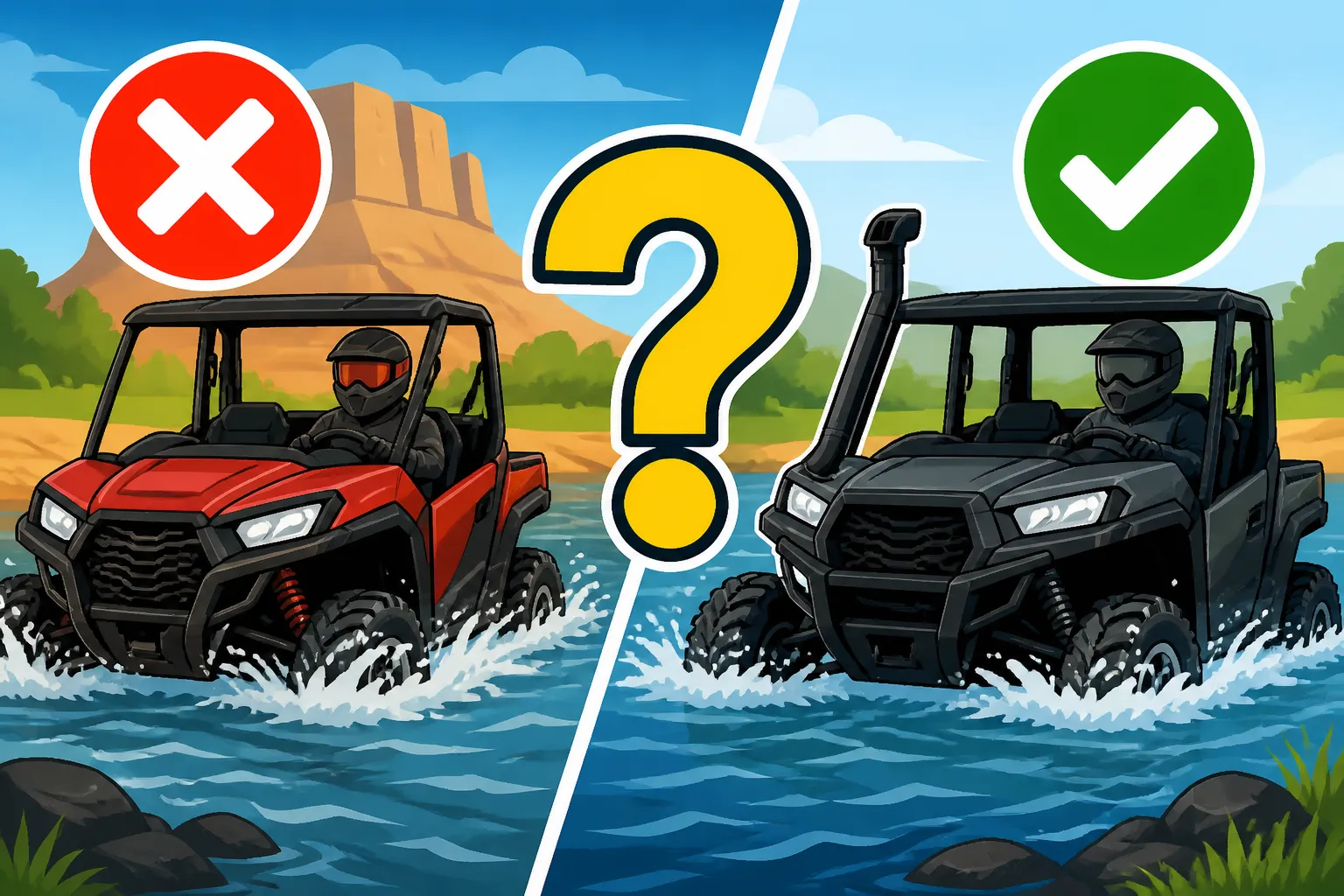
Do You Need a Snorkel for River Crossings?
A shallow-looking crossing can hide a deep rut, a soft bottom, or a current strong enough to push an ATV or UTV off line. A snorkel may help protect an engine and CVT when water is part of your regular riding, but it does not make a machine waterproof. This guide explains when a snorkel helps, what it cannot protect, and how to assess a Nebraska ride before entering water.
What an ATV or UTV snorkel actually does
Raising the engine air intake
An engine needs air, and its intake opening is usually positioned where it can draw in air during ordinary riding. If water reaches that opening, the engine may suck water into the intake. Because water does not compress like air, trying to run or restart an engine that has taken in water can cause severe damage.
A snorkel relocates the engine’s air intake to a higher point, often near the handlebars or roofline. That can reduce the chance of drawing water into the engine during a crossing. The height matters: a snorkel only offers protection up to the point where its opening is submerged, and waves, splashing, a sudden drop-off, or a nose-down angle can bring water higher than expected.
A snorkel is not a license to enter deep water. The machine still has electrical connections, bearings, seals, control components, and other areas that may be affected by immersion. Even if the engine intake stays above water, a crossing can leave you with contaminated fluids, wet connectors, a damaged belt, or a machine that cannot safely make it back to shore.
Protecting the CVT and other vents
Many ATVs and UTVs use a continuously variable transmission, or CVT. It relies on airflow through its housing to help manage heat. Depending on the machine, the CVT has an air intake and an outlet that may sit lower than the engine’s air intake. A high engine snorkel by itself may not protect the CVT from water.
A properly designed snorkel system may raise the engine intake, CVT intake, and CVT outlet. Some machines also have differential or transmission breather lines that need attention. If those vents are low, water can enter as components cool or pressure changes. A kit that appears to have tall pipes may still leave important openings exposed, so check the design for your exact make and model.
Installation quality matters just as much as snorkel height. Loose clamps, gaps, poorly sealed joints, or a line routed where it can kink may undermine the setup. Some owners install a kit and assume the machine is ready for deep water, then discover that one unprotected vent or connection was the weak point.
What a snorkel does not make waterproof
Think of a snorkel as one part of a water-preparation plan, not a waterproofing package. It cannot prevent water from entering through every seal, electrical connector, axle, brake, or housing. It also cannot keep the machine afloat or protect you from a hidden hole, slippery rocks, or a current that shifts the vehicle sideways.
Before buying a kit, read the machine’s owner’s manual for its stated water-fording guidance. Treat that guidance as a boundary, not a challenge to exceed. If the manual’s recommendation is more conservative than what you have seen other riders do, follow the manual. A modified machine may have different weak points, but modifications do not automatically increase its safe operating depth.
When a snorkel may be worth considering
How often you expect to ride in water
For an occasional crossing on a marked trail, a snorkel may not be necessary. The safer decision may be to avoid water that is deeper than the machine’s guidance, choose a dry route, or turn around. If your normal riding involves repeated water crossings, muddy conditions, or a machine used for work where shallow water is routine, protecting the intake and CVT may be worth discussing with a qualified ATV or UTV mechanic.
The key question is not simply, “Will I cross water?” It is, “How often, how deep, and under what conditions?” A single predictable, shallow crossing is different from repeated immersion in silty water or a fast-moving channel. Repeated water exposure can also increase maintenance needs, even when no dramatic failure happens on the trail.
Your machine and its intended use
A snorkel setup that works for one model may not fit another. Check whether a complete kit is available for your exact machine and whether the installation affects body panels, storage, visibility, or access to service points. If you use a UTV for ranch or utility work, consider whether raised pipes could snag on branches, interfere with a cab, or make it harder to load the machine.
| Riding situation | Is a snorkel likely to help? | What to consider first |
|---|---|---|
| Infrequent, shallow crossings | Often not essential | Follow the manual and avoid uncertain water |
| Regular muddy riding | May help protect intake and CVT openings | Confirm all relevant intakes and vents are addressed |
| Deep or flowing water | Not a substitute for avoiding the crossing | Current, bottom conditions, and machine limits can make it unsafe |
| Work use with predictable water exposure | May be worth evaluating | Ask a mechanic about the specific machine and maintenance demands |
| Unknown depth or hidden channel | No modification makes it a safe bet | Turn around or find a known route |
A snorkel can also change how you use and maintain your machine. Ask the installer how to inspect the system, what to do after water exposure, and whether the modification affects warranty coverage. Get clear answers about the engine intake, CVT airflow, and breather routing—not just the height of the visible pipes.
When a snorkel is the wrong answer
A snorkel is not a solution to strong current, a flood-swollen stream, a washed-out trail, or a crossing where you cannot see the bottom. Water can push an ATV or UTV downstream, destabilize it, or conceal a hole deep enough to trap the machine. A raised intake does not change those hazards.
It is also a poor reason to enter water that is prohibited or outside the designated riding area. Before planning a ride, check the site’s current rules and route information. For example, [Nebraska Corps Land Riding Rules] can help you understand why access rules around managed areas matter, while Nebraska State Parks Ban ATVs is a useful reminder that a public recreation area is not automatically open to motorized riding. Confirm the rules for the specific place you intend to visit.
How to assess a crossing before you ride
Check the route and local access rules
Do not plan a trip around an assumption that a river, creek, or wet section is open to ATV or UTV traffic. A line on a map does not guarantee that a crossing is legal, maintained, or passable. Trail access can vary by property, management area, season, and temporary closure.
Use a current trail map or mapping tool such as onX Offroad to help plan your route and understand nearby land boundaries. Treat the map as a planning aid, not permission to ride. Confirm access with the land manager or riding area, and check for closures before hauling the machine. The broader guide Nebraska ATV Trails: Where to Ride can help you start with designated riding areas, while Nebraska Trail Conditions Before You Tow is relevant when weather may have changed the route.
Pay attention to the whole route, not just the crossing itself. A trail may be open but have a washed-out approach, soft banks, or a closure beyond the water. If your plan depends on cell service, save the route information ahead of time; Planning for No Cell Service on a Forest Ride covers why an offline backup can matter when you are away from reliable coverage.
Judge depth, current, footing, and exit
Never assume a crossing is shallow because the water looks calm from the bank. A clear surface can hide a deep rut, submerged debris, a sharp drop, or a soft bottom that will swallow tires. Water color, reflections, and glare can make it difficult to judge depth accurately. If you cannot confidently assess the entry, crossing, and exit, do not ride into it.
Moving water deserves particular caution. Current can push against the machine’s tires and body, and the force may increase quickly with depth. A UTV’s larger side profile can catch water, while an ATV can lose traction or be pushed off its line. Do not step into moving water to test it if doing so could put you at risk. If the water is moving fast, rising, or carrying debris, choose another route.
Look for a stable entry and exit that are part of the legal route. A safe-looking approach is not enough if the far bank is steep, muddy, undercut, or blocked. If you cannot see a clean exit, or the route requires riding through a streambed that is not designated for motorized use, turn around. Reading Nebraska Trail Etiquette Locals Expect can also help keep a ride respectful of shared trails and land.
Choose a conservative crossing strategy
If a crossing is permitted and within the machine’s stated limits, approach slowly and steadily. Avoid charging in, which can throw a bow wave over the intake or make it harder to react to a hidden obstacle. Keep enough distance from other riders that you are not forced to enter before you have watched the crossing and assessed conditions.
Do not follow another rider blindly. Their machine may have a different intake height, tire setup, wheelbase, or ground clearance. A crossing that was manageable for a snorkeled UTV may be unsuitable for a stock ATV. If you are riding with a group, agree that anyone can call off the crossing without pressure or teasing.
Use onX Offroad or another mapping tool to identify alternate routes before you leave, but recheck the ground conditions when you arrive. A map can help you avoid wasting a long tow to a closed trailhead; it cannot tell you whether a particular crossing has changed after rain. When the water is unfamiliar or conditions have worsened, taking the longer dry route is often the better ride.
What to do after water reaches the machine
If the machine stalls or may have taken in water
If the engine stalls in water, do not keep trying to start it. Repeated cranking can worsen damage if water has entered the engine. Get the machine to a safe, dry location without creating another hazard. If you cannot recover it safely, call for help rather than putting yourself in moving water or risking a second machine.
Once it is out, contact a qualified mechanic or follow the manufacturer’s service guidance before restarting. Water may be present in the intake, engine, CVT housing, differential, or other components. A machine that starts after drying out is not necessarily free of damage; water and contamination can cause problems later.
Inspect and maintain after a wet ride
Even a crossing that seemed uneventful deserves attention if water reached areas the manufacturer warns about. Check the intake system for moisture, inspect the CVT housing as directed by the manual, and look for signs of water around electrical connections and breather lines. Do not use high-pressure water on sensitive seals or electrical components when cleaning mud from the machine.
Pay attention to unusual noises, slipping, warning lights, changes in braking, or rough engine behavior. If you notice any of these, stop riding and have the machine inspected. Maintenance needs vary by model and by how much water entered, so follow the owner’s manual or ask a technician rather than relying on a one-size-fits-all checklist.
Use onX Offroad to make the next trip easier to plan, not to justify pushing through conditions that have changed. Save a dry alternative and confirm access before leaving. For rides in areas where the route is unfamiliar, Nebraska National Forest Riding and Nebraska Trails That Allow Side-by-Sides are useful starting points for checking riding-area context and vehicle suitability. The safest snorkel is still the one you never have to test in water you cannot confidently cross.
Disclaimer
This article is for general informational purposes only and does not constitute professional advice. Laws, prices and regulations vary by location and change over time. Consult a qualified professional for guidance on your specific situation.