Nebraska Parent Riding With a Child
Taking a child ATV or UTV riding in Nebraska raises two different questions: can the child operate the machine, and can the child ride as a passenger? The answer depends on the place, the machine, its seating, and the land manager’s rules. Use these checks to plan a safer ride without assuming that a parent’s supervision overrides local requirements.
Start With the Machine and the Child’s Role
“Riding with a child” can mean a parent and child sharing one machine, or a child operating a separate ATV while an adult rides nearby. Those situations have different safety concerns. Before choosing a trail, work out which one you mean and check the machine’s owner’s manual.
Sharing one machine
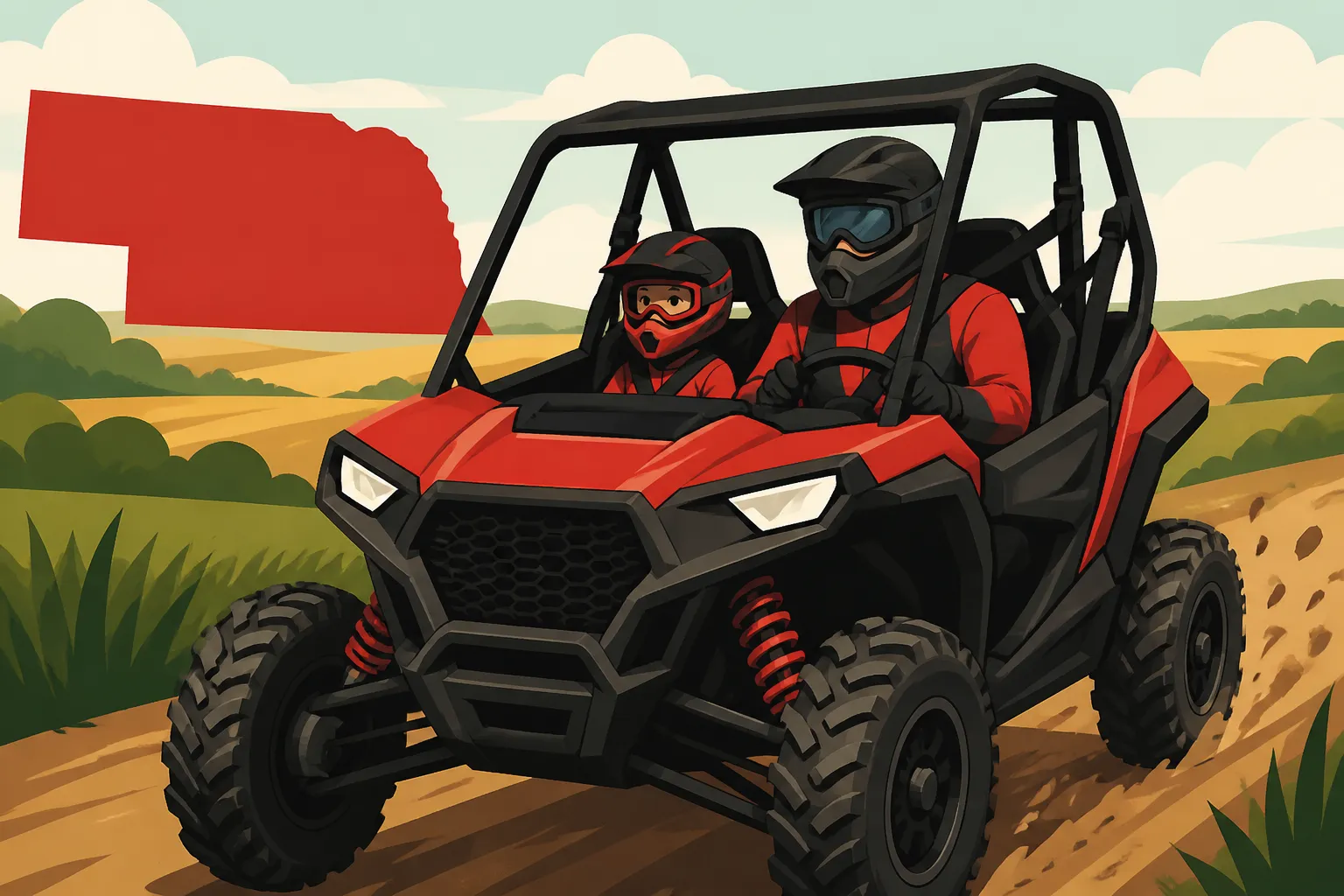
A child should ride as a passenger only if the ATV or UTV is designed for passengers and has a proper passenger seat and footrests. Many single-rider ATVs are built for one person, even if a child seems small enough to sit behind the operator. A second rider can affect balance, steering, braking, and the driver’s ability to control the machine.
Check the manual for passenger capacity and any rider-size or age guidance. If the machine is designed for one rider, do not carry a child on it. A lap, cargo rack, or improvised seat is not a safe substitute for a passenger seat. With a UTV, use the intended seat and seat belt for each occupant; do not exceed the manufacturer’s capacity.
A child who rides as a passenger still needs properly fitting protective gear. A helmet should fit securely and be intended for motorized riding, not just bicycle use. Goggles or other eye protection, gloves, long sleeves, long pants, and over-the-ankle footwear help protect against debris, branches, burns, and scrapes. If you buy gear online through Amazon or another seller, check the product’s fit guidance and safety labeling rather than choosing by appearance alone.
Letting a child operate a separate machine
An adult riding nearby is useful supervision, but it does not make an oversized or unfamiliar ATV appropriate for a child. Match the machine to the child’s size, strength, coordination, and experience. The child should be able to reach and operate the controls, steer, brake, and stop without stretching or losing control.
Begin on a flat, open area with no traffic, steep slopes, water crossings, or other riders nearby. Teach the controls and stopping procedure before allowing a child onto a trail. Keep the child within sight and close enough to respond, but leave enough space to avoid a collision if either machine stops suddenly. A child should not be expected to follow an adult’s pace on a machine that is too powerful or too difficult to handle.
Nebraska does not set a general minimum age for off-highway ATV riding, but that should not be read as a recommendation that every child can ride any machine anywhere. Landowners, riding parks, event organizers, and trail managers may set their own age, supervision, helmet, or machine-size rules. For age-specific questions, see Nebraska Rules for a Ten-Year-Old Rider and Nebraska Rules for a Fourteen-Year-Old Rider.
| Situation | What to check before riding |
|---|---|
| Child riding as a passenger | The machine is designed for passengers and has a proper seat and footrests |
| Child operating a separate ATV | Machine size and controls fit the child; the riding area allows it |
| Private riding park | Park age, supervision, helmet, passenger, and waiver policies |
| Public riding area | The land manager’s rules, open routes, access conditions, and any site fees |
| Public road | Applicable road-use requirements; an adult riding along does not replace them |
Check the Rules for the Place You Plan to Ride
Nebraska does not have one statewide ATV sticker or permit that gives a family permission to ride on every kind of land. Access depends on the property and its rules. A permit for a vehicle or a place to park should not be treated as permission to ride an ATV on nearby land.
Private parks and organized rides
A private riding park can set its own minimum age, supervision requirements, machine restrictions, helmet rules, passenger policies, and waiver process. Those rules can differ from one facility to another. Contact the park before loading the trailer, especially if the child will ride a separate machine or be a passenger in a UTV.
Ask specifically whether the park allows the child’s age group on the intended trails, whether an adult must ride alongside, and whether the child may ride as a passenger. Check the facility’s rules for the particular machine rather than relying on general information about ATV riding. Nebraska Supervision at a Private Park and Nebraska Private Park Age Minimums cover the questions to raise before you go.
For an organized ride, do not assume that the event follows the same rules as an ordinary visit to the property. The organizer may have additional age, equipment, or registration requirements. Find out who must sign any waiver for a minor and whether the child needs to stay with a designated adult.
Public land and trail access
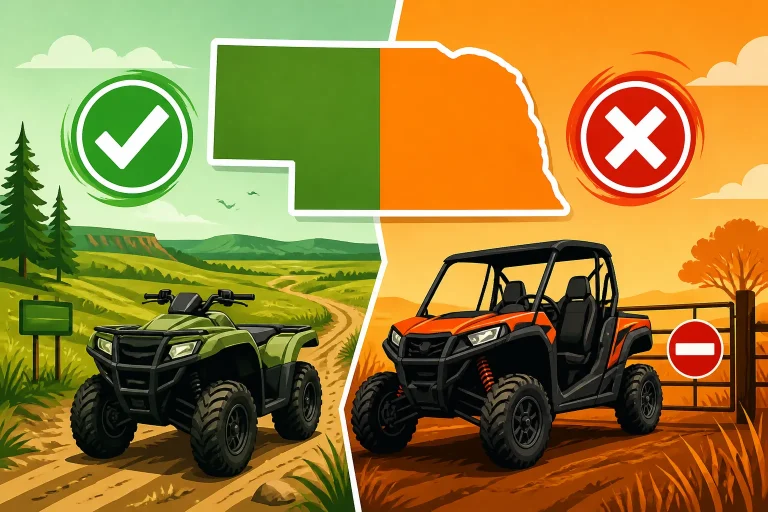
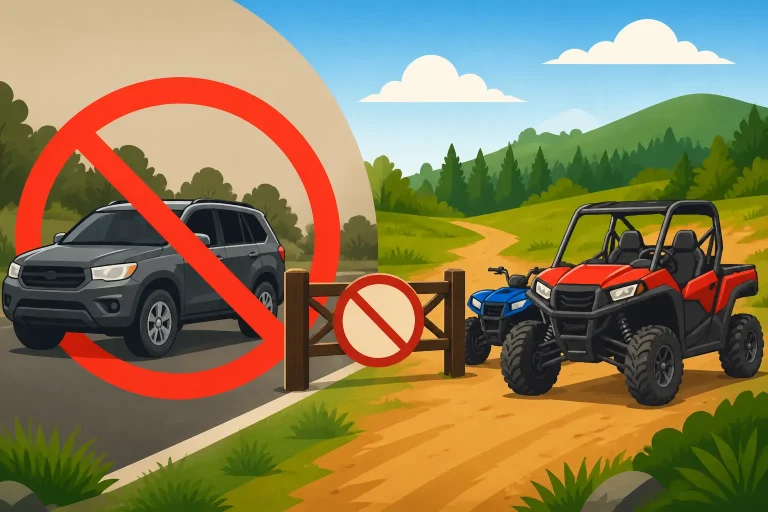
Public ownership does not automatically mean that ATV riding is allowed. Some areas prohibit ATVs, while others allow riding only on designated routes or under site-specific restrictions. Conditions can change, so check the current rules for the exact trailhead or property before setting out.
Nebraska state parks generally do not allow ATVs on park trails. Certain public riding opportunities exist elsewhere, but the rules depend on the managing agency and the specific area. If a route is open to ATVs, check whether there are limits on vehicle type, trail use, hours, or equipment. The child’s age or the presence of a parent does not override a closure or a route restriction.
Wildlife management areas require particular care: access may be limited to designated roads or other stated uses, and rules can differ by area. Review Nebraska WMA Access for a Quad and confirm that the intended route is open to motorized riding. For broader public-land checks, see Nebraska Park Rules for ATVs and Nebraska Has No OHV Permit or Sticker.
Some riding locations or parking areas may charge a fee or require a separate permit. A state park entry permit, for example, is not an ATV trail permit. Before leaving home, confirm what the fee covers, where it must be displayed, and whether it applies to the vehicle towing the ATV or to the ATV itself.
A parent’s presence does not make every route legal
A parent riding beside a child can supervise, but it does not change the legal status of a road, trail, or closed area. Nebraska’s road-use rules are separate from off-road riding rules. If the plan involves any public road, check whether that road use is allowed and what operator, equipment, insurance, and time-of-day requirements apply.
Do not take a child onto a road on the assumption that following an adult makes the trip legal. The adult’s license or permit does not automatically qualify a child to operate a machine. Likewise, having an ATV title or another state’s registration does not by itself authorize riding on a Nebraska public road or a closed trail.
Plan a Ride That Matches the Child’s Ability
Good supervision is more than staying close. A child may be able to operate an ATV in an open field but not be ready for a narrow trail, loose sand, steep grades, or a busy riding area. Choose the location and route for the least experienced rider in the group.
Before the ride
Use a short pre-ride routine so that safety checks do not depend on memory:
- Confirm access. Check the land manager’s current rules and make sure the exact area and route are open to the machine.
- Check the child’s role. Confirm whether the child will be a passenger or operate a separate machine, and follow the manufacturer’s limits.
- Inspect both machines. Check tires, brakes, throttle, lights, controls, and fuel. Make sure the seat belt works in a UTV and that any passenger has a designated seat.
- Fit protective gear. Use a properly fitting helmet and eye protection, along with gloves, long sleeves, long pants, and sturdy footwear.
- Agree on signals and boundaries. Explain where the child may ride, how to stop, what to do if separated, and which hand or voice signals the group will use.
- Start with an easy route. Keep the first ride short and choose terrain that leaves room to stop and turn around.
A voluntary safety course can help a young rider understand controls, terrain, and safe decisions. Nebraska does not require a statewide ATV safety course for every rider, but a course may still be worthwhile. See Nebraska Has No Mandatory Safety Course and Nebraska Safety Course Options.
During the ride
Keep speeds low enough for the child to react and for the adult to stop safely. Leave plenty of space between machines, especially on hills, in dust, and around blind corners. Do not ride side by side on a narrow trail or pressure a child to keep up.
Take breaks before a child is tired, cold, overheated, or frustrated. Fatigue can make it harder to steer, brake, and notice hazards. Be ready to shorten the ride or turn around if the child is uncomfortable, the surface is more difficult than expected, or visibility becomes poor.
If the child is a passenger, explain where to hold on and how to keep hands and feet inside the machine. The operator should avoid abrupt turns, hard acceleration, and terrain that could shift or throw the passenger. If the machine does not have a proper passenger position, the child should not ride on it.
If riding with a group
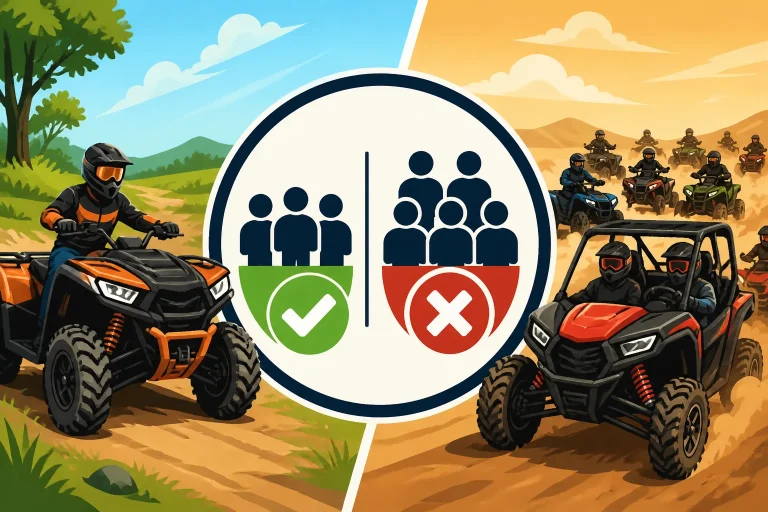
Set a simple plan before departure: who leads, who stays with the child, where the group will stop, and what everyone should do if separated. The adult closest to the child should be able to focus on that rider rather than managing the whole group. If the group includes riders with different experience levels, choose a route that the child can manage rather than splitting attention between a difficult trail and supervision.
For longer outings, plan for water, weather changes, and limited phone service. Tell someone who is not riding where you are going and when you expect to return. Carry basic first-aid supplies and a way to contact help if the route allows it. A child should know to stay with the machine and the adult if the group becomes separated, rather than riding off to look for the others.
A Practical Checklist Before You Go
The safest answer to “Can I ride with my child?” depends on three checks: the child’s role, the machine, and the location. A passenger needs a passenger-designed machine and seat. A child operating a separate ATV needs a machine and route suited to their ability. Either way, the parent should confirm the land manager’s rules and avoid assuming that supervision grants permission.
Use this checklist before loading up:
- Is the planned area open to the type of machine?
- Does the property or event set a minimum age or supervision rule?
- Is the child riding as a passenger or operating a separate machine?
- Does the manufacturer allow the child’s role and passenger count?
- Does the child have properly fitting protective equipment?
- Is the route appropriate for the child’s experience and the group’s pace?
- If any road is involved, have you checked the applicable road rules?
- Do you know where to stop, how to turn around, and what to do if separated?
For a child riding at a private facility, ask the park directly rather than relying on rules from another location. For public land, verify access with the land manager and follow posted signs. If any part of the ride is unclear, choose a different route until you can confirm the requirements.
Disclaimer
This article is for general informational purposes only and does not constitute professional advice. Laws, prices and regulations vary by location and change over time. Consult a qualified professional for guidance on your specific situation.