Nebraska Rules for a Fourteen-Year-Old Rider
A fourteen-year-old can ride an ATV or UTV in Nebraska, but the answer depends on where the machine will be used. Private land, public riding areas, and roads have different rules, and local ordinances or park policies may add restrictions. The key is to check the rider, machine, and location together before setting out.
Is There a Statewide Minimum Age for ATV Riding?
Nebraska does not set one general minimum age that applies to every off-road ATV or UTV ride. That does not mean a fourteen-year-old can ride anywhere or on any machine without limits. The landowner, riding facility, or public-land manager may set its own age, supervision, equipment, and passenger rules.
On private property, start by getting permission from the landowner and checking any conditions they set. Permission to ride does not automatically make every activity safe or legally allowed. For example, a property owner may restrict where a young rider can go, what size machine they can use, or whether an adult must accompany them. Nebraska’s trespass rules still matter; riding on a neighbor’s pasture or farm ground without permission is not allowed just because the rider is a minor.
At a private riding park, the park’s own rules are especially important. Parks can set minimum ages, require helmets, restrict passengers, or require a parent or guardian to sign a waiver for a rider under 18. Those policies can differ from one facility to another, so do not rely on another park’s rules. Check the facility’s current requirements before loading the machine. Nebraska Private Park Age Minimums and Who Signs the Waiver for a Rider Under 18 cover the kinds of restrictions to ask about.
Safety is a separate question from the legal minimum age. A rider’s age alone does not show whether they can handle a particular machine. Match the ATV or UTV to the rider’s size, strength, experience, and ability to reach and use the controls. A powerful full-size machine may be difficult for a younger rider to control, even if a particular location permits them to ride it. Follow the manufacturer’s age and fit recommendations, and supervise closely rather than treating the absence of a statewide age minimum as approval for every machine.
| Where the fourteen-year-old rides | What to check before riding |
|---|---|
| Private property | Landowner permission, safe boundaries, machine fit, and any conditions the owner sets |
| Private riding park | The park’s age, helmet, supervision, passenger, waiver, and machine rules |
| National forest or other public land | Whether motorized riding is allowed on that specific route and any site rules |
| Wildlife management area | Whether the route or area is open to ATVs and whether special access rules apply |
| Public road or street | Whether a narrow legal exception applies, local rules, operator qualifications, and required equipment |
A parent or guardian should also make sure the young rider understands the property boundaries and knows what to do if the machine breaks down or someone is injured. Those practical steps matter whether the law requires an adult to be present or the land manager does not specify supervision.
Public Riding Areas Have Their Own Rules
Do not assume that an area is open to ATVs just because it is public land or has trails. The rules depend on who manages the land and what kind of route is designated for motorized use. A public area may allow some vehicles on some routes while closing others to ATVs and UTVs.
Nebraska state parks and state recreation areas generally are not places to take an ATV for trail riding. A separate exception may apply to frozen water under specific conditions, but it is not permission to ride park roads or trails. Confirm the area’s current rules and signs before unloading. Nebraska Parks Closed to ATVs explains the distinction between riding areas and state park property.
Wildlife management areas also have restrictions. Motorized access may be limited to designated roadways or parking areas, and a route that looks rideable is not necessarily open to ATVs. Frozen-lake use has its own conditions, too. Check the signs at the area and review the relevant rules before planning a ride. See Nebraska WMA Roadway Rules and Nebraska WMA Ice Riding Rules for more on those limits.
National forest riding is different again. A forest may have designated motorized routes, but that does not mean an ATV can travel anywhere through the forest. Check the current route map, closures, and vehicle restrictions for the specific riding area. Conditions can change, and signs at a trailhead or junction matter. The rules may also differ between an ATV and a wider side-by-side. Nebraska National Forest Riding is a useful starting point for understanding where riding is allowed.
Before going to a public riding area with a fourteen-year-old:
- Identify the land manager and the exact trail or route.
- Confirm that the route is open to the machine’s type and size.
- Check age, supervision, helmet, and passenger rules for the location.
- Review closures and posted signs on arrival.
- Make sure the rider can follow trail directions and stop when asked.
Nebraska does not have a general statewide OHV permit or sticker for recreational riding, but that does not eliminate every permit or access requirement. A park entry permit, parking charge, or site-specific rule may still apply. A park permit is not an ATV registration and does not give permission to ride in an area that is closed to ATVs. Nebraska Has No OHV Permit or Sticker explains that difference.
A fourteen-year-old should ride only on a route that is open and appropriate for the machine. Keep the rider within sight or close enough to communicate, especially on unfamiliar trails. If the route has steep slopes, deep sand, water crossings, or tight turns, choose an easier area until the rider has the skills to handle it safely.
Road Riding Is a Different Question
Permission to ride an ATV off-road does not give a fourteen-year-old permission to use public streets or roads. Nebraska road use is restricted, and a road trip is legal only in circumstances allowed by state law and any applicable local rules. The machine may also need specific safety equipment, insurance, and operator qualifications.
Some limited road use can be allowed, including certain agricultural trips and routes opened by a city or county. These are exceptions, not a general right to ride an ATV between trails or around town. A road that is open in one community may be closed in another. A town ordinance or county action can affect whether a particular route is available. Can You Drive an ATV on the Road in Nebraska? and Nebraska Cities That Adopt ATV Ordinances explain why checking the exact route matters.
Nebraska’s road rules include requirements that can involve a valid Class O license or farm permit, liability insurance, lighting, a safety flag, and a speed limit. The details depend on the kind of road use and the exception involved. A fourteen-year-old should not assume that being old enough to apply for a farm permit makes every road trip legal. The permit’s conditions and the specific agricultural-use rules must fit the trip. Confirm the current requirements with the appropriate official source before riding on a road. Can a Farm Permit Replace a Driver’s License? and Nebraska Requires Liability Insurance on Roads provide more detail.
A road-use check should include all of the following:
- Is this road or street legally open to ATV or UTV use?
- Does the trip fit a permitted exception, such as a qualifying agricultural trip?
- Does the rider hold the operator credential required for that use?
- Does the machine meet the equipment requirements?
- Is the required liability insurance in place?
- Do local rules add age, registration, or route restrictions?
If any answer is uncertain, keep the machine off the road until the rule is confirmed. A short ride on a gravel road is still road use; calling it a farm road or a quick crossing does not automatically make it legal. For more on agricultural use, see Nebraska’s Agricultural Road Exception. For the crossing rules, see Nebraska Rules for Crossing a Highway.
Even where road use is permitted, it is not necessarily a suitable first ride for a young operator. Traffic, loose gravel, limited sight lines, and other road users create risks that are different from riding on a controlled trail or private field. A parent should assess whether the rider can obey traffic controls, maintain control of the machine, and respond calmly to an unexpected vehicle.
A Parent’s Check Before the Ride
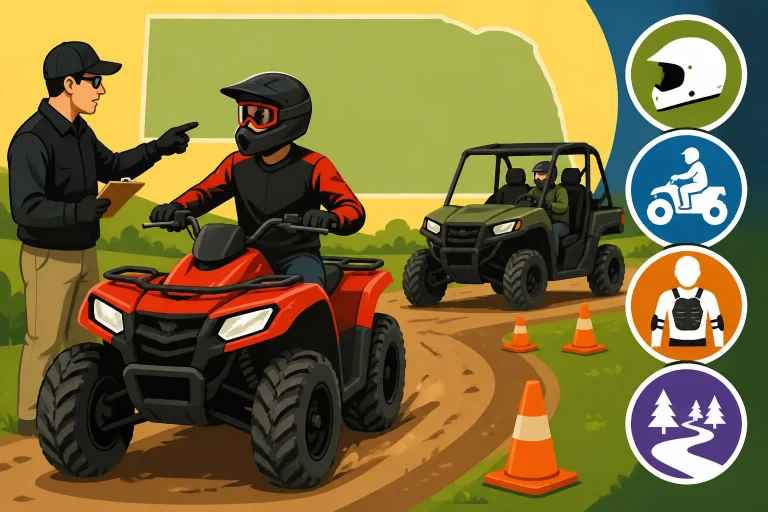
A quick check before each outing can prevent confusion at the trailhead or an unsafe ride. Start with the location, not the machine: verify that the land is open to motorized use and that the route is appropriate for the ATV or UTV. Then check who is allowed to ride, whether an adult needs to supervise, and whether the site requires a helmet or other protective gear.
Make sure the machine fits the rider. The rider should be able to reach the controls, operate the brakes, steer, and stop reliably. If they cannot comfortably reach or use a control, the machine is not a good match. Do not carry a passenger unless the vehicle is designed for one and the location permits it. A passenger changes the machine’s handling and can make it harder for a young operator to control.
Before the engine starts, agree on simple boundaries: which trails or fields are allowed, where the rider must stop, how they will communicate, and what to do if they become separated. Set a pace the rider can manage. A young operator should not be pressured to keep up with adults on faster machines or follow a group into terrain beyond their ability.
A useful preparation list includes:
- Confirmed permission or access to ride.
- The current route map and any posted closures.
- A machine that fits the rider and is in safe working condition.
- A helmet and suitable protective clothing, even where a particular site does not require them.
- A charged phone or another agreed way to contact the supervising adult, where service is available.
- Water and a plan for breaks, especially on a long or hot ride.
- A clear rule that the rider stops if visibility, trail conditions, or confidence worsens.
Do not treat a parent’s presence as a substitute for knowing the rules. An adult can help supervise and respond to problems, but they cannot make a closed trail open or turn an unauthorized road trip into a legal one. Keep the title or ownership information accessible and know what documentation the land manager may ask riders to show. Nebraska Proof of Ownership on the Trail discusses that practical issue.
The simplest rule for a fourteen-year-old rider is to separate the decisions: first confirm that the place allows the machine, then confirm that the rider meets the location’s requirements, and finally assess whether the ride is safe for that young person. If the plan involves a public road, make a separate check of the road-use exception, operator qualification, insurance, equipment, and local rules. When one of those pieces is unclear, choose a legal off-road location instead.
Disclaimer
This article is for general informational purposes only and does not constitute professional advice. Laws, prices and regulations vary by location and change over time. Consult a qualified professional for guidance on your specific situation.