Who Signs the Waiver for a Rider Under 18
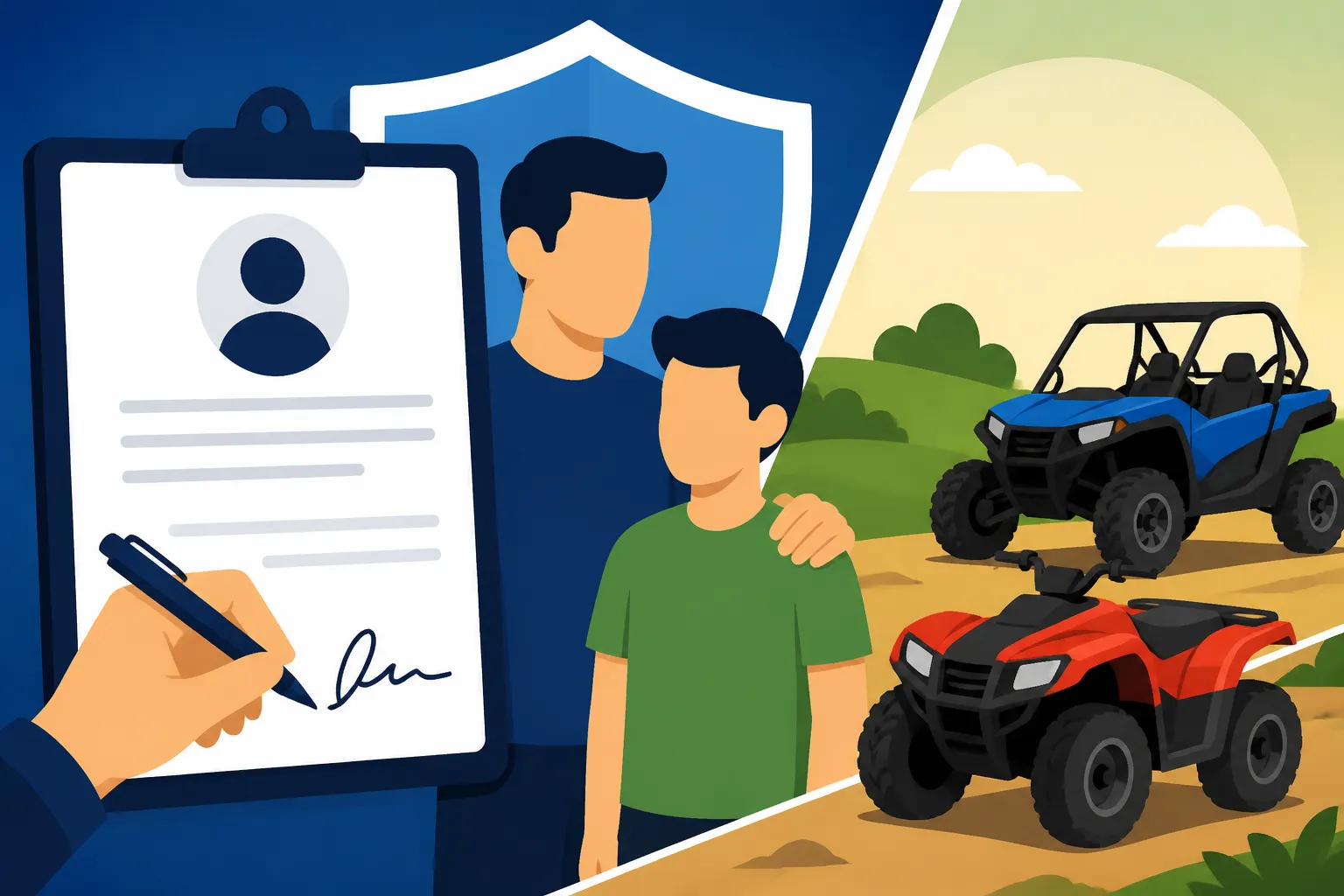
A parent or legal guardian is usually the right person to handle a waiver for an ATV or UTV rider under 18 at a Nebraska private riding park. But each operator sets its own paperwork and supervision rules. Before you travel, confirm who must sign, whether the minor must sign too, and what identification or proof of authority the park expects.
Who should sign for a rider under 18
For a private riding park, start by asking the operator whether it requires a parent or legal guardian to sign the waiver. Many parks use an adult’s signature to acknowledge risks and accept the park’s conditions for a minor. The rider may also be asked to sign a separate acknowledgment, even though an adult completes the required parent or guardian section.
Do not assume that any adult accompanying the child can sign. A grandparent, aunt, family friend, coach, or other caregiver may not meet the park’s definition of an authorized signer. Some operators accept written permission or other documentation from a parent; others may require the parent or guardian to appear in person. Only the park can tell you what it will accept.
If the rider is coming with someone other than a parent or legal guardian, contact the park before the trip. Ask whether the signer must be present at check-in, whether the park has its own consent form, and whether it accepts a signed document prepared in advance. A phone call or email can prevent an adult and child from arriving only to learn that the person who brought them cannot complete the paperwork.
The person signing should read the waiver rather than treating it as a routine registration form. It may cover risks associated with operating or being near machines, use of the property, safety requirements, and the park’s expectations for riders and accompanying adults. Forms differ, so there is no single set of terms to assume. If a section is unclear, ask the operator to explain it before signing.
A waiver does not automatically give a minor permission to ride every machine or trail. A park may set a minimum age, restrict which machine sizes a child can use, require direct adult supervision, or limit passengers. Review the park’s own Nebraska Private Park Waivers and Rules and Nebraska Private Park Minimum Ages before deciding that a child is eligible.
| Situation | Who to ask about signing | What to confirm |
|---|---|---|
| A parent brings the rider | The park’s check-in staff or office | Whether the parent signs in person and whether the minor also signs |
| A legal guardian brings the rider | The park | Whether it needs proof of guardianship or other documentation |
| A grandparent or family friend brings the rider | The park, before traveling | Whether that adult is authorized to sign and what written consent is accepted |
| A youth group brings several riders | The park and the group organizer | Whether each minor needs an individual waiver and which adult signs |
| The rider uses a public trail or public land | The land manager or agency | Whether any separate form, permit, or access rule applies |
The table is a planning aid, not a substitute for the operator’s instructions. A park can require additional documents or use a different process.
Private parks, public riding areas, and paperwork
The waiver question depends in part on where the family plans to ride. A private riding park controls access to its property and can set admission conditions, including waivers, age limits, supervision requirements, and machine restrictions. Its procedure may apply even when the rider has completed a safety course or the family has its own insurance.
Public riding areas operate under different access rules. A private-park waiver is not automatically required simply because a rider is under 18, but the family should not assume that public access means there is no paperwork. The relevant land manager may have its own entry conditions, vehicle restrictions, or permits. Check the rules for the specific location before leaving home.
Nebraska has no statewide OHV permit or sticker for general ATV and UTV use, but that does not remove a private park’s authority to require its own forms. Nor does it mean that every public area allows motorized riding. A park entry permit, where required for the vehicle taking the family to a recreation area, is a separate matter from a minor’s waiver. See Nebraska Has No OHV Permit or Sticker for the state-level distinction, and confirm access requirements with the area you plan to visit.
The same distinction matters for out-of-state visitors. A visitor should not treat an out-of-state registration or permit as proof that a Nebraska riding area will admit the machine or waive its own paperwork. The operator or land manager decides the applicable entry process. Families traveling from another state can review Nebraska Visitors From Iowa or the relevant visitor information, then verify the chosen area’s current rules directly.
For a private park, check these points before setting out:
- Does the park require a waiver for every rider, including minors?
- Must a parent or legal guardian sign, or does the park accept another authorized adult?
- Does the signer need to be physically present at check-in?
- Must the minor also sign or initial any part of the form?
- Is the park’s form available to review or complete ahead of time?
- Does the park require identification or documentation showing the adult’s authority?
- Does every adult passenger or non-riding participant need a separate waiver?
- Are there age, machine-size, passenger, helmet, or supervision limits that apply to the child?
Do not rely on an old form saved from a previous visit unless the park confirms that it is still accepted. Operators may update their procedures, and a form for one location may not work at another.
What to bring and how to avoid check-in problems
A little preparation is useful when a minor is riding. Contact the park directly and explain who will attend, the rider’s age, and whether a parent or guardian will be present. If someone else is bringing the child, say so plainly. Ask the operator to describe the acceptable process rather than assuming a generic permission note will be enough.
For a smooth check-in, the accompanying adult can prepare:
- The park’s current waiver or consent form, if the operator provides one in advance.
- Identification for the adult who is expected to sign.
- Any documentation the park specifically requests to establish that adult’s authority.
- Information about the child’s age and the machine the child plans to ride.
- The contact information for the parent or guardian, if another adult is accompanying the minor.
- Any required proof of insurance, ownership, or registration that applies to that location or activity.
Do not send sensitive documents or personal information through an unofficial channel. If the park requests documentation, ask how it wants the information delivered and whether the adult can present it at check-in instead.
It is also worth separating the waiver from other rider requirements. The waiver is an entry or liability form; it is not a safety course certificate, proof of ownership, insurance policy, state permit, or permission to ride on a particular trail. A park may ask for more than one of these, while a public area may have different requirements. Nebraska does not require a statewide ATV safety course for general riding, but a private operator may set its own training or supervision conditions. Nebraska Safety Course Options can help families consider voluntary training, while the park remains the authority on its admission policy.
Likewise, a parent’s signature does not make an otherwise restricted use of a machine lawful. It does not override age limits, equipment rules, land access restrictions, or road-use laws. Before the trip, check the operator’s rules for the specific machine and rider. If the planned outing includes public roads, review the applicable requirements separately; a private-property waiver does not authorize road riding. Families can use Nebraska Rules for a Teen Rider as a starting point for age-related riding questions.
Supervision and the limits of a waiver
A signed form is only one part of taking a minor to ride. A private park may require an adult to remain with the child, ride nearby, or supervise from a designated area. The details can vary with the park, the trail, the machine, and the rider’s age. Confirm whether the adult must be the same person who signed the waiver; do not assume that signing once means the child can ride independently for the rest of the visit.
Ask what the park means by supervision. “An adult must be present” could mean the adult needs to stay on the property, remain within sight, accompany the child on the trail, or be available at a particular location. If the child will ride with other family members, clarify whether the park has a required adult-to-youth arrangement or other group rule. The operator’s written instructions are more useful than a general assumption about what supervision means. See Nebraska Supervision at a Private Park for related planning considerations.
Parents and guardians should also match the machine to the child’s abilities. A waiver does not make an unsuitable machine safe. Consider the rider’s experience, physical reach, ability to control the throttle and brakes, and capacity to follow trail instructions. Ask the park whether it has restrictions on youth machines, passengers, or particular parts of the riding area. If staff say a rider does not meet a requirement, treat that as an access condition rather than trying to solve it with an extra signature.
Keep the signed paperwork accessible during check-in, but do not assume you need to carry a waiver on every trail. Follow the park’s instructions about whether it retains the form or expects the group to keep a copy. Proof of ownership or other documentation may be a separate concern; Nebraska Proof of Ownership on the Trail explains why families should distinguish ownership records from admission forms.
If the rider is not allowed to participate after arrival, do not pressure staff to make an exception based on the fact that an adult signed. Ask whether the park offers another activity, a different eligible machine, or a way to reschedule. When the answer depends on a legal document or the operator’s interpretation of its policy, get clarification before the ride rather than relying on a verbal guess at the gate.
The practical rule is straightforward: for a Nebraska private riding park, ask the operator who is authorized to sign for the minor, whether the child must sign too, and what supervision is required. For public riding areas, check with the land manager instead. A parent or guardian’s signature may be central to a minor’s visit, but it is not a substitute for the rest of the location’s rules.
Disclaimer
This article is for general informational purposes only and does not constitute professional advice. Laws, prices and regulations vary by location and change over time. Consult a qualified professional for guidance on your specific situation.