Speed Limits Posted Inside a Private Riding Park
A posted speed limit at a private riding park is a maximum, not a promise that the trail is safe at that speed. Limits may change by area, and dust, traffic, terrain, or a blind corner can call for going slower. Here’s how to read park signs, handle unclear limits, and avoid confusing a park rule with a Nebraska road rule.
How posted speed limits work at a private riding park
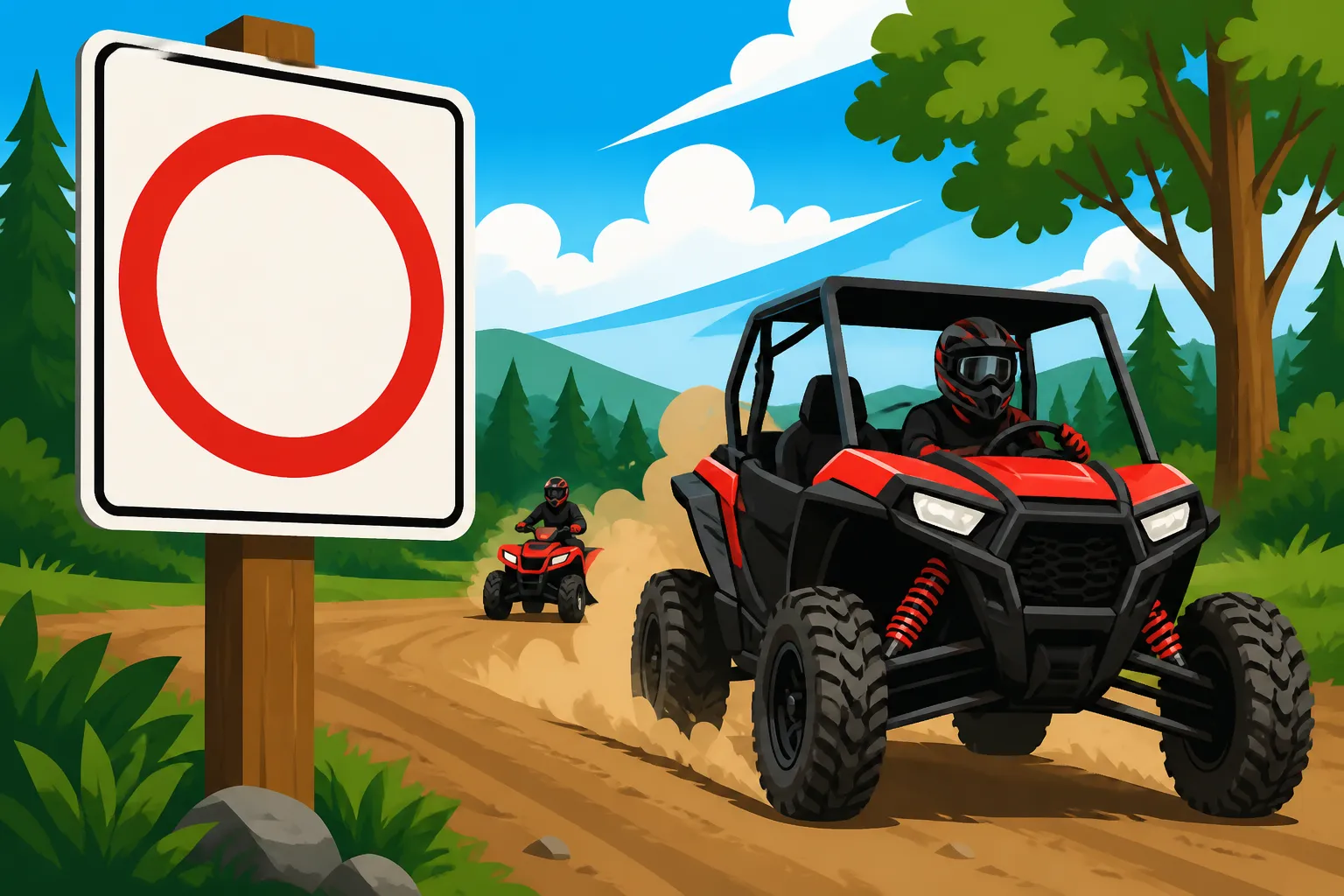
A private park sets operating rules for its property. When a speed limit is posted, treat it as the fastest permitted speed in that area, not as a recommended pace for every rider or machine. The park may also have rules in its admission materials, waiver, trail map, or staff instructions. Read those before unloading, not after reaching a disputed sign.
There is no single speed limit that applies to every private riding park in Nebraska. A park may use different limits for its entrance road, staging area, campground, shared trail, or riding zone. It may also require riders to travel below the posted maximum when conditions make that necessary. Check the park’s own rules rather than assuming that a speed from one property applies elsewhere. For more on the rules that can accompany entry, see Nebraska Private Park Waivers and Rules.
A posted number is usually the clearest instruction, but it does not replace judgment. If the sign allows a speed that feels too fast for the surface, visibility, or traffic, slow down. A maximum is not a target, and a rider is still responsible for controlling the machine.
| Situation | Practical approach |
|---|---|
| A speed-limit sign is clearly posted | Stay at or below the limit, and slow further if conditions call for it. |
| You enter a busy staging or parking area | Reduce speed to a crawl or walking pace where appropriate, and watch for people moving around. |
| Dust or a hill blocks your view | Slow enough to stop safely within the distance you can see. |
| You see a lower limit in a specific zone | Follow the lower limit there, even if another part of the park has a higher one. |
| Signs appear inconsistent or unclear | Take the safer interpretation and ask park staff before continuing at speed. |
| A posted limit seems faster than conditions allow | Ride slower; the sign does not require you to travel at its maximum. |
Limits may apply to all riders on a trail, or a park may provide additional directions for particular areas or machine types. Never assume a side-by-side can travel faster than a quad just because it feels more stable, or that a small youth machine is exempt from a posted rule. If the park does not make an exception explicit, ask staff.
Park rules can also set expectations beyond a number on a sign. They may cover where machines can travel, passing, noise, passengers, helmets, or conduct around other visitors. Those policies are separate from a speed limit but affect how you ride. Check any posted instructions at the entrance and in the staging area, and review Nebraska Private Park Helmet Rules if helmet requirements are part of your planning.
Why the safe speed may be lower than the posted limit
A speed limit cannot account for every change in trail conditions. Loose sand, ruts, mud, gravel, sharp turns, washouts, and sudden elevation changes can all affect stopping distance and control. A speed that is manageable on a wide, clear straightaway may be unsafe on a narrow trail or near a crest.
Visibility matters just as much as the surface. Dust from another machine can hide a stopped rider, a trail junction, or an approaching vehicle. On a blind hill, assume someone may be coming from the other side. Slow down before you reach the point where you lose sight of the trail, rather than waiting until you can see an obstacle.
Traffic also changes the pace that makes sense. A trail may have riders moving at different speeds, families learning the route, or machines that need more room to turn. Keep enough distance to react without swerving into another rider’s path. Pass only where the park permits it and where you can see that the move is clear. If you cannot pass safely, wait.
Consider these conditions before deciding how fast to ride:
- People nearby: Slow near trailheads, parking, campgrounds, picnic areas, and any place where someone may step into the path.
- Limited sight distance: Reduce speed before blind corners, dips, hill crests, and dusty sections.
- Changing terrain: Ease off when the trail becomes rough, slippery, narrow, or unfamiliar.
- Mixed traffic: Leave more space when you encounter pedestrians, children, beginners, or machines moving at a different pace.
- Passengers or cargo: Account for the extra weight and any effect on braking, steering, or balance.
- A less experienced rider: Choose a pace that lets the rider stay in control, even when the posted maximum is higher.
Trail difficulty labels, if the park provides them, are not speed guidance. A route marked for experienced riders may have technical obstacles that call for a very low speed. Conversely, an easy route still needs caution around other users and changing visibility. Use Nebraska Trail Difficulty Ratings for a broader look at what trail ratings can and cannot tell you, and follow the park’s own descriptions for its property.
The machine matters, too. A side-by-side and a quad differ in width, turning behavior, and how they respond to uneven ground. A machine that feels stable at a certain speed on a smooth section may behave differently on loose or rutted ground. Keep a speed that allows you to steer, brake, and stop under the conditions in front of you. Do not use another rider’s pace as proof that the same speed is safe for your machine.
What to do when signs are missing or conflict
A missing, damaged, or hard-to-read sign is not a reason to speed up. Until you can confirm the rule, ride at a conservative pace and assume the area may have a lower limit than the last section you traveled. Pay attention to maps, entry materials, and instructions from staff; limits may be specific to a zone even when a sign is not visible from every approach.
If two signs appear to give different limits, do not try to decide which one is legally controlling while riding. Slow down, stop somewhere safe and out of the traffic path, and ask a staff member. A lower posted limit may apply only to the section you are entering, while a higher sign may refer to the route behind you. Staff can clarify where each rule begins and ends.
Before riding, check these details with the park:
- Where the limits apply. Ask whether a sign governs only the nearby trail or a larger area.
- Whether there are special low-speed zones. Confirm expectations for staging areas, campgrounds, and shared routes.
- How to report a problem sign. A damaged sign may need repair before other riders rely on it.
- Whether the park has additional speed rules. Some instructions may be printed on a map or included in entry materials rather than posted at each trail.
- What happens after a violation. Ask staff what enforcement may involve, including whether they can require a rider to leave.
A park can enforce its own access conditions on its property. Depending on its rules and the circumstances, a violation may lead to a warning, loss of riding privileges, or removal from the park. Do not assume that paying an entry fee gives unlimited access or overrides a posted instruction. See When a Riding Park Can Send You Home for more on how park staff may respond to rule violations.
If you are visiting from another state, do not treat an out-of-state registration or permit as permission to disregard the park’s conditions. Park admission and conduct rules are separate from a machine’s registration status. Nebraska has no statewide OHV permit or sticker, but a private riding park may have its own entry process and requirements; confirm them directly before traveling. Related details are covered in Nebraska Has No OHV Permit or Sticker and Riding in Nebraska on an Out-of-State Registration.
A practical routine for a safer park ride
A little preparation helps avoid confusion once you are on the trail. Before loading up, check the park’s current rules and ask whether speed limits or other operating instructions have changed. Review its map if one is available, and plan to stop at the entrance or office if anything is unclear. An online description or an old map may not reflect a temporary closure or a newly posted rule.
At the park, use this routine:
- Read the entry instructions. Review any waiver, map, and posted notices before starting the machine.
- Locate the main signs. Look for speed limits and warnings near entrances, intersections, staging areas, and shared-use zones.
- Ride below the maximum when needed. Adjust for dust, traffic, trail condition, visibility, and your experience.
- Leave space. Keep a gap that gives you time to respond if the rider ahead slows or stops.
- Ask instead of guessing. Check with staff if a sign is missing, unclear, or inconsistent with another instruction.
- Respect other visitors. A controlled pace near people, campsites, and trailheads helps prevent close calls and keeps the park pleasant for everyone.
If you ride with a group, agree on the park rules and a conservative pace before leaving the staging area. Keep the group together without pressuring slower riders to match the fastest person. A leader should be prepared to slow down when visibility drops or the trail narrows, and riders should avoid bunching up where dust or a sudden stop could cause a collision. Nebraska Trail Etiquette Locals Expect has more practical guidance for sharing riding areas.
Parents and group leaders should also account for age and experience. A young rider may need a simpler route and closer supervision regardless of the sign’s maximum. Parks may set their own age, supervision, or equipment conditions, so confirm them in advance rather than relying on assumptions. See Nebraska Private Park Age Minimums for related planning questions.
The most reliable rule is straightforward: follow the park’s posted limit, obey any more specific instruction, and ride slower whenever the conditions demand it. If there is no clear answer, slow down and ask staff. That approach works whether the limit is posted on a trail sign, included in the park’s entry information, or explained at the gate.
Disclaimer
This article is for general informational purposes only and does not constitute professional advice. Laws, prices and regulations vary by location and change over time. Consult a qualified professional for guidance on your specific situation.